Recent Bitcoin price movements are often described as if there is only one main character: ETF funds. Money flows in, prices rise; money flows out, prices fall. This perspective is neat and not incorrect, but it’s incomplete because Bitcoin is more than just a trading symbol. The network has its own internal “operating system,” and many of the best clues about our position in the cycle are found directly on on-chain data.
The charts I follow are like measuring pulses beneath sensational headlines. Miners, long-term holders, and most on-chain wallets do not react like ETFs; they do not reverse course based on short-term emotions. They accumulate, hold, endure pressure, and then recover.
Therefore, I check several “cycle clocks” that have repeatedly provided reliable signals: miner reserves, NUPL, and the ratio of UTXOs in profit.
Miner Reserves Decline
Starting with miners, because this is where Bitcoin’s “real economy” meets the fiat world. They have electricity costs, operational expenses, and debts. When profitability no longer makes sense, they cannot just rely on faith; they must sell, shut down, restructure, move, hedge to survive.
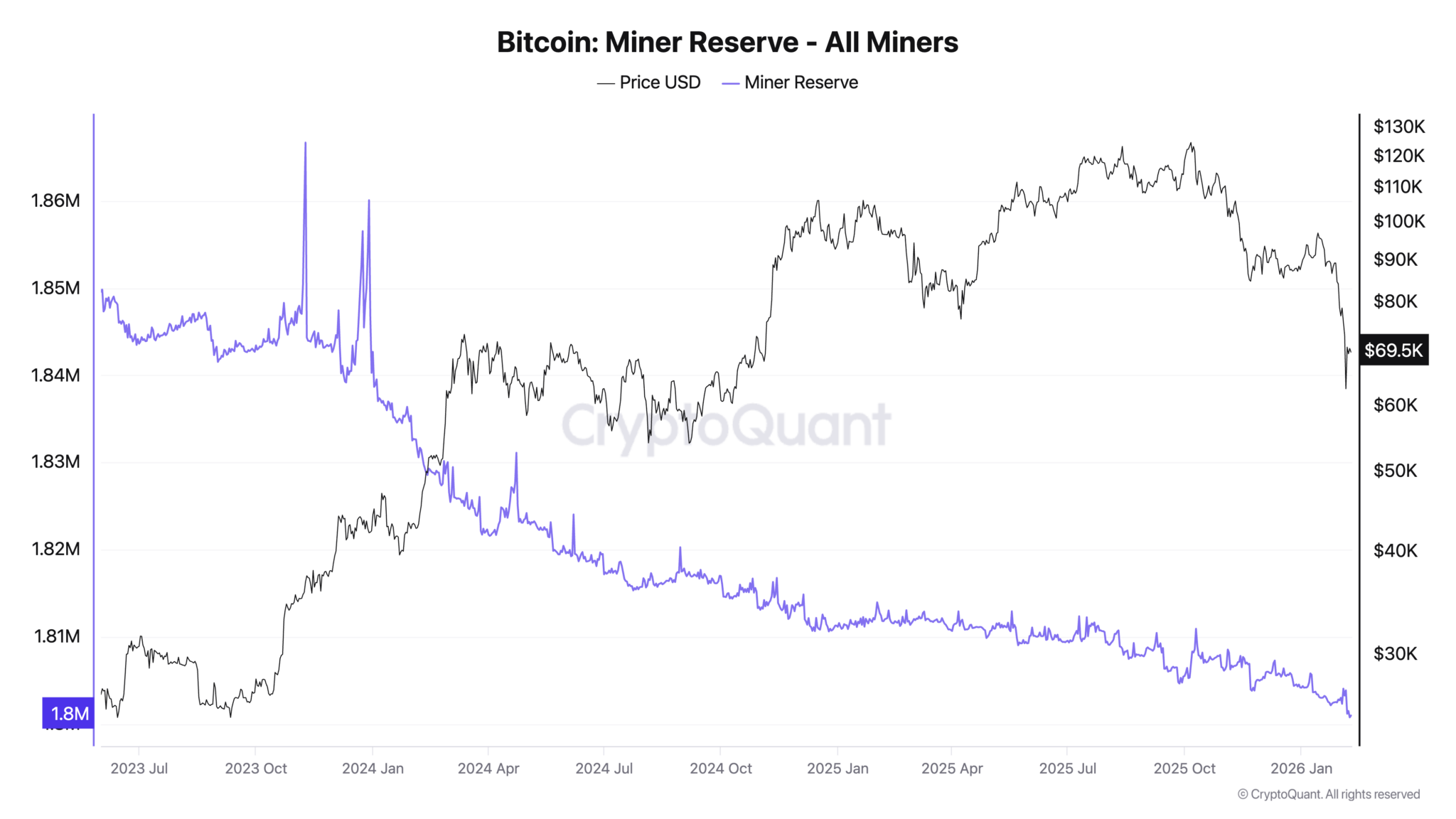
Data shows miner reserves are decreasing to the lowest levels since the early stages. Currently, miners hold about 1.801 million BTC.
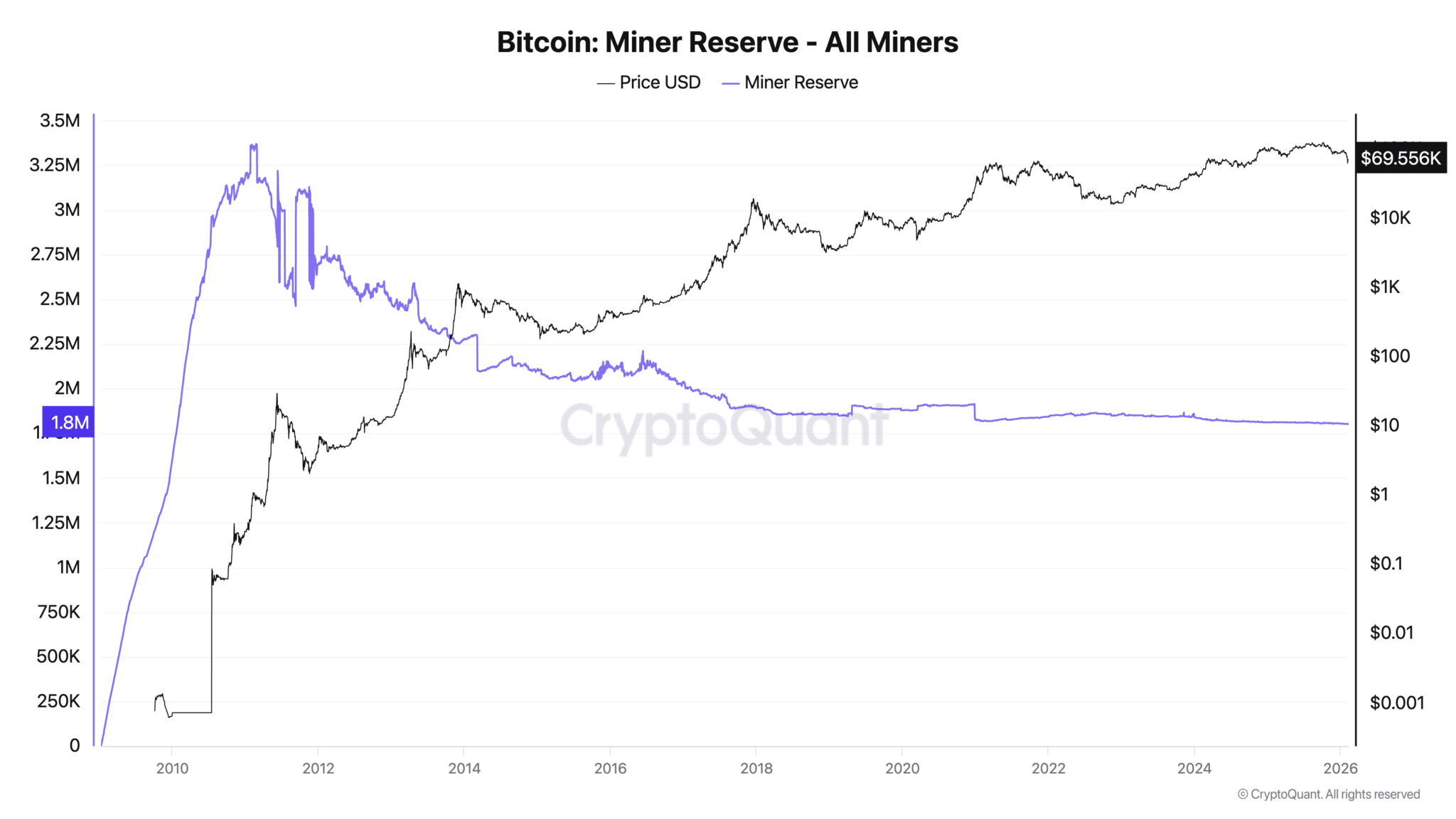 *The amount of Bitcoin held by miners has been steadily decreasing since the early cycle peak, even as prices trend higher in the long term, indicating a structural reduction in supply held by miners. (Source: CryptoQuant)*Over the past 60 days, they have reduced about 6,300 BTC, averaging over 100 BTC daily. This is a steady “leak,” often seen when businesses face pressure and treasuries are converted into working capital.
Long-term trends also show miner reserves gradually declining over years, even as prices rise, reflecting a structural erosion of supply held by miners.
In USD terms, the picture is even clearer. The value of miner reserves is around $133 billion, down more than 20% in just two months. Partly due to price declines, partly due to coins leaving miner wallets. This combination narrows their “safety buffer.”
When BTC drops while reserves thin out, miners are less resilient to volatility, and the market gains a potential additional supply if conditions worsen.
 Miner reserves in USD continue to decline during 2024-2026, even amid sharp price swings, indicating persistent pressure on the industry’s balance sheets. (Source: CryptoQuant)
When ETF Stories Meet On-Chain Data
ETF capital flows can be very volatile in the short term. Recent 10 sessions show a net outflow of about $1.7 billion, averaging $170 million daily. That’s enough to influence marginal demand and quickly shift sentiment before most of the market realizes.
The problem with only looking at capital flows is that you see only the surface, not what’s accumulating beneath.
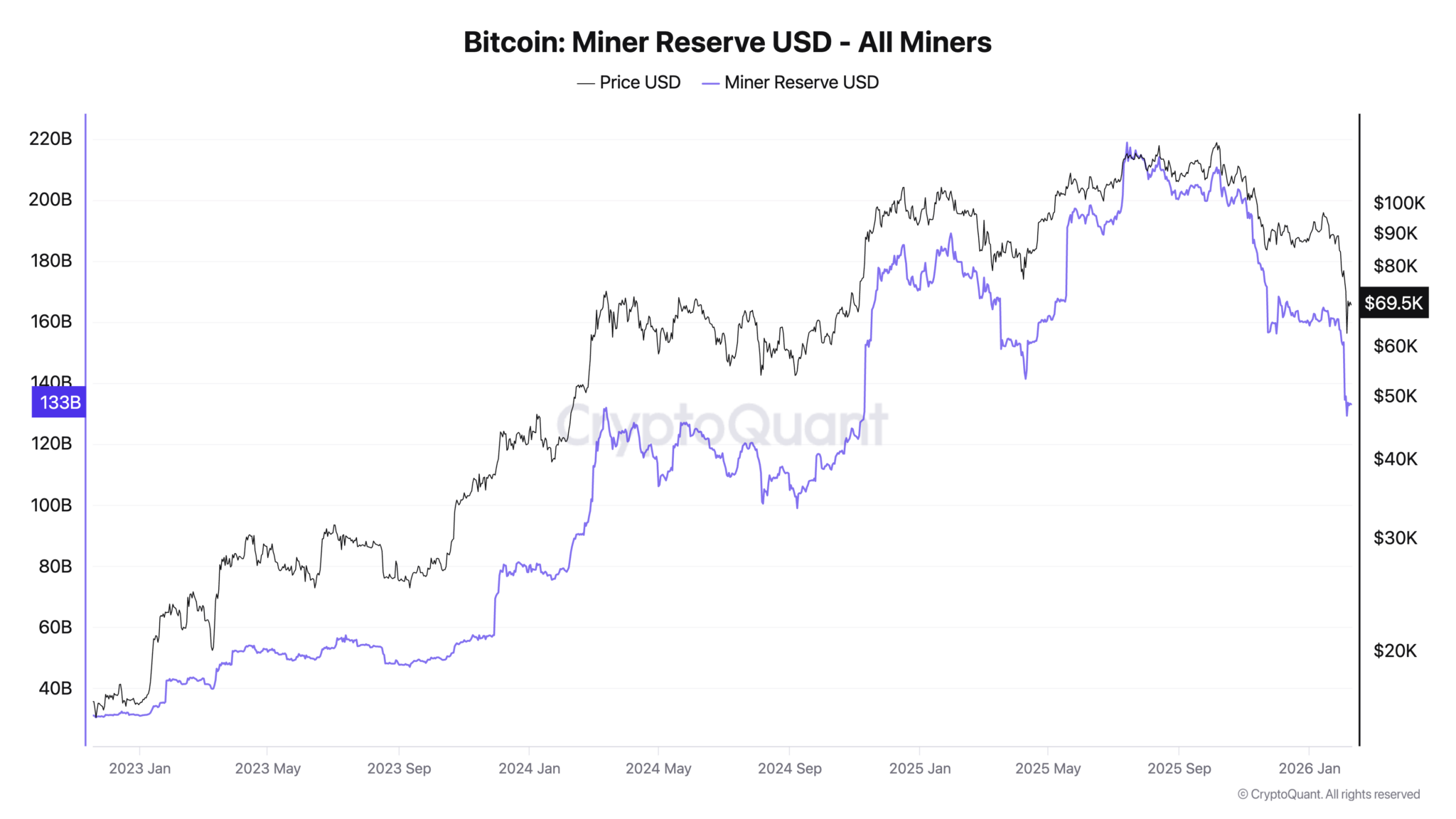 Bitcoin miner reserves in USD have fallen sharply along with recent price weakness, erasing a significant portion of the industry’s balance sheet reserves, though still high relative to historical standards. (Source: CryptoQuant)
NUPL: Is the Market in Profit or Pain?
To determine where we are in the cycle, we need to know if the market is in a normal correction or approaching a deeper “washout.” NUPL (Net Unrealized Profit/Loss) helps see whether the market is sitting on profits, losses, or somewhere in between.
Latest data shows NUPL remains positive, around 0.215, meaning Bitcoin is still in the “green zone.” However, the indicator has dropped sharply in recent months, to about 0.17. This slope reflects narrowing profits and shifting sentiment.
A critical threshold is when NUPL drops below zero, especially approaching -0.2. The last time NUPL was negative was early 2023, and below -0.2 was late 2022 — a zone often associated with capitulation and the “bottom confirmation” of a bear market.
We are not there yet. This doesn’t mean the bottom isn’t near, but there’s no classic cycle confirmation either.
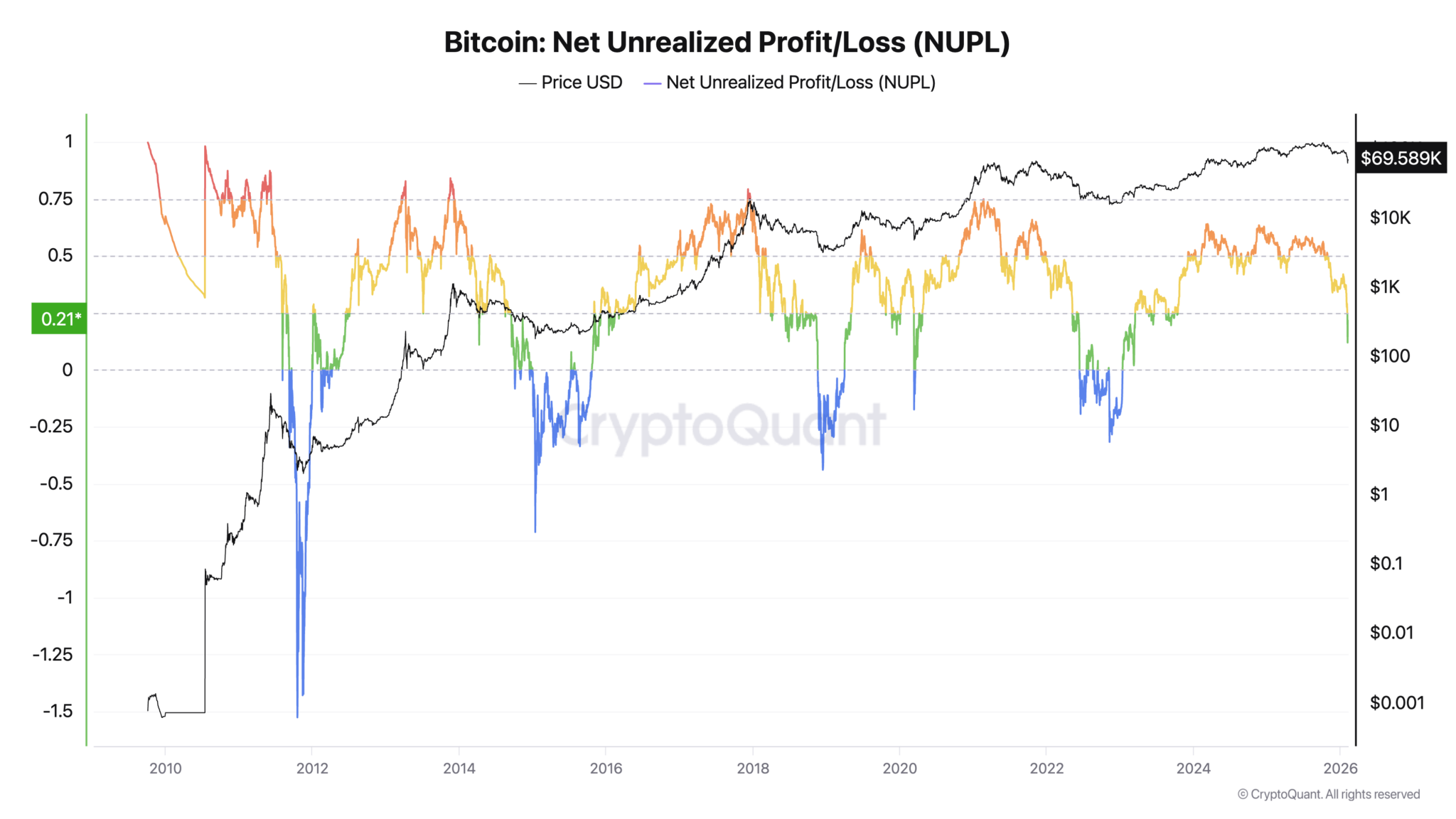 Bitcoin’s net unrealized profit/loss (NUPL) remains positive but has declined sharply, signaling that overall profits are shrinking without fully turning into net losses. (Source: CryptoQuant)
How Many UTXOs Are in Profit?
The UTXO in profit chart shows the market’s maturity over time. At previous cycle lows, almost no one was in profit:
- 2011: about 8%
- 2015: about 15%
- 2018: about 49%
(COVID crash 2020 is an exception)
In 2023, the bottom was around 60%. Currently, 2026 shows a low around 58%, with the latest reading near 71%.
Rising “floor” levels tell a story: more long-term holders, more coins at lower cost basis, more participants who have experienced enough cycles to understand the game. This reduces the depth of pain needed before buying interest re-emerges.
It may also cause bottoms to form faster, as less profit needs to be wiped out to push the majority into discomfort.
The big question is: if UTXO in profit has reached levels similar to previous bottoms, is the bottom closer than expected, even if the “4-year cycle” suggests it’s still early?
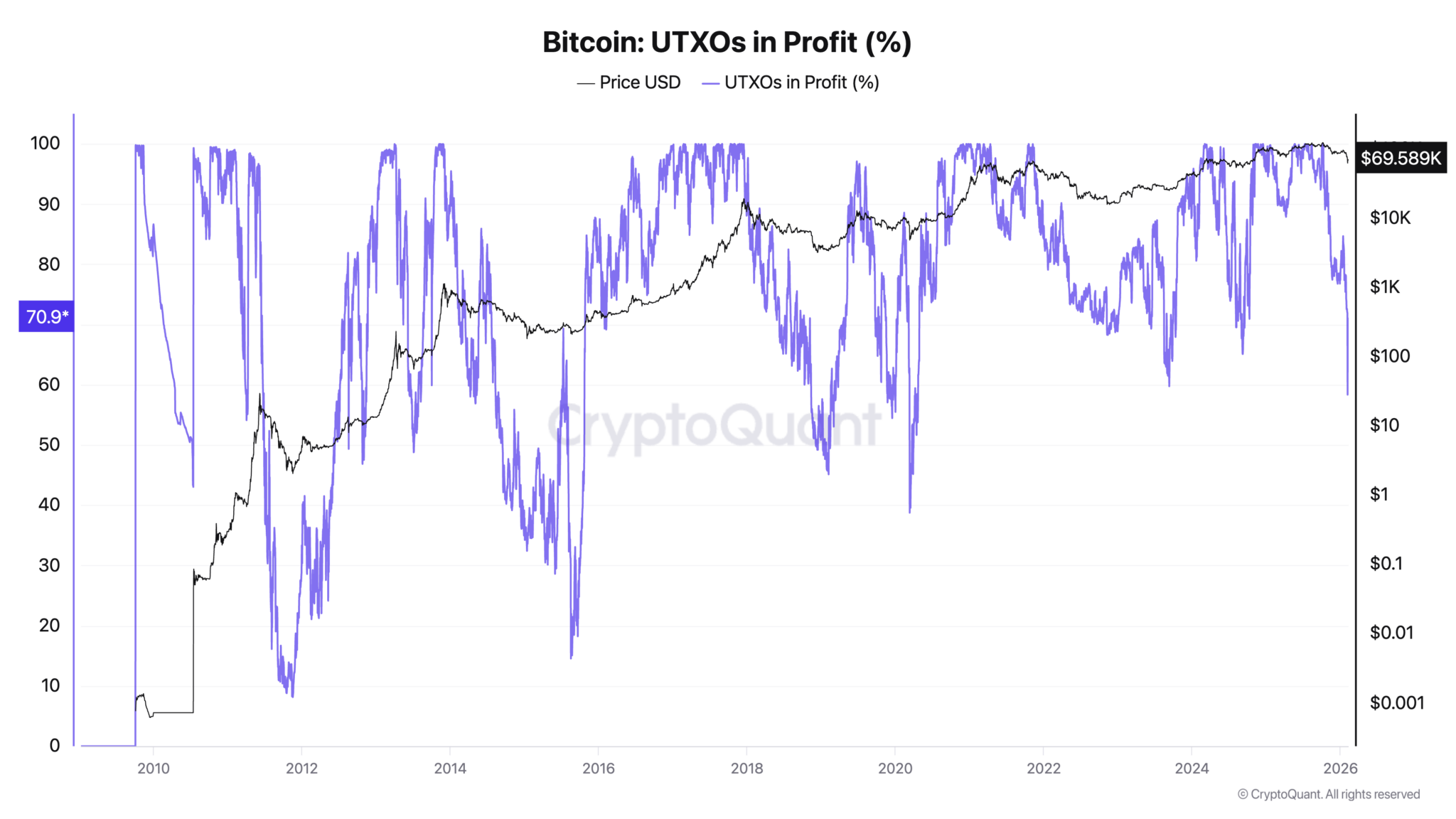 The profit/loss ratio of Bitcoin UTXOs remains high, near record levels, reflecting a more solid holder base structurally, even as periodic dips mark tense market moments. (Source: CryptoQuant)
Public Testing of Resilience
During deep declines, miners ignore narratives. Machines keep running, bills must be paid, loans come due. When prices fall and the network remains active, they are the first to face tough decisions.
Thus, long-term miner reserve lows carry psychological significance. They show miners have been offloading inventory over time, and the mining industry now operates like a real economy with a genuine balance sheet.
If reserves are thin and profits continue to be squeezed, selling may shift from voluntary to forced.
Broader mining data also shows real pressure: large difficulty adjustments and hash rate drops often occur during economic stress or operational disruptions. Recently, one of the largest difficulty adjustments in history occurred, accompanied by a hash rate decline — consistent with industry stress signals.
Money Flows: Miners vs ETF
In 60 days, miner reserves decreased by about 6,300 BTC — worth hundreds of millions USD at spot prices. It sounds large, but compared to ETF capital flows that can shift billions in just weeks, ETFs can “absorb” supply from miners in ways retail never could.
The key point is the interaction:
Negative ETF flows + falling prices → squeezed miner margins → declining reserves → more supply in a weak environment.
This feedback loop doesn’t guarantee a crash but increases the probability if it persists.
When NUPL and UTXO in Profit Diverge
Current signals are somewhat contradictory:
- NUPL remains positive → market has not entered widespread loss territory of a deep bottom.
- UTXO in profit has hit levels similar to 2023 lows → most “damage” may have already occurred earlier than expected.
A bottom isn’t a single candle; it’s a social process — when the last group to believe they’re right also stops watching the price. UTXO in profit proxies that fatigue, and the “floor” rising across cycles reflects a market with “scar tissue.”
Therefore, the bottom may be near. But “may” is key, and the NUPL threshold remains the boundary between a sharp pullback and a prolonged grind.
Three Future Scenarios
Scenario 1: Uncomfortable sideways
ETF flows slow their outflows, miners halt rapid reserve depletion, NUPL stabilizes around 0.15–0.30. The market neither crashes nor breaks out, just erodes patience.
Scenario 2: Classic capitulation
ETF continues large outflows, prices decline, NUPL drops below zero heading toward -0.2, miners accelerate distribution due to economic pressure. This pattern confirms a deep bear market.
Scenario 3: Early bottom
From UTXO in profit signals: ETF shifts to inflows, NUPL stays positive and rises, miner reserves stop shrinking. The market absorbs shocks quickly and finds buyers before full psychological reset.
ETF and On-Chain Are Not Opposites, But Part of the Ecosystem
The macro environment explains the ETF story: when institutions participate, market rhythm ties to interest rates, liquidity, and risk appetite. Fed policy expectations influence how large allocators decide whether, how much, and when to allocate.
ETFs can set the short-term tempo. On-chain data offers deeper cycle clues — where pressure can turn a normal correction into a structural event.
Conclusion
Data suggests the market may be closer to exhaustion than what ETF flows alone indicate, but there’s no full capitulation confirmation yet.
Miners have reduced reserves, USD reserve value has shrunk sharply, NUPL is compressing but still positive, and UTXO in profit has reached levels associated with previous bear bottoms. This combination indicates that cycle theory could still hold, but the timing might surprise us.
We must view the market through the lens of three groups that cannot “pause”: miners operating machines, holders balancing faith and fear, and institutions following policy signals and capital flows. All are pulling the price in different directions.
The next big moment will come when on-chain pressure is either broken or relieved — not after headlines about capital flows.


