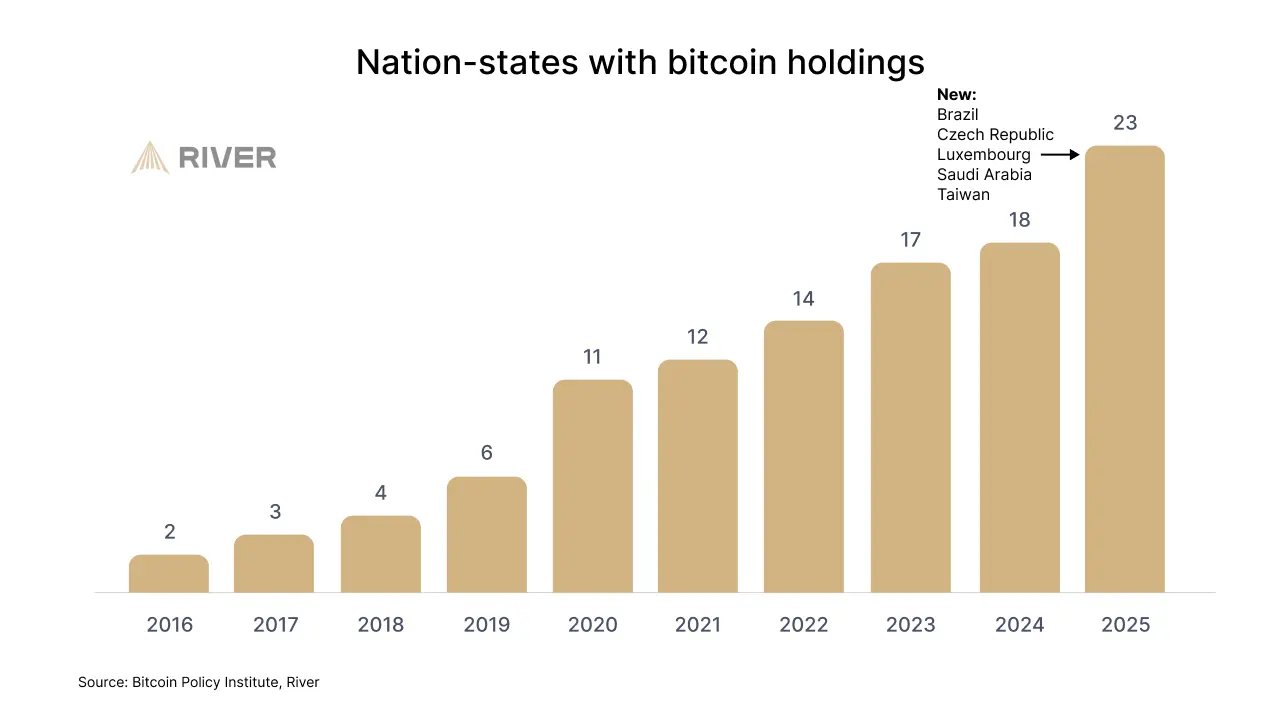
A new research report from bitcoin-focused financial services firm River estimates that 23 nation-states now hold bitcoin, signaling a steady shift from fringe asset to sovereign balance sheet contender.
River Report: Nearly 2 Dozen Countries Now Hold Bitcoin as Nation-State Adoption Expands
River’s latest adoption report paints a clear picture: bitcoin (BTC) is no longer confined to retail traders and tech founders. Governments are now part of the equation, with 23 nation-states estimated to own BTC through seizures, direct purchases, state-backed mining or sovereign wealth allocations.
A breakdown in the report shows the United States leading sovereign holdings with 328,372 BTC, primarily from asset seizures. The United Kingdom follows with 61,245 BTC, while the United Arab Emirates holds 30,382 BTC via sovereign wealth exposure and mining-related strategies. China, despite its domestic mining ban, is estimated to control 15,000 BTC through confiscations.
El Salvador remains the only country to have adopted bitcoin as legal tender and is listed with 7,514 BTC acquired through direct purchases. Bhutan appears with 5,884 BTC tied to state-backed mining, underscoring how smaller economies are experimenting with strategic exposure.
The report’s map of sovereign ownership spans North America, Europe, the Middle East, Asia, and parts of Africa and Latin America, reflecting what River describes as accelerating nation-state adoption.
Beyond sovereign holdings, River emphasizes that bitcoin’s infrastructure has grown more geographically dispersed. According to its hashrate distribution analysis, 34 countries now account for more than 0.1% of global hashrate, while 12 exceed 1%, suggesting mining concentration risk has eased compared with prior cycles.
The report’s ownership distribution data as of Dec. 31, 2025, indicates individuals still dominate with 14.01 million BTC, or 66.7% of supply. Funds and ETFs control 1.49 million BTC, businesses hold 1.45 million BTC, and governments account for 432,000 BTC, roughly 2.1% of the supply.
Institutional participation continues to broaden. River highlights allocations from hedge funds, asset managers, sovereign wealth funds, endowments, pension funds, and insurance firms, with billions in reported exposure across categories.
Merchant adoption is also expanding. The River report notes that North America led merchant growth in 2025, with 6,535 merchants accepting bitcoin and a year-over-year increase of 1,299. Europe maintains a slight lead in total merchants at 6,745.
On the payments front, Lightning Network activity saw significant growth. River estimates Lightning volume rose 300% in 2025, with exchanges increasingly integrating deposits and withdrawals, pushing average transaction sizes higher.
Regulatory shifts appear to be moving in bitcoin’s favor in many jurisdictions. The report notes that 34 countries have approved bitcoin exchange-traded funds (ETFs) or exchange-traded products (ETPs), while several others legalized mining, clarified tax treatment, or allowed banks to custody bitcoin in recent years.
Taken together, the findings suggest bitcoin’s role in the global financial system is maturing. It is no longer solely a speculative vehicle; it is increasingly a strategic asset considered by institutions, businesses, and governments alike.
For a network born in the shadow of the 2008 financial crisis, landing on sovereign balance sheets in 23 countries marks a notable chapter in its evolution.
FAQ 🔎
- **How many countries hold bitcoin, according to River?**River estimates that 23 nation-states currently own bitcoin through various acquisition methods.
- **Which country holds the most bitcoin?**The United States leads with an estimated 328,372 BTC, largely from asset seizures.
- **How do governments acquire bitcoin?**Governments obtain bitcoin through seizures, direct purchases, state-backed mining and sovereign wealth allocations.
- **What share of bitcoin supply do governments control?**Governments collectively hold about 432,000 BTC, representing roughly 2.1% of total supply.
Disclaimer: The information on this page may come from third parties and does not represent the views or opinions of Gate. The content displayed on this page is for reference only and does not constitute any financial, investment, or legal advice. Gate does not guarantee the accuracy or completeness of the information and shall not be liable for any losses arising from the use of this information. Virtual asset investments carry high risks and are subject to significant price volatility. You may lose all of your invested principal. Please fully understand the relevant risks and make prudent decisions based on your own financial situation and risk tolerance. For details, please refer to
Disclaimer.
Related Articles
U.S. Bitcoin reserves expand to enter the top 20 globally, Tinder founder increases purchase by 1.8 million shares
American Bitcoin Company (ABTC) Bitcoin reserves increase to 6,500 coins, ranking among the top 20 publicly listed companies worldwide. Despite stock price fluctuations, the reserve news prompted an 11.7% rise in stock price. ABTC is expanding its mining machine hash rate and plans to invest in reducing Bitcoin acquisition costs. Board member Tinder founder recently increased his holdings by purchasing 1.8 million shares.
ChainNewsAbmedia38m ago
Vancouver City Government in Canada has decided to terminate the Bitcoin reserve proposal after legal review.
Vancouver city government employees recommend terminating the "Bitcoin Friendly City" motion due to regulations prohibiting Bitcoin from being used as a municipal reserve asset. The motion was proposed by Mayor Ken Sim and aimed to explore the possibility of accepting cryptocurrency for taxes and converting financial reserves into Bitcoin, but it is restricted by provincial laws.
GateNews50m ago
Vancouver Moves to Close Bitcoin Reserve Proposal After Legal Review
In brief
City staff have concluded the Vancouver Charter does not allow Bitcoin in city reserves.
The motion followed a late 2024 decree by Mayor Ken Sim to study crypto use.
Municipal finance rules keep assets like Bitcoin outside treasuries, Decrypt was told.
Vancouver staff have
Decrypt1h ago
Data: Yesterday, the US Bitcoin spot ETF experienced a net outflow of $240.14 million.
Cryptocurrency analyst Trader T has detected that US Bitcoin spot ETFs experienced a net outflow of $240.14 million yesterday, primarily due to net outflows from multiple ETFs including BlackRock, Fidelity, and Bitwise, while Valkyrie's ETF saw a small net inflow.
GateNews1h ago
Construction Begins on Quantum Facility Capable of Breaking Bitcoin
The quantum computing race is edging closer to a commercially viable milestone, with PsiQuantum revealing progress toward a facility that could house a million qubits. The company, which has tied its plans to a collaboration with Nvidia, says the ambitious Chicago site will rely on advanced error-to
CryptoBreaking1h ago
Bitcoin mining companies have sold over 15,000 BTC since October last year, indicating a shift in industry holding strategies.
Since October last year, publicly listed Bitcoin mining companies have sold over 15,000 BTC, indicating a shift from holding strategies to selling. Many companies are participating in the sell-off, profit margins are narrowing, and the industry faces severe challenges. MARA Holdings has attracted attention for its flexible trading strategy, holding over 53,000 BTC.
GateNews1h ago


