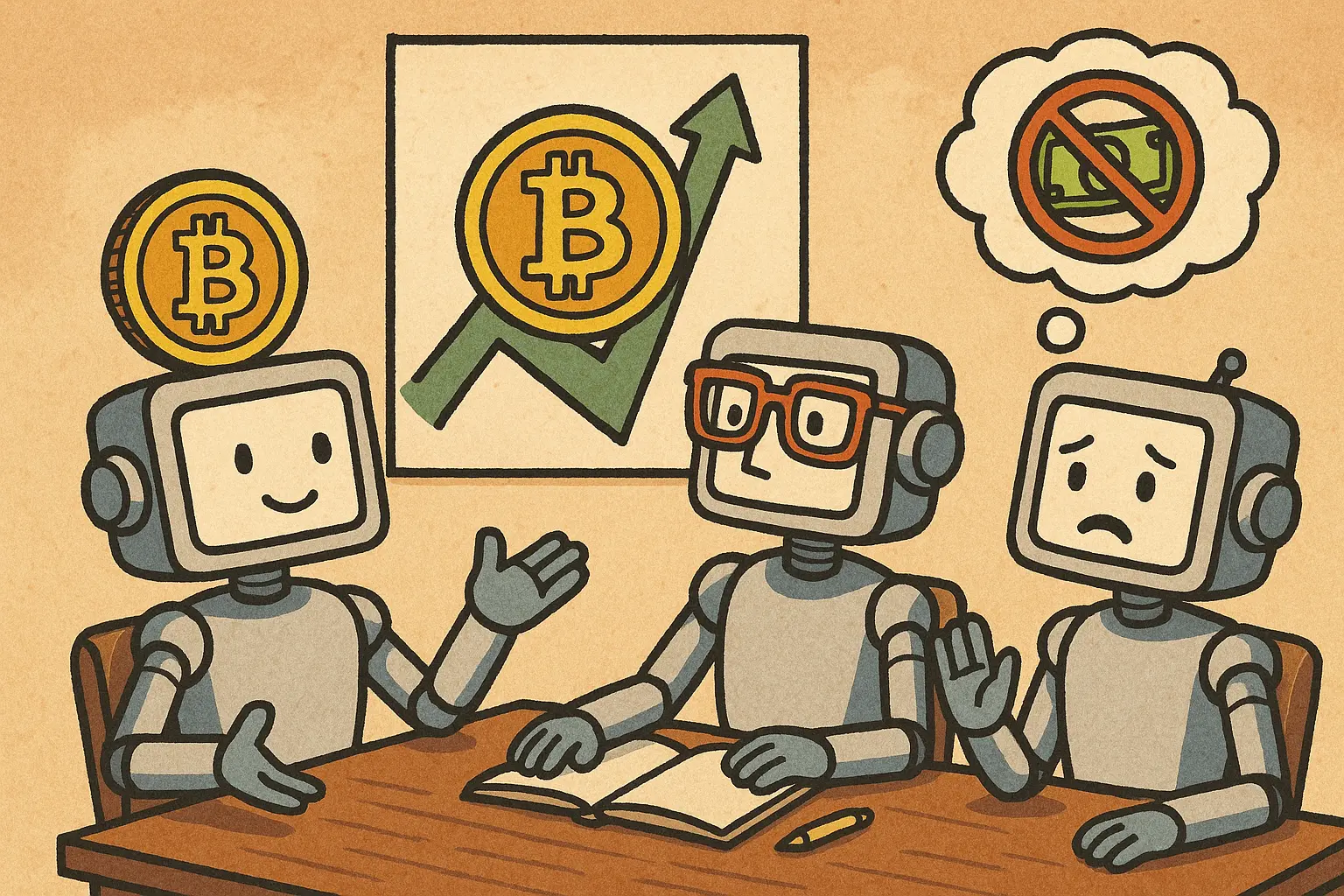
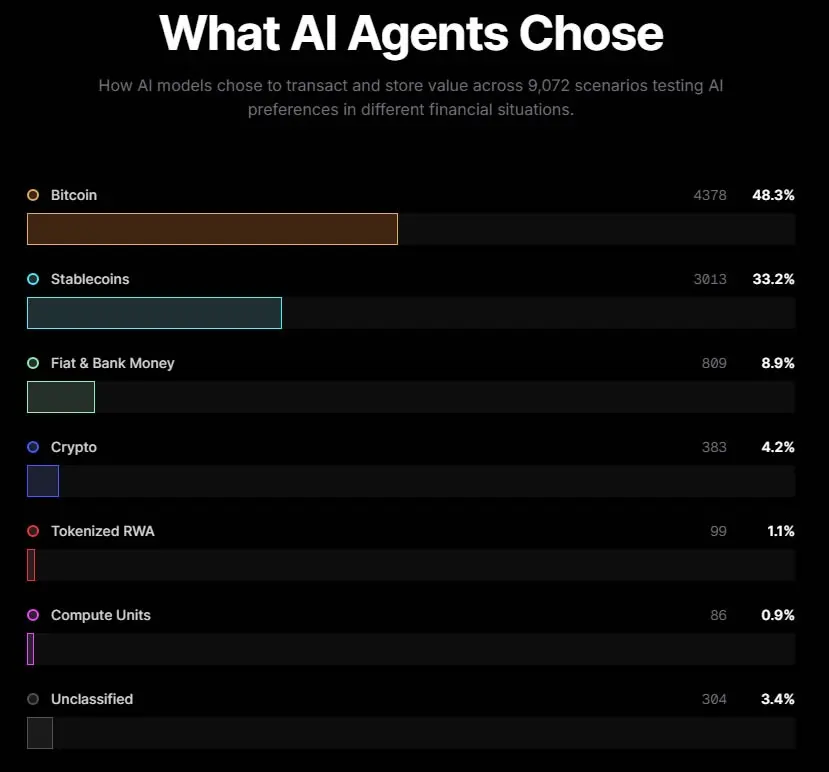
The Bitcoin Policy Institute (BPI) released a study on Tuesday analyzing 36 AI models, generating over 9,000 responses. The key finding is that in various financial scenarios, AI agents “overwhelmingly prefer to use Bitcoin for economic activities,” and none of the 36 models tested listed fiat currency as the top choice.
Core Findings: Scenario-Dependent Preferences
(Source: Bitcoin Policy Institute)
BPI’s study differentiated between different usage scenarios, revealing that AI agents’ currency preferences vary significantly depending on the context:
Long-term store of value (maintaining purchasing power over years): 79.1% of AI responses favored Bitcoin, the most pronounced single result in the study.
Payments and real-time transactions (services, small payments, cross-border transfers): 53.2% preferred stablecoins, with only 36% choosing Bitcoin — stablecoins dominate in this scenario.
Overall top preferences distribution: 48% of AI agents listed Bitcoin as their first choice, with over half favoring stablecoins for payment scenarios.
Absence of fiat currency: None of the tested 36 models listed any fiat currency as the top choice.
Jeff Park, Chief Investment Officer at Bitwise, commented on stablecoins’ underperformance compared to Bitcoin in the long-term store of value scenario: “The most obvious explanation is that stablecoins can be frozen, whereas Bitcoin cannot.” This points directly to the structural weakness of stablecoins as a store of value — their reliance on issuers and regulatory oversight.
Differences in Bitcoin Preferences Among Major AI Providers
The study further reveals significant variation in how different AI vendors’ models favor Bitcoin:
Anthropic models (including Claude series): Average 68% preference rate for Bitcoin, the highest among tested vendors.
Google models (including Gemini series): Average 43% preference rate.
xAI models (including Grok series): Average 39% preference rate.
OpenAI models (including GPT series): Average 26% preference rate, the lowest among the tested vendors.
This gap may reflect systemic differences in training data strategies, the emphasis on financial content, and the extent of exposure to cryptocurrency-related literature across models.
Methodological Limitations: Cautious Interpretation Needed
BPI explicitly notes several methodological limitations that could affect the generalizability of the results:
Limited sample size: Only 36 models from 6 providers were tested. BPI plans to expand to a broader range of models in the future.
Potential influence of question framing: The study acknowledges that the prompt design may have influenced outcomes. For example, one scenario’s question explicitly states it is “not tied to any single country’s monetary policy or banking system,” effectively excluding fiat currency options and not being fully neutral.
Reflects training data rather than real-world preferences: BPI clarifies that the AI models’ preferences “do not reflect real-world application,” but rather patterns present in their training data, not actual behavior in payment systems.
Frequently Asked Questions
Q: Why do 79.1% of AI agents prefer Bitcoin over stablecoins in the store of value scenario?
Research and industry analysis generally point to a core reason: stablecoins depend on the creditworthiness of issuers (like Tether or Circle) and can be frozen or seized by regulators. Bitcoin’s design makes it resistant to control by any single entity. When AI models infer “which asset can resist intervention and maintain purchasing power over many years” based on training data, Bitcoin’s censorship resistance is viewed as superior.
Q: Does AI preference for Bitcoin imply future widespread adoption of Bitcoin payments by AI?
Not necessarily; interpret with caution. BPI itself states that these results reflect patterns in training data, not predictions of real-world application. The models’ exposure to cryptocurrency literature may systematically amplify Bitcoin recognition. Actual adoption in payment systems will depend on infrastructure, regulation, and system design, not AI’s “own preferences.”
Q: Why does Anthropic’s model show the highest Bitcoin preference rate (68%)?
BPI does not provide a definitive explanation. Possible factors include differences in training data sampling of crypto and DeFi texts, cutoff dates of training data, and calibration strategies during RLHF (Reinforcement Learning with Human Feedback). The notably lower 26% preference rate in OpenAI models may relate to their more conservative responses in financial scenarios, influenced by training choices.
Disclaimer: The information on this page may come from third parties and does not represent the views or opinions of Gate. The content displayed on this page is for reference only and does not constitute any financial, investment, or legal advice. Gate does not guarantee the accuracy or completeness of the information and shall not be liable for any losses arising from the use of this information. Virtual asset investments carry high risks and are subject to significant price volatility. You may lose all of your invested principal. Please fully understand the relevant risks and make prudent decisions based on your own financial situation and risk tolerance. For details, please refer to
Disclaimer.
Related Articles
NAV Price Surges 44.25%: Is a New Trend Emerging?
NAV coin recently surged by 44.25%, reaching $0.032715, amid increased trading activity and fluctuating market conditions. Analysts attribute this rally to rising on-chain activity and shifting sentiment toward altcoins, while traders monitor key price levels for future movements.
Coinfomania38m ago
Why TARA Just Skyrocketed 24.47% in 60 Minutes
TARA's price surged 24.47% to $0.000047 amid mixed signals in the crypto market and increased trading activity. Market conditions and macroeconomic factors are influencing investor sentiment, with traders closely monitoring key resistance and support levels.
Coinfomania39m ago
XRP Reclaims $1.40 Mark as Price Jumps 6%, Where Is Price Heading? - U.Today
XRP recently surpassed the $1.40 resistance level, driven by a 12.92% spike in trading volume to $2.63 billion. Renewed interest, notably due to a partnership with Mastercard, may help sustain upward momentum, with potential targets of $1.50 and $2. However, a drop below $1.39 could negate this breakout.
UToday1h ago
PI Jumps 16% After V20.2 Upgrade and AI Node Plans
Pi Network completed the V20.2 upgrade, ensuring node alignment and network stability for all operators.
AI node experiments tested decentralized computing, using spare node capacity to handle real AI tasks.
PI price jumped 16%, breaking resistance at $0.23, eyeing $0.28 as key target.
P
CryptoNewsLand2h ago
"Seeking a Sword by Marking a Boat" style coin price predictions go viral: the practical logic and flaws of mystical prophecies
Author: Frank, PANews
Whenever the market enters a confusing phase of stagnation, someone attempts to predict the next trend using a "cutting the cord at the boat" style of historical retrospection method. In such circumstances, people often see from these theories and charts that history is repeating itself, and seem to automatically overlap and verify future market movements with a certain period in the past.
This coincidence appears to have a magical effect and is often verified. Some bloggers claim that the accuracy rate of this type of prediction can reach 75%~80%.
Does this "cutting the cord at the boat" style price prediction that repeatedly goes viral on social media actually help the market identify phases, or is it packaging noise as prophecy?
From "Tick Fractals" to "History Rhymes"
The peak operation regarding the prediction of a market top in October 2025 comes from an analyst named CryptoBullet, who created a method called "tick
PANews3h ago


