


CryptoQuant: Bitcoin's 7% rise driven by institutions, with an 18% surge in leverage amplifying volatility risk

CryptoQuant community analyst Maartunn points out that Bitcoin recently rose from $68,000 to $73,500, primarily driven by institutional demand — the Coinbase premium gap once reached $61, indicating strong buying pressure from U.S. institutions; meanwhile, new leveraged positions in BTC increased by approximately $3.55 billion, which could trigger large-scale liquidations if spot buying weakens.
Institutional Contrarian Positioning: Dual Confirmation from ETF Flows and Coinbase Premium
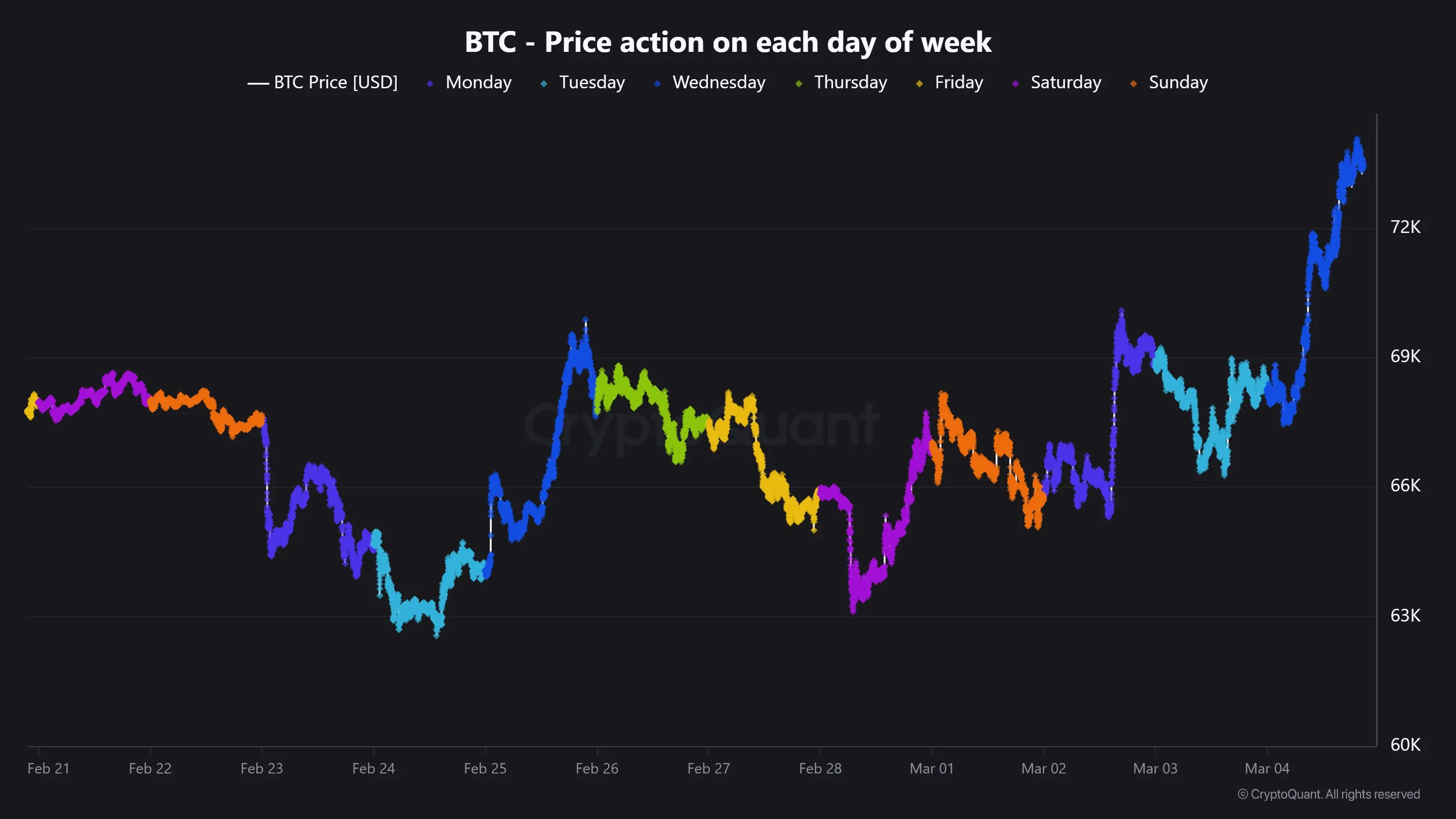
(Source: CryptoQuant)
Maartunn’s analysis on CryptoQuant confirms multiple signs of active institutional inflows. The Coinbase premium gap (Coinbase Premium Gap) once hit $61 — this indicator reflects the price difference between Coinbase BTC/USD and Binance BTC/USDT. A high and positive value typically indicates strong buying activity from U.S. institutions and is one of the key indicators used to track institutional capital flow.
ETF fund flow data further supports this assessment: over five trading days, Bitcoin ETFs attracted a total of $1.5 billion, with a single-day peak of $458 million — the strongest daily inflow this quarter. Among the top 25 institutions holding Bitcoin ETFs, 17 increased their holdings counter to retail selling. Analyst Zach Townsend describes this divergence as “confidence disparity” — a phenomenon often observed before major price swings, though the direction of volatility remains uncertain.
Long-term Holders Net Buying $14 Billion, Signaling Structural Shift Since 2025
CryptoQuant’s on-chain data shows that long-term holders (LTH), wallets holding Bitcoin for over 150 days, net accumulated 212,000 BTC in the past 30 days, worth over $14 billion at current prices. The “Long-term Holder Net Position Change” indicator was mostly negative throughout 2025 but turned positive after Bitcoin dropped to multi-year lows — this shift appears to have begun around February 6, when Bitcoin fell to about $60,000.
Key Data on Institutional Moves and Market Structure
- Recent BTC Price Increase: from $68,000 to $73,500 (~7%)
- Coinbase Premium Gap: once reached $61, indicating strong U.S. institutional buying
- ETF Inflows: $1.5 billion over five days, with a peak of $458 million in a single day (this quarter’s highest)
- Institutional Contrarian Accumulation: 17 of the top 25 ETF holders increased holdings during retail sell-off
- Long-term Holders: net buy of 212,000 BTC (~$14 billion) in the past 30 days
- Leverage Risks: new leveraged positions in BTC increased by about $3.55 billion (+18%); ETH about $1.8 billion (+17%)
Frequently Asked Questions
Why is Coinbase Premium Gap an important indicator for tracking institutional buying?
The Coinbase Premium Gap reflects the price difference between Coinbase BTC/USD and Binance BTC/USDT. Since Coinbase is a primary trading platform for U.S. institutional investors, when Coinbase prices stay above Binance, it generally indicates strong active buying pressure from U.S. markets and is widely used as a proxy for institutional capital flow.
Why is the $14 billion net buy by long-term holders noteworthy?
Long-term holders typically possess strong risk tolerance and informational advantages. Their large accumulation often signals confidence in the asset’s long-term value and can reduce market supply. CryptoQuant’s historical data shows that LTH accumulation cycles often precede significant market rebounds, though they do not guarantee specific timing; the ultimate outcome depends on macroeconomic conditions, regulatory developments, and new demand.
Why should we be alert to the rapid increase in leverage?
When large leveraged positions accumulate quickly, a weakening spot market can trigger forced liquidations, causing chain reactions and amplifying downward volatility. Maartunn emphasizes that the recent increases in leverage — 18% in BTC and 17% in ETH — are among the most critical risks to monitor in the current market structure.
Related Articles
Yesterday, the US Bitcoin spot ETF saw a net inflow of $461.9 million, with total inflows over the past three days exceeding $1.1 billion.
Arthur Hayes: BTC has not yet decoupled from American SaaS technology companies and may only be a short-term rebound
The top account in Coincoin's real trading profits is currently long on $30.31 million worth of ETH and BTC.