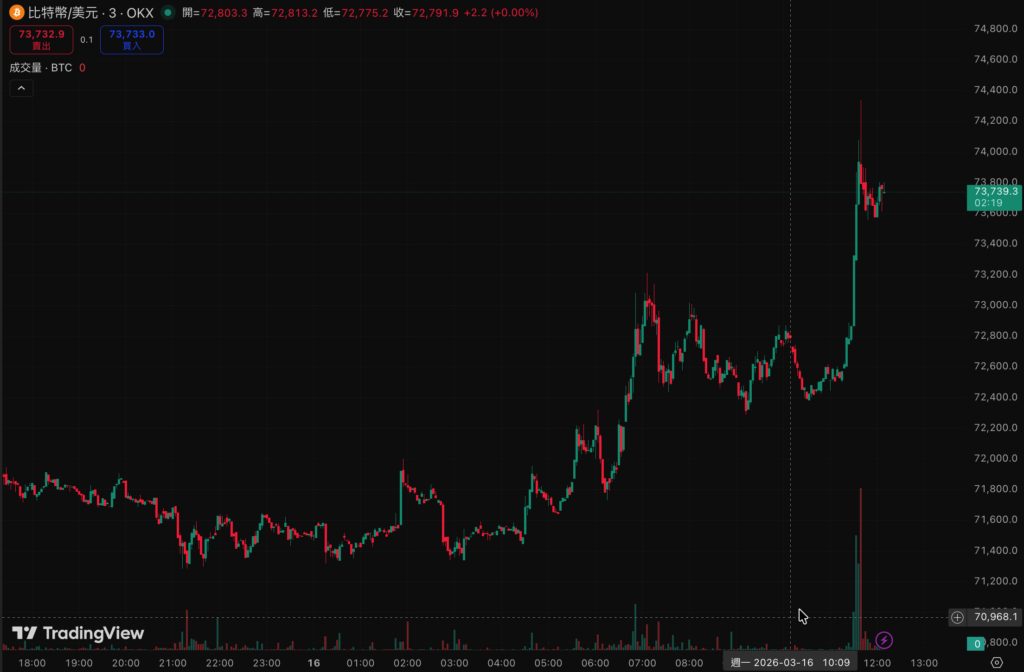
Bitcoin broke through the key resistance level of $74,000 on March 16, trading at $74,049.98, up 3.68% over 24 hours. Market analysis indicates that continuous ETF capital inflows, the halving supply shock, and geopolitical safe-haven demand are resonating to drive this breakout.
(Background: Continuing rally! Bitcoin briefly surpasses $74,000, Ethereum exceeds $2,200, and the entire network experiences $570 million in liquidations.)
(Additional context: Breaking news — Bitcoin rebounds above $70,000, up nearly 5% in 24 hours.)
Market data shows Bitcoin broke the $74,000 mark today, reaching a high of $74,049.98, with a 24-hour increase of 3.68%. Volatility remains high, so investors should be cautious of risks.
It’s worth noting that $74,000 has previously been a short-term resistance level, rejected four times over the past two weeks. Whether it can hold this time remains a key focus. Technically, if bulls defend $74,000 and break through with volume, the next targets are $78,000 to $80,000; if profit-taking pressure causes a pullback, support levels are between $70,000 and $71,500.
ETF Inflows, Halving, and Geopolitical Resonance
On the fundamentals side, multiple bullish factors are converging. In March, US spot Bitcoin ETF net inflows reached about $1.3 billion, potentially marking the first positive month since October last year, indicating a clear institutional demand resurgence. Meanwhile, the supply shock from the halving continues to unfold, with miners producing half as much daily, creating structural bullishness amid rising demand.
Additionally, escalating geopolitical tensions in the Middle East, combined with weakening traditional safe-haven assets like gold due to strong oil prices, may be driving some safe-haven capital into Bitcoin, further strengthening the fundamental support for this rally.
Short-term Volatility and Risk Management
Despite the bullish momentum, market volatility is increasing. Leveraged traders should exercise caution. The price is oscillating around $74,000, which could trigger both long and short liquidations. It’s advisable to control positions, set reasonable stop-losses, and avoid chasing highs to prevent being caught in a squeeze.
Overall market sentiment remains optimistic, but ongoing monitoring of ETF capital flows, on-chain holdings, and macro factors (such as Federal Reserve policies and dollar trends) is essential to detect any reversal signals.

Disclaimer: The information on this page may come from third parties and does not represent the views or opinions of Gate. The content displayed on this page is for reference only and does not constitute any financial, investment, or legal advice. Gate does not guarantee the accuracy or completeness of the information and shall not be liable for any losses arising from the use of this information. Virtual asset investments carry high risks and are subject to significant price volatility. You may lose all of your invested principal. Please fully understand the relevant risks and make prudent decisions based on your own financial situation and risk tolerance. For details, please refer to
Disclaimer.


