President Trump posted on Truth Social that “productive talks” between the U.S. and Iran are underway, and announced a five-day delay in the original strike plan. Following the news, the market capitalization of the S&P 500 increased by approximately $2 trillion within just 20 minutes, oil prices dropped sharply, and Bitcoin moved higher in tandem, marking one of the fastest cross-asset re-pricing events since 2026.
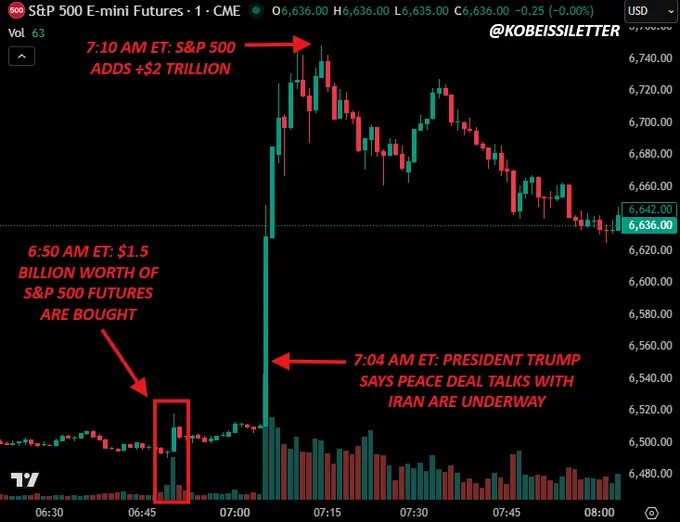
14-Minute Time Gap: Precise Timing of Large Futures Orders
(Source: KobeissiLetter)
The reason this $1.5 billion buy order attracted widespread attention is due to its exact timing relative to Trump’s post. Large buy orders during the early morning low-liquidity trading hours are unusual in themselves, but this order was placed precisely 14 minutes before the key news that shifted global market expectations. This coincidence makes it difficult for market observers to ignore.
If the trader holding this position took profits within minutes after Trump’s statement, they could have realized tens of millions of dollars in short-term gains. Based on publicly available information, there is no direct evidence linking this trade to insider information. In the low-liquidity environment of early morning, algorithmic trading systems or macro strategy models may have simultaneously built large cross-asset positions without a single clear trigger signal. The SEC and CME have not publicly commented on this event.
Market Reaction to Trump’s Statement Across Asset Classes
Following Trump’s announcement, the three major asset classes experienced sharply divergent movements:
U.S. Stocks Surge: The market cap of the S&P 500 increased by about $2 trillion within 20 minutes, with investors interpreting the delay of the worst-case scenario of war as a positive signal for corporate earnings, quickly boosting risk appetite.
Oil Prices Collapse: Traders rapidly unwound the premium built into the Strait of Hormuz disruption, causing WTI crude oil to fall sharply, reflecting the energy market’s extreme sensitivity to Middle East geopolitical tensions.
Bitcoin Rises Alongside: Bitcoin did not act as a “safe haven” but moved higher in tandem with improved risk appetite—during the conflict, BTC and the S&P 500 had a correlation coefficient as high as 89%. This reaction further confirms their strong linkage under geopolitical events.
Even though Iranian officials publicly claimed Trump was “bluffing,” the directional movements of these three assets remained unchanged, indicating that the market’s pricing was driven by the expectation that “the short-term worst-case scenario has been postponed,” rather than optimism about substantive progress in peace negotiations.
Market Structure Significance: How Geopolitics Are Repriced in Real Time
The deeper significance of this event lies in its clear illustration of the interconnectedness of modern global markets. Stocks, oil, and cryptocurrencies responded with different logic to the same information, yet collectively achieved real-time cross-asset re-pricing. This high level of connectivity means that traders who can accurately judge market direction just minutes before key geopolitical news are able to realize large profits in a very short time—this is the fundamental reason why the $1.5 billion futures order has sparked widespread market discussion.
Frequently Asked Questions
What exactly did Trump’s statement say, and why did it trigger such a big market reaction?
Trump on Truth Social stated that productive talks between the U.S. and Iran are underway, and announced a five-day delay in the planned strike on Iran’s energy facilities. This directly changed market expectations about “immediate escalation of military conflict,” leading stocks to reassess growth prospects, oil markets to unwind war premiums, and crypto markets to follow risk appetite higher.
Does the $1.5 billion futures order involve insider trading?
There is currently no publicly available evidence directly linking this trade to insider information. Large trades during low-liquidity early hours, algorithmic cross-asset triggers, or macro bets on geopolitical tensions could all be reasonable explanations. The SEC and CME have not issued any public statements.
Is Bitcoin acting as a “safe haven” or a “risk asset” in this event?
In this case, Bitcoin clearly behaved as a “risk asset,” moving higher alongside improved risk appetite, rather than as a hedge against geopolitical risk. This aligns with the overall trend during the Iran conflict, where BTC and the S&P 500 maintained a correlation coefficient of about 89%. It shows that in short-term macro-driven markets, Bitcoin’s safe-haven characteristics are less robust than traditional narratives suggest.
Disclaimer: The information on this page may come from third parties and does not represent the views or opinions of Gate. The content displayed on this page is for reference only and does not constitute any financial, investment, or legal advice. Gate does not guarantee the accuracy or completeness of the information and shall not be liable for any losses arising from the use of this information. Virtual asset investments carry high risks and are subject to significant price volatility. You may lose all of your invested principal. Please fully understand the relevant risks and make prudent decisions based on your own financial situation and risk tolerance. For details, please refer to
Disclaimer.


