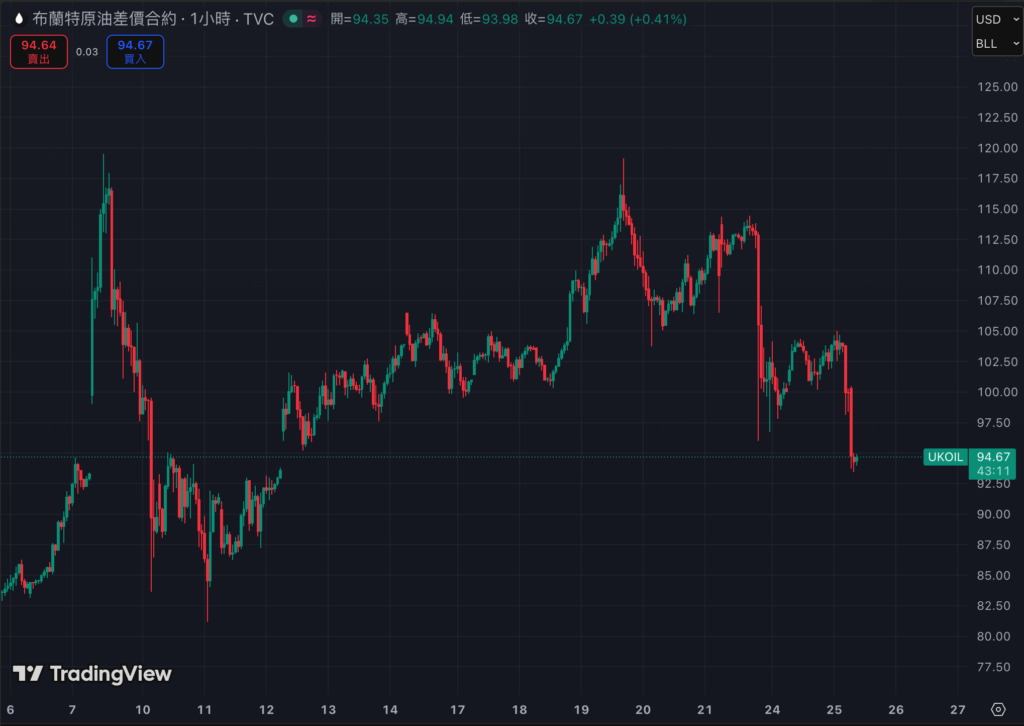
Brent crude oil has experienced intense fluctuations this week, temporarily dropping below $95 per barrel. Whether the US and Iran can truly reach a reconciliation agreement remains a major factor.
(Background: Bitcoin rebounded to $70,800, with 87,000 traders liquidated, totaling $230 million; “Extreme Fear” has lasted 46 days, the longest record since FTX.)
(Additional context: Bank of New York Mellon CEO states that banks will not be replaced by DeFi, but rather DeFi is a key bridge for the next phase of cryptocurrency adoption.)
Brent crude oil has been highly volatile this week, dropping from last weekend’s high of $112 by 11% to $97, then rebounding to $104. Early this morning (25th), it quickly fell again by 8%, currently at $94.67.
Behind this sharp movement is the market questioning: How much credibility do Trump’s statements hold?
What did Trump say?
On March 25, Trump claimed at the White House that the US is “talking directly with Iran,” stating that Iran is eager to reach an agreement, has agreed not to develop nuclear weapons, and has sent a valuable gift involving oil, natural gas, and the Strait of Hormuz transit rights.
Vice President Vance and Secretary of State Rubio are both involved, and the US also revealed that it has submitted a 15-point peace plan to Iran through Pakistan.
Trump summarized: “We have already won this war.”
What did Iran say?
Iran’s response was a clear and concise denial. Iran’s semi-official news agency stated that no negotiations have taken place and that Trump is unreliable. Parliament Speaker Ghalibaf used even more direct language, calling it “fake news manipulating the oil market.”
Meanwhile, Iran’s Supreme Leader’s office appointed hardliner Mohammad-Bagher Zolghadr as head of the National Security Council. This personnel change at this time is completely opposite to the direction of “approaching reconciliation.”
Iran’s previous public condition was: demanding compensation from the US and guarantees that there will be no future attacks. The details of Trump’s 15-point plan have not been made public, but based on the current public statements from both sides, even the basic question of whether negotiations are happening seems to lack consensus.

Disclaimer: The information on this page may come from third parties and does not represent the views or opinions of Gate. The content displayed on this page is for reference only and does not constitute any financial, investment, or legal advice. Gate does not guarantee the accuracy or completeness of the information and shall not be liable for any losses arising from the use of this information. Virtual asset investments carry high risks and are subject to significant price volatility. You may lose all of your invested principal. Please fully understand the relevant risks and make prudent decisions based on your own financial situation and risk tolerance. For details, please refer to
Disclaimer.


