Author: Loopy Lu

The growth space of a financial product/asset is often determined by the market capacity. And this market capacity includes both the scale of funds and the number of investors. If considered in this dimension, the future of friend.tech is not optimistic.
Let’s take NFT with poor liquidity as an example. A set of “standard” PFP series has 10,000 “assets”. In theory, such an NFT Collection can accommodate 10,000 investors. In order to improve poor liquidity, many NFTFi products such as fragmentation, lending, and leasing have emerged in the industry.
Speaking of friend.tech, how many investors can a “user” share target accommodate?
Let’s take Racer, which ranks Top 1 in the share market value list, as an example. Racer’s current share market value is 773 ETH. Dune data shows that there are currently only 232 individual shares of Racer, and the number of holders is as low as 138 addresses; a total of 960 transactions have occurred, including 596 buys and 364 sells.
Have you noticed, even though it is hotly discussed in the circle, the transactions of the strongest target in friend.tech are still very low-frequency. This means that the market capitalization can soar to a high position (relative to the enthusiasm for market participation) with very few transactions.
why?
Evolution of Matchmaking: Overhead the role of counterparty
Here, we need to re-understand the mechanism design of friend.tech.
In traditional trading venues such as CEX, matching transactions through order books is the core pricing mechanism. Buyers and sellers continuously initiate bids, and when both parties reach an agreement, the transaction is completed. And this transaction price is instantly displayed by the trading platform, which is also the instantaneous price we observed to balance the expectations of both parties to the transaction. But in friend.tech, this continuous transaction process does not exist.
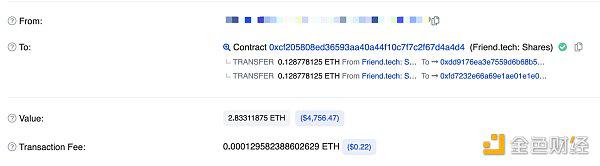
The picture above is a typical buy trade in friend.tech. We can see that the 2.83 ETH used to purchase the share, after deducting two 5% share, has all been entered into a contract address ending in “a4d4”. (By the way: It is also an important innovation of the project to directly “exchange money” without using NFT as an intermediary. In addition, the cancellation of mint also saves gas.)
In a sale transaction, we can see that the contract address ending in “a4d4” directly transfers the proceeds from the sale to the seller after deducting two commissions.
The contract ending in “a4d4” is named Friend tech Shares V1. This contract is used to store the ETH handed over by users when buying shares. Currently, there are 3434 shares in the contract.
**Simply put, in friend.tech, there is never a direct transaction between buyers and sellers. **
Yes, that’s the magic of friend.tech. I even think that this is a “great invention” comparable to AMM.
Remember the shock that AMM brought to traders in the circle when it came out? It eliminates the disadvantage that the order book must be executed in real time, so that buyers and sellers do not need to “exist” together at the instant of the transaction.
Real-time transactions have great requirements for liquidity. For the nascent crypto market, it is difficult for a niche target to maintain sufficient and high-frequency transactions 7 x 24 hours.
AMM makes LP an eternal “seller/buyer”. Buyers/sellers can close deals at any time as long as the LP remains.
And friend.tech is more radical than AMM, it even wiped out LP. There is no need for the role of LP to “pretend” the counterparty, and it also allows the transaction initiator to ignore the liquidity and trade at any time.
Since friend.tech has never officially released a white paper, and has not named its mechanism. For the convenience of the following text, I will use “Void Trading” as the nickname for its trading mechanism.
Void Trading: The “Great Innovation” That Moves the Price Timeline
Odaily Planet Daily once became popular in “Friend.tech, how are individual stocks priced?” "The price mechanism is introduced in the article. In a nutshell, the price of friend.tech is determined by the supply of trading items - the more individual shares exist, the more expensive they are.
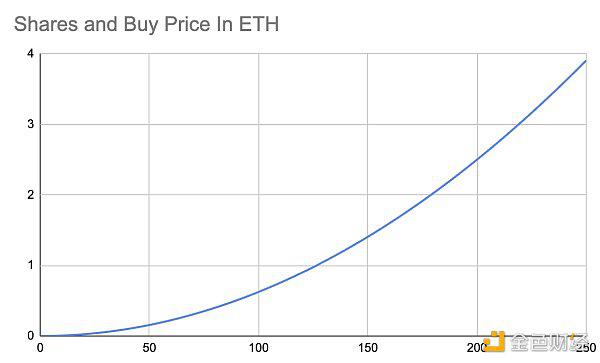
The horizontal axis is the number of shares, and the vertical axis is the transaction price
Intuitively, this mechanism seems to be in line with common sense-the stronger the buying, the more buyers, and the more shares are created, so the price rises accordingly-scarcity leads to price rises.
But is that really the case?
Let us look back at the traditional matching transaction. In a matching transaction, the transaction is executed in real time. When you buy a target for $1,000, there must be someone who is willing to sell it for $1,000. And when the market expects it to rise, due to “supply exceeds demand”, other traders will quote $1001 to buy. A transaction price of $1,001 was finally reached.
Nobody “prices” the item at $1001. The market spontaneously traded at $1001, and the trading platform showed it, that’s all.
AMM is also similar, LP just acts as an “eternal existence” counterparty.
In matching transactions and AMM, the price has already happened, it is “past tense”.
In “empty trading”, there is a clear “pricing” rule, and the price is a clear “future tense”-I must know the price of the next purchase (or sale).
Under the mechanism trap, does “transaction” exist?
What problems will “empty trading” bring? It’s hard to rate.
My personal subjective value judgment is that this mechanism greatly distorts the real market.
The sale and purchase of shares does not seem to be classified as a traditional “transaction”.
Because the price is a “future tense” rather than a “past tense”. Share trading is more like a game behavior with benefits - within a clear framework of rules, priced by rules, non-market spontaneous, and no opponents. The market script has been written in advance, and economic rules cannot freely set prices here.
In fact, this seems to be closer to a gambling behavior?
“Void trading” “locks” the rise and fall of prices in advance through clear pricing rules. This will bring up the following questions:
· Unable to achieve a sufficiently “fair” price - there is no counterparty in the market, no need to reach a consensus with others.
· There is no “effective” price - the price is a “future tense” rather than a “past tense”, and cannot represent the combined force that buyers and sellers have formed in the market.
· The price is “full of plans” but jumps and changes - if 1 ETH cannot be traded, you cannot quote 1.01 ETH, and the price becomes stepped rather than linear.
Taking two adjacent buying transactions as an example, the second transaction has an increase of 0.99% compared with the previous one.

Changed to a more familiar expression-this means that the depth of ** is seriously insufficient. **
Unlimited liquidity, high market value, is the deliberate design of the project party?
In the NFT trading market, taking MAYC as an example, you can buy 65 NFTs within a 1% increase in the floor price (4.51 ETH). The same goes for selling, with up to 90 bids available on Blur in the 1% down range.
In friend.tech, if you want to drive a 1% increase/decrease, you only need to initiate a buy transaction.
Such a poor depth means that it is more conducive to market making and trading.
Whether this “empty trading” mechanism is good or bad depends on where you start from.
On the positive side, this artificial “pricing” mechanism allows friend.tech to theoretically have unlimited liquidity. As long as you hold ETH or personal shares, users can eventually make transactions under any market background.
When AMM replaced traditional market makers with LPs, people exclaimed that market making can be so efficient. In friend.tech, even the “50/50” ratio among LPs is abandoned, and all funds become liquid.
**But when you compare the data with the traditional ERC-20, you will find the horror of void transactions. **
Remember the mantissa “a4d4” contract address mentioned above? This address is used to store all liquidity funds, about 3434 ETH. Given that these funds are all ETH liquidity (there is no “50/50” design), it can be equivalent to a TVL of 6868 ETH.
Generally speaking, if an on-chain protocol wants to support a larger market value, it needs to absorb a larger asset size (ie TVL). A protocol’s ability to absorb assets is often seen as an important factor in protocol valuation.
At present, the total market value of friend.tech’s personal share is 10,000 ETH. The ratio of MCap to TVL of friend.tech is as high as 1.45, and the capital efficiency is extremely terrible.
DeFiLlama data shows that this data is much higher than other on-chain protocols. To a certain extent, this means that its current market value is inflated.
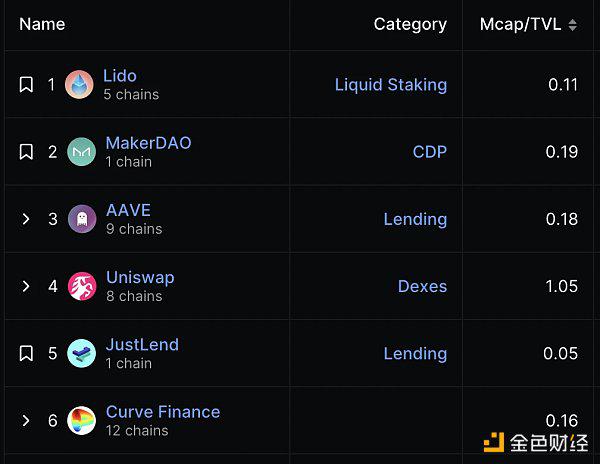
But the reason for the soaring market value is intriguing-is it the soaring market value caused by investors’ optimism about this project, or is it the “market manipulation” behavior caused by artificial mechanism design?
Insufficient vertical depth, horizontal and vertical fields
From the perspective of each individual share. **friend.tech undercuts Ponzi’s market space like never before. **
The top trading target can only hold hundreds of people at the same time. Once the number of people starts to grow rapidly, the artificially designed price curve will make the trading products expensive and out of reach of most investors. And it is difficult to form a consensus on transaction targets that lack a broad mass base.
But on the other hand, **it turns every transaction target into a little Ponzi. **Although the growth prospect of a single trading product market is limited, friend.tech can provide you with countless similar trading targets.
A new type of trading mechanism that gives the most efficient liquidity but is extremely easy to manipulate prices has emerged. What impact will such innovations have on the industry?
Maybe in a few years, a “great” Ponzi project will be born: it has unlimited liquidity, horizontal expansion and prosperity, and can attract everyone into a well-designed trap. And the origin of all this comes from the inspiration of a brand-new “void transaction” mechanism…
Will the innovative mechanism that friend.tech brings to the industry open up the market like AMM, or will it lead the industry to a darker abyss? The gears of fate have begun to turn.


