Author: GabyGoldberg, Substack; Compiler: Yvonne, Marsbit
In 2018, USV’s Dani Grant and Nick Grossman published “The Myth of The Infrastructure Phase,” arguing that it was applications that inspired infrastructure. development, rather than the latter acting on the former. Five years later, this argument seems more common than ever.
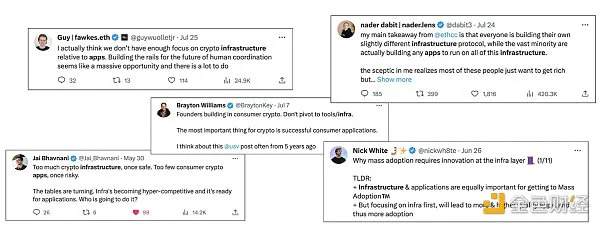
Tweets from the past six months
If you want to know quickly, long story short, there are advantages to both sides. The infrastructure team believes that better tools can improve the user experience of applications and allow developers to build applications faster, while the application team insists that in the shift of major technology platforms, breakthrough applications such as Lightbulbs, airplanes, or AOL) appeared first, and only later inspired the infrastructure (power grids, airports, or web browsers) to support widespread adoption of these applications.
As much as I would like to take a side in this debate, I think this conversation is too binary to begin with. Infrastructure and applications need to constantly feed each other. Like the shift from dial-up to broadband to Wi-Fi, or from call delivery to DoorDash, the path to success isn’t linear—it’s a two-way street. In the cryptocurrency space, we often like to build on existing technology or use cases, but building in this space fundamentally requires accepting that this can all change.
One heuristic that feels like a distraction in this debate is “mass adoption” in cryptocurrencies – building products at consumer scale. What does “scale” actually look like in cryptocurrencies? On the one hand, there are businesses that look and feel similar to companies producing traditional consumer goods, but with traces of the use of blockchain technology behind them, often for payments (like Beam or Sphere) or loyalty (like Medallion or Blackbird) . Consumers of these products often have little interest in or understanding of cryptocurrencies, so as much technology as possible is abstracted away for a more seamless user experience. Meanwhile, on the flip side, you launch crypto-native products targeting crypto-native consumers — a growing user base who like to try new products and spend a lot of real money on them.
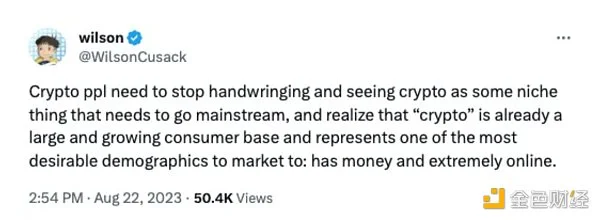
Photo credit: @WilsonCusack
Although both user personas are attractive from a business perspective, they are often fundamentally inconsistent. Existing tools may “work” for the users and applications that have existed so far - but if we want to grow users, then we must grow the infrastructure as well. This isn’t a binary opposition (“We need a killer app!”) but rather a push and pull based on consumer demand. Let’s take the wallet as an example, which is the consumer portal for all activity in the ecosystem:
The first iteration of crypto wallets (let’s call them Wallet 1.0) was largely limited in terms of use cases. Many early cryptocurrency adopters care deeply about the technology’s fundamental pillars, such as decentralization, transparency, and immutability. It is worth noting that if users want to engage with this technology, they need to value or at least understand the concept of self-regulation. A great example of Wallet 1.0 is MetaMask, created by ConsenSys in 2016. In July 2020, MetaMask had 545,000 monthly active users. In August 2021, due to the arrival of “DeFiSummer”, the number of active users soared to more than 10 million, and liquidity mining became an important factor in the surge of users. At the time, using MetaMask to earn DeFi yields was an obvious choice for consumers, as MetaMask helped users access the protocol (which was widely supported) more easily than its competitors.
This means that, in the meantime, successful applications are being built with existing MetaMask users in mind – users who own the wallet and want to use it. It makes sense that consumer applications would be crypto-native in nature based on the market opportunities provided by the available infrastructure.
Many popular wallets today are still primarily self-hosted and serve a similar user base. However, over the past few years, we’ve also seen the pendulum swing completely to the other side as consumer demands continue to change. Specifically, we’ve seen a proliferation of tools that make it easy to log into crypto wallets, so new users can participate in blockchain-based applications like NBA Top Shot or Starbucks Odyssey without having to worry about mnemonic phrases. Infrastructure such as Magic and Web3Auth bring us into the “Wallet 2.0” era. In many ways, this solves the problems of Wallet 1.0, where users can create wallets seamlessly, and enables traditional consumer companies to add crypto-native elements to their businesses. But in other ways, it creates entirely new problems: instead of using several self-hosted wallets across all dapps, users have a new wallet for each app, which is almost like getting a co-branded credit card for each store . These application-specific wallets lock consumers into vertical brand ecosystems and eliminate the potential for portability because the keys are no longer kept by the user. Why use cryptocurrencies if you can’t actually own your assets and take them with you?
*“While wallets and apps are users’ first touchpoints with cryptocurrency, we pit ease of use against interoperability.” ——Nitya Subramanian (*Former Product Head of Celo)
Consumer interest has largely driven this change. While Wallet 1.0 catered to cryptocurrency-native users and focused primarily on transactions, Wallet 2.0 bucks this trend and introduces a branded and mass-market consumer experience. Now, the pendulum seems to have landed somewhere in the middle — what we might call Wallet 3.0, which combines the interoperability of the first iteration (true self-custody) with the robust consumer user experience of the second iteration . This is accomplished by service providers like Capsule, which leverages distributed multi-party computation to enable developers to build applications that interact with user assets on their terms without sacrificing interoperability.
As applications and infrastructure continue to match and improve, wallets become the expressive building blocks of consumer identity, and more parts of the ecosystem begin to be empowered.
Now, the opposite is true. In a rapidly changing ecosystem, it is often reassuring to build on existing use cases, but to be successful, you must be fundamentally open to the evolution of these cases. That’s why we’re excited.
Disclaimer: The information on this page may come from third parties and does not represent the views or opinions of Gate. The content displayed on this page is for reference only and does not constitute any financial, investment, or legal advice. Gate does not guarantee the accuracy or completeness of the information and shall not be liable for any losses arising from the use of this information. Virtual asset investments carry high risks and are subject to significant price volatility. You may lose all of your invested principal. Please fully understand the relevant risks and make prudent decisions based on your own financial situation and risk tolerance. For details, please refer to
Disclaimer.


