Source: Bulu said
Since Bitcoin completed the Taproot upgrade in 2021, Bitcoin has changed from a simple blockchain “public ledger” used to record transactions to a blockchain network space with a certain amount of data storage capacity, and more profound changes have begun to take place here.
Bitcoin is now in the process of changing from quantitative to qualitative, and the driving force of this cycle is “innovation” – including the launch of a number of emerging protocols and the future imagination of the BRC-20 standard.
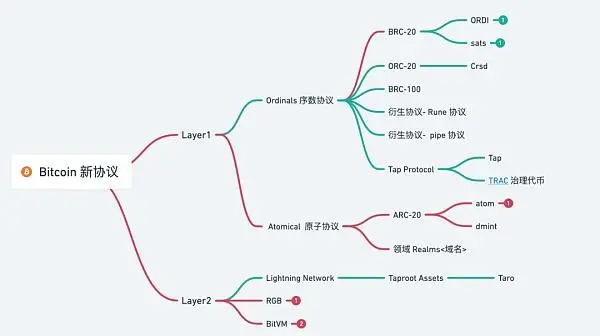
A list of Bitcoin’s new protocols, source: imToken
According to the network’s public information, in 2023, Bitcoin’s computing power has achieved an increase of more than 80%. Compared to other blockchain digital assets, this oldest digital asset is being revitalized, the market is performing better and better, and emerging Bitcoin NFT and DeFi projects are also receiving more attention.
With the development of the Bitcoin app, the Bitcoin ecosystem is taking shape. At this juncture, this article will sort out and introduce the new protocols and noteworthy technical routes that have helped shape the Bitcoin ecosystem since 2023.
**Ordinals Protocol: Freedom BTC from the “nihilism” of value
In January 2023, Bitcoin Core developer Casey Rodarmor officially released the Ordinals protocol, which was built with the main goal of creating a traceable unique number for BTC based on the smallest unit of BTC (the cryptocurrency issued on Bitcoin) “Satoshi”, which introduced the concepts of ordinals and inscriptions The birth of the first NFT in the Bitcoin network.
Learn more
· To understand the Ordinal theory, the law of ordinal number identification, and the corresponding scarcity hierarchy of Satoshi (Bitcoin’s quantitative unit word, translated as “Satoshi” in Chinese), you can see:
· To learn more about how personalized content can be written into a Satoshi via the Ordinal protocol, please refer to:
As of now, although the Ordinals protocol has been online for less than a year, it has attracted both participants from the Bitcoin community and a large number of developers from the Ethereum community, and protocols and applications that have been improved and expanded around Ordinals are constantly emerging.
● 引爆 Bitcoin NFT
Why has Bitcoin been around for so long and hasn’t had NFTs like Ethereum?
The innovation and ingenuity of the Ordinals protocol lies in the fact that although it is difficult to run smart contracts on Bitcoin, and NFTs running on independent smart contracts cannot appear, if the non-fungible content that gives NFTs the difference from the general fungible digital asset Cryptocurrency is marked on Bitcoin’s existing asset BTC, is it also creating a unique Bitcoin NFT?
This process of marking is often referred to as “inscription”, and the non-fungible content marked on BTC is called “inions”. It can be seen that Bitcoin NFT is still essentially BTC, but it has become a personalized BTC.
Since 2023, Bitcoin NFT transactions have shown a high growth trend. According to the data tracked by CryptoSlam, during May ~ June 2023, the trading volume of Bitcoin NFTs ranked second on the public chain NFT trading list, second only to Ethereum’s NFT trading volume.
As of November 20, 2023, the NFT trading volume on Bitcoin in the past 30 days has exceeded $302 million, standing at the top of the public chain NFT trading volume rankings, and Ethereum’s NFT trading volume in the past 30 days is currently in second place, at $296 million, behind Bitcoin.

Ranking of the total trading volume of NFTs on each blockchain in the past 30 days Source: CryptoSlam, screenshot on November 20, 2023
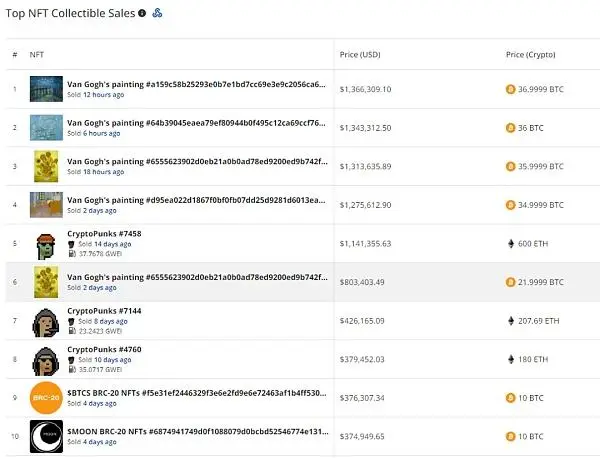
Ranking of individual NFT trading volume in the past 30 days Source: CryptoSlam, screenshot on November 20, 2023
● BRC-20
Since the Ordinals protocol can create Bitcoin NFTs by inscribed non-fungible data on BTC, is it possible to deploy contracts on BTC through the Ordinals protocol to create new Bitcoin Cryptocurrency?
On March 8, 2023, former Twitter user @domodata proposed the idea of using the Ordinals protocol to engrave JSON-formatted data on BTC to realize the deployment of contracts on Bitcoin - the BRC-20 asset issuance standard was announced, and at the same time, the first Bitcoin inscription Cryptocurrency “$ordi” based on the BRC-20 standard was officially issued, with a total issuance of 21 million.
As can be seen from the name, the BRC-20 standard is based on the Ethereum ERC-20 standard, and the JSON format data content contained in BRC-20 mainly includes three functions: Deploy, Mint, and Transfer, corresponding to the implementation of three transaction functions: deploying assets, minting assets, and transferring assets.
Learn more
To learn more about the main functions of BRC-20, please refer to:
● BRC-100
When the Ordinals protocol was able to issue a new type of inscription cryptocurrency (although it is still BTC in essence) on Bitcoin, then the construction of an ecosystem based on inscription cryptocurrency was immediately put on the agenda.
On October 25, 2023, the Layer 1 Foundation, founded by former Twitter user @domodata, the creator of the BRC-20 standard, announced the release of the BRC-100 standard.
The BRC-100 standard is based on the Ordinals protocol, a design standard for creating decentralized applications (DApps) on Bitcoin, with the help of which developers can build decentralized financial applications, blockchain games, and blockchain games on Bitcoin.
Although BRC-100 is an application class creation protocol, it also covers BRC-20’s existing functions such as deploying assets, minting assets and trading assets, which is more comprehensive than BRC-20 and makes the entire inscription asset scheme closer to the architecture and creation goals of the Ethereum ERC-20 standard.

The above are the technical products or technical standards that have been extended around the Ordinals protocol since the release of the Ordinals protocol.
From the perspective of the development timeline, this revolution on Bitcoin started with the official release of the Ordinals protocol, and the release of the BRC-20 standard officially detonated the heat of the entire inscription digital asset.
However, without the support of the transaction infrastructure, the wide application of the BRC-20 standard may also be very difficult to develop, and, from the perspective of the essence of the asset, the inscription Cryptocurrency or BTC is not prominent in its own value, and it also lacks the actual application value of the scene, and the release of the BTC-100 standard is at the right time, which is the key to the future development of the inscription type digital asset on Bitcoin.
In fact, according to the construction plan and goal of the Bitcoin blockchain, the emergence of the Ordinals protocol is actually an inevitability - the Ordinals protocol is not the first and not the only technical protocol that attempts to “engrave” (which can be understood as “storing”) data or “identifying” data in BTC transactions, but the Ordinals protocol is the first technical protocol to realize that the engraved data can follow the circulation of BTC, allowing BTC to get rid of the blockchain The “nihilistic” risk that is difficult to solve in cryptocurrency-like digital assets, the technical logic of this value superposition is indeed very ingenious.
**Atomicals Protocol: Makes it easier to create BTC assets
With the rise of the popularity of Bitcoin inscription assets, on September 17, 2023, the Atomicals protocol was officially released.
The Atomicals protocol was released with the same goal of creating cryptocurrency-like digital assets on Bitcoin, but with several optimizations to the previously released BRC-20 standard to make it easier to “create” “digital items” on Bitcoin. For example, on data storage, one or more files can be stored at the time of creation, but the BRC-20 standard can only engrave one file.
Features of the Atomicals protocol include:
- Like the BRC-20, it is based on a UTXO design.
- The smallest unit of Bitcoin, Satoshi, is used as the base unit.
- The standard for asset issuance using the Atomicals protocol is ARC-20.
- ATOM is the name of an asset issued in accordance with the ARC-20 standard.
Learn more
A significant difference between the ARC-20 standard and the BRC-20 standard is that in the ARC-20 standard, only the taproot address (i.e., P2TR) is used when creating and updating assets, but not when transferring assets, that is, the relevant data is not recorded on the chain, but in the BRC-20 standard, all interactions such as deployment, minting, updating, and transfer require the taproot address.
In addition to the above-mentioned Ordinals protocol and Atomicals protocol, Ordinals founder Casey Rodarmor also released the RUNE protocol based on the UTXO model in order to solve the shortcomings of BRC-20, but no application has been launched yet. In addition, there is the OrdFi ecological protocol designed by the well-known developer BennyTheDev in response to the flaws of BRC-20… All of them are gaining popularity in the Bitcoin community.
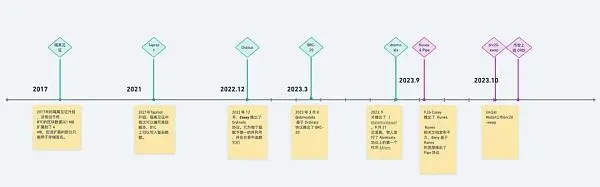
The history of the development of the new BTC protocol Source: Network
In fact, the Bitcoin ecosystem is far more prosperous than you think. In addition to the emerging protocols mentioned above, the technical solutions that have emerged in Bitcoin development so far to improve the scalability and privacy of Bitcoin include Colored Coins, Omni Protocol, Lightning Network, Counterparty, Stamps, Liquid, Stacks, Libre, RGB Protocol, TAP Protocol, and PIPE Protocols, Bitcoin, Bitcoin Rollups, etc.
Different technical solutions are deriving a variety of applications or products.
Taproot Assets : an alternative solution for building “contracts” on Bitcoin*
On October 18, 2023, Lightning Labs released the alpha version of the Taproot Assets mainnet, which attracted the attention of many blockchain participants.
Taproot Assets is a technology protocol that integrates directly with the Lightning Network and enables the creation of cryptocurrency and NFT-like assets.
As we all know, Bitcoin is designed so that it can’t run smart contracts in its entirety, but it can still implement certain programming capabilities, such as writing “simple code” into a script at the Taproot address (i.e., P2TR), and then executing this code as a conditional instruction for UTXO.
In the asset issuance scenario of Taproot Assets, the above “simple code” can be specified as the issuance rules of a certain type of token asset, and at the same time, a set of multisig addresses can be accessed, and the two parties can jointly trigger this “simple code”, that is, the party that generates the multisig address and the party who multisig the address can become the issuer of the token asset.
Therefore, the Taproot Asset mainnet also implements peer-to-many trading scenarios, which can realize the forwarding of assets to multiple account addresses within a trading channel - this is the biggest difference between the Taproot Asset mainnet and the traditional Lightning Labs, because the traditional Lightning Network only supports peer-to-peer trading scenarios.
However, in order to issue assets on the Taproot Assets mainnet, due to the multisig system and the fact that Bitcoin is not used as a layer of data validity, it may bring a relatively high engineering threshold and issuance cost compared to the issuance of inscription assets using the Ordinals protocol or related standards.
However, some industry insiders believe that the Lightning Network has the advantage of conducting high-frequency trading, and may be able to realize popular stable Coin scenarios such as circulating USDT on Bitcoin through the Taproot Assets mainnet.

Taproot Assets, BRC-20 based on Ordinals protocol, ARC-20 based on Atomicals protocol Comparison Source: Network
2024 is just around the corner, and Bitcoin is about to enter the next halving cycle, and while it is impossible to predict exactly when the halving will occur, there are many emerging protocols or trading models for Bitcoin whenever the new halving cycle approaches.
When we look at these innovative models, we can see that seeking future value for Bitcoin, ensuring the liquidity of assets and the interests of developers has always been a long-term issue. In the process of exploring these issues, how to get more participants into Bitcoin is a prerequisite for the ecosystem to finally build and maintain continuous innovation - and to achieve this, it is not only necessary to attract value, but also to lower the barrier to asset acquisition.


