Aptos is ready to go.
Written by Peter Horton, Messari
Compiled by: Aptos Global
TLDR
-
Aptos is a Layer 1 blockchain designed around the core principles of scalability, security, reliability and upgradeability. It was born out of Meta’s Diem and Novi projects and will be launched in October 2022.
-
Aptos’ technology stack has many novel aspects, including the AptosBFTv4 consensus mechanism, Quorum Store mempool protocol, Block-STM parallel execution engine, and programming language Aptos Move.
-
Since July 2023, Aptos has averaged more than 475,000 daily transactions and more than 72,000 daily active addresses. One-day public art creation events on the social media platform Chingari, the oracle Pyth and Graffio have promoted on-chain transactions Activity.
-
Aptos Labs and Aptos Foundation have established partnerships with many well-known companies and enterprise groups, including Microsoft, Alibaba Cloud, NPIXEL, Rakuten Group, Coinbase Pay, etc., with many growth plans focused on the Asia-Pacific region.
The modularity vs. integration debate has been widely discussed, and all in all, both sides are heading towards similar ends: modular chains are initially optimized for verifiability and decentralization, while integrated chains are optimized for low latency and high throughput. .
Aptos is one of the biggest players in the integration camp, with development team Aptos Labs having raised about $400 million in total funding. Since going online in October 2022, the network has been upgraded rapidly, with more than 40 AIPs and 8 major versions released. The Aptos ecosystem is relatively young, but already has projects such as an on-chain order book, a perp DEX, and a social media platform. In a recent mainnet-like test environment, Aptos verifiably reached a peak of 30,000 TPS, with more than 2 billion transactions a day. If it can continue to upgrade its technology and attract developers and users, Aptos is ready to go.
background
Aptos was born out of Meta’s Diem and Novi projects. In 2019, Meta (then known as Facebook) officially announced the upcoming launch of a blockchain-based payments network, a project consisting of the permissioned Diem blockchain (originally known as Libra) and the Novi wallet (originally known as Calibra). Development was led by independent consortium Diem Association and Facebook subsidiary Novi Financial, but Diem and Novi were never launched due to regulatory resistance. Diem was shut down in January 2022 and sold its assets to Silvergate Capital, and in September 2022, Meta announced the closure of Novi.
Aptos Labs was established in December 2021 and officially launched in February 2022. Aptos Labs was co-founded by Mo Shaikh, head of strategic partnerships at Novi, who previously led strategy at Consensys and founded part of the blockchain-based real estate platform Meridio, and Avery Ching, a software engineer with a background in supercomputing. The remaining founding team consists of PhDs, researchers, engineers, designers and strategists, many of whom have also worked at Diem or Novi.
In March 2022, Aptos Labs announced it had raised $200 million and launched its public development network and open source code base. The financing, which includes equity and token options, was led by a16z, with participation from Multicoin Capital, ParaFi Capital, Coinbase Ventures and many other investors. In July 2022, Aptos Labs announced a subsequent funding round of $150 million, reportedly valued at $2 billion, led by FTX Ventures and Jump Crypto. FTX Ventures also participated in the first round of funding; its investment is currently controlled by FTX’s bankruptcy proceedings. Further strategic investments from Binance Labs and Dragonfly Capital bring total funding to approximately $400 million.
After Aptos Labs released the Aptos white paper in August 2022, the mainnet network was launched in October 2022. Since the launch of the main network, the Aptos network has completed multiple upgrades. The current version is V1.8.0. The Aptos Foundation leads the development of the Aptos ecosystem.
technology
The Aptos technology stack is designed around the core principles of scalability, security, reliability, and upgradability, which brings novel mechanisms to many aspects of the stack.
Consensus
Aptos is Delegated Proof of Stake (DPoS) layer 1 using the AptosBFTv4 consensus protocol.
BFT Apartments
AptosBFT (originally called DiemBFT) went through four iterations during Diem before being adopted by the Aptos blockchain. The first AptosBFT was based on HotStuff, which itself was based on the traditional Practical BFT (pBFT) protocol. Aptos’ current implementation, AptosBFTv4, is now based on Jolteon, which improves HotStuff latency by 50% via pBFT-style quadratic view changes.
Additionally, to reduce latency caused by false leaders, AptosBFT selects leaders based not only on staking, but also on performance (collectively, “reputation”). Validator performance measures their success as a leader (how often they submit proposals) and as a non-leader (how often they vote on proposals).
Aptos throughput has been further improved with the implementation of Quorum Store in the Aptos V1.5 upgrade completed on July 18, 2023. Quorum Store is an implementation of the memory pool protocol Narwhal. Quorum Store improves consensus by separating data dissemination from consensus. Decoupling data dissemination from consensus is a key finding of the Narwhal and Tusk paper co-authored by researchers at Aptos Labs and Mysten Labs.
Before Quorum Store, transaction processing included the memory pool and consensus phases:
-
Mempool phase: All transactions will be broadcast to all validators.
-
Consensus phase: The leader broadcasts all transactions in the block it creates to all validators, and non-leaders vote on the block by sending signed block metadata.
This results in two bottlenecks:
-
Repeated transaction propagation: All transactions will be propagated to all verification nodes twice in the memory pool and consensus stages.
-
Uneven distribution of work: During the consensus phase, the leader does more work than the non-leader because it has to send the original transaction with the signed block metadata (a relatively small message). Therefore, the total bandwidth is capped by the leader’s bandwidth, and the bandwidth of non-leaders is underutilized.
Quorum Store adds an intermediate stage between the mempool and the consensus protocol. The complete process now is:
Mempool phase: Transactions are no longer broadcast to validators, but sent to the Quorum Store;
**Quorum Store phase: **Quorum Store protocol receives transactions from the memory pool and sorts them in batches according to the Gas fee. Quorum Store broadcasts these batches to the validator. After receiving the batch, the validator sorts the batch Sign it and send it to other validators. Once the batch receives signatures from more than ⅔ validators, the Quorum Store creates an availability certificate, guaranteeing the uniqueness and availability of the batch.
Consensus Phase: The consensus protocol is the same, except now the leader creates a block using certified batches from the Quorum Store instead of raw transactions from the mempool.
This solves the above two bottlenecks:
Repeated transaction propagation: The original transaction is only propagated once (from mempool to Quorum Store), and then only in batches, reducing the amount of data in the message.
Uneven distribution of work: During the consensus phase, the leader only needs to send the batch metadata (and the corresponding PoAv), which is much less work than before and more equal to the workload of non-leaders. In addition, all validating nodes All work equally during the quorum storage phase.
In testing, Quorum Store increased the TPS limit by 12x in the consensus-only test and 3x in the end-to-end test. However, leader-based protocols like AptosBFT cannot realize the full advantages of Quorum Store, therefore, Aptos Labs is exploring upgrading to a DAG-based consensus protocol, more details can be found in the roadmap section.
DPoS
Validators are compensated through inflationary staking rewards, and currently, all transaction fees are burned. Staking rewards are weighted based on the reputation of the validator (staking and performance), rewards are distributed and automatically compounded every epoch, lasting two hours, and staked tokens are locked on a global 30-day cycle.
Each validator will set a commission rate and pass the remaining percentage of tokens to its delegators. Delegated staking within the protocol will be implemented on the mainnet on April 20, 2023. Delegators need at least 11 APT to participate. This makes more people in the community eligible to participate in staking, as the minimum stake to participate as a validator is 1 million APT ($10.5 million as of December 26, 2023).
The maximum APT pledge amount of a validator is 50 million, accounting for about 5% of the total supply. This is not a very strict upper limit. However, if a validator operator acquires enough stake, it will be incentivized to launch multiple validator nodes, and it is worth noting that locked tokens can be staked and receive liquidity rewards (after a global 30-day unlocking period).
There are currently no penalties for offline or malicious validators, but such mechanisms could be added through governance in the future.
implement
Once validators agree on the block order, they need to execute the transactions in the block and save the results to storage. Many blockchains have a sequential transaction engine, where transactions are ordered and executed one by one. To speed up execution, Aptos uses a parallel execution engine. Furthermore, what differentiates Aptos from other networks with parallel processing of transactions, such as Solana and Sui, is that it does not require upfront knowledge of user-declared dependencies.
To do this, Aptos uses Block-STM, which is built on the principles of Software Transaction Memory (STM) and Optimistic Concurrency Control (OCC). STM libraries with OCC follow a general framework where transactions are executed optimistically (i.e. assuming no dependencies), verified after execution, aborted if dependencies are present, and finally re-executed. However, this approach is rarely used in practice due to limited performance due to managing dependencies and cascading aborts.
To be suitable for deployment and overcome these limitations of OCC STM systems, Block-STM utilizes preset transaction sequences to estimate dependencies and thus reduce the number of aborts. One of the key findings of Bohm’s (2014) research paper is the observation that preset transaction sequences can be a blessing rather than a curse. Block-STM makes more use of preset sequences than Bohm, improving the dependency estimate for each abort in the system (thus, reducing the chance of further aborts).
Block-STM also improves upon general STM by leveraging various aspects of blockchain, including:
-
VM security: Move VM (Move will be described in detail below) ensures that uncommitted status does not negatively impact other ongoing transactions by catching errors and charging Gas fees;
-
Block granularity: Garbage collection is simple because it can happen between blocks. Although Block-STM originally just tracked block commitments to reduce synchronization costs, Aptos Labs has since improved the algorithm and now supports rolling commits within blocks. , without sacrificing performance;
Before walking through each step of Block-STM, it will be helpful to first define a term that has already been mentioned: dependencies. Blockchain transactions consist of smart contract code that reads and writes shared memory. When executed, each transaction has a list of these read and write locations, called a read set and a write set. If Mo’s transaction reads from the location in shared memory written first by Avery’s transaction, then Mo’s transaction depends on Avery’s transaction. Transactions with dependencies must be executed in order. In this case, Avery executes first, then Mo execute.
**In this way, we can gain an in-depth understanding of the step-by-step process of Block-STM, divided into five main stages: **
1. Transaction default sorting
From the previous consensus phase, there are blocks containing transactions in order. As mentioned above, this preset order is a key advantage of Block-STM, and the parallel execution results must produce the same set of reads and writes as the sequential execution results.
2. Optimistic execution
Block-STM optimistically executes transactions in parallel. In other words, it executes transactions assuming no dependencies.
3. Verification
The executed transaction is then verified, i.e. the dependencies are checked, this is done by re-reading the read set of the transaction and comparing it with the latest executed read set, if the two read sets are not equal, the transaction will be aborted.
A key part of Block-STM is the continuous scheduling of execution and verification tasks in an efficient manner, specifically:
Prioritize older tasks in a preset order.
Send a batch of verifications to detect missed dependencies early to avoid cascading aborts.
Note that verification is much cheaper than execution, so continuous verification (re-reading the read set) is not a major bottleneck.
4. Abort and re-execute
When a transaction is aborted, the ESTIMATE tag is applied to the location where the transaction was written. Then, if a later transaction reads this location, they will see an ESTIMATE tag. After the ESTIMATE tag is read, transaction execution is suspended until a value overwrites the ESTIMATE tag. This occurs once the original, aborted transaction is successfully re-executed. Whenever a transaction is re-executed, the schedule guarantees that any transactions higher in the preset sequence and dependent on that sequence will be revalidated.
This dynamic dependency management is a key concept of Block-STM. Without the ESTIMATE tag, the second transaction will be executed and then potentially aborted because it reads from the location where the aborted transaction was written. Therefore, Block-STM avoids a lot of wasted work in executing potentially aborted transactions. In addition, performing dynamic dependency management provides some improvements to the upfront dependency system. First, users do not have to declare dependencies, supporting the atomicity of arbitrarily complex transactions (complex transactions do not need to be decomposed). Second, it only manages dependencies when needed, rather than storing dependencies for all transactions. Finally, most dependencies are based on a newer state than the state at the beginning of the block.
5. Commitment
Once Block-STM detects that the output of the transaction’s optimistic execution is correct, it is submitted through the rolling commit mechanism, which relies on lightweight synchronization to verify and commit each batch of transactions before processing the next batch of transactions.
In testing, Block-STM achieved up to 170,000 TPS using 32 threads on the Aptos benchmark. This is a 17x improvement over sequential execution.
6.Storage
When a block is committed, its data is persisted in the storage layer. Although submissions are done in blocks, each individual transaction is stored separately in a Merkle tree after execution. Everything that happens on the blockchain (including transactions, state changes) can be calculated according to what is called the “root hash”. The digest is cryptographically proven, and the digest is signed by the current validating node for authentication. This approach differs from other blockchains, which require a traceable blockchain to verify past transactions, allowing for more fine-grained provable data access.
To handle large amounts of data, Aptos uses two types of Merkle trees: Jellyfish Merkle trees for storing data on disk and in-memory sparse Merkle trees for fast updates. These trees are optimized to store data efficiently and allow concurrent updates. Aptos Labs is exploring several further avenues for scaling storage, specifically storage sharding detailed in the roadmap section.
7.Move
Move is a bytecode language inspired by Rust, created by the Diem and Novi teams. Move provides enhanced flexibility and security over Solidity and other Web3 programming languages.
Move consists of two types of programs: transaction scripts and modules. Transaction scripts are atomic and can only be used once, while modules are published in global state and retained indefinitely.
Modules are similar to smart contracts in other programming languages, they define resources and their associated processes. A resource is like an object and processes are the operations that can be performed on it, such as creating, modifying, or deleting. Resources are designed to represent scarce assets such as tokens, and they have built-in protection features that help these assets avoid being mistakenly copied or discarded.
Modules enforce data abstraction, where types are transparent within their declaring module and opaque outside of them. In other words, only the original module can create, destroy or update values. External access to module data is limited to public procedures exposed by the module. These guarantees are enforced at execution time by Move’s bytecode validator, which all modules and transaction scripts must pass before they can be executed by the Move VM. This data abstraction is done more explicitly in Move than in Solidity/EVM, which has encapsulation but less strict enforcement.
Move aims to eliminate attack vectors present in Solidity and the EVM, particularly those arising from the lack of first-class assets outside of ETH and re-entrancy attacks.
First-Class Assets: ERC-20 and other assets on EVM do not have the same built-in scarcity and access control properties as Ether. Solidity developers need to implement these protections manually to avoid introducing bugs that lead to duplication, reuse, or loss of assets. In contrast, all assets on Move (not just native assets) are considered first-class assets with these protections.
Reentrancy attack: Unlike EVM, Move does not have unsafe dynamic scheduling. Through unsafe dynamic scheduling, the virtual machine does not know what operations the external contract function is performing before the contract is run. Dynamic scheduling leads to reentrancy attacks, which is one of the most common sources of blockchain hacking, including the recent Curve/Vyper vulnerability. In a reentrancy attack, a contract calls an external contract, which calls back to the original contract before the original contract has completed execution and updated the balance, which may result in repeated depletion of funds.
The purpose of Move is to make it harder for developers to make mistakes.
In addition to bytecode verifiers, developers can also leverage the formal verification tool Move Prover. Of course, Move does not eliminate the possibility of smart contract vulnerabilities. Programmers still need to establish appropriate safety invariants within their modules. Furthermore, Bytecode Verifier and Move Prover do not replace the need for auditing. Auditing firm CertiK observed examples of developers either not using Move’s built-in protection mechanisms or adopting programming patterns that may have been ported from legacy code designs that ran counter to Move’s design philosophy.
8.Other main features
User Guarantee
Aptos includes several features that improve user experience and security, including flexible key management, transaction result transparency, and light client support.
Aptos accounts decouple private keys from public keys, allowing for flexible key management. Users can rotate their account’s private keys to preempt or respond to a compromise without having to transfer all assets to a new account. Users can also set up their accounts to be multi-signed, with each public key having different permissions. For example, a user can create an account with two hot public keys that can sign transactions, and a cold public key that can sign transactions but also rotate the private key. The user can then specify that 2/3 of the account keys are required to sign the transaction.
To help prevent phishing attacks and generally increase transparency, wallets can use transaction pre-execution to interpret transaction results in a readable format before the user signs it.
Aptos also adds transaction protection by adding an expiration time and a sequence number to the transaction. The sequence number functions like a random number on the EVM and helps prevent replay attacks.
Light clients allow people to easily verify blockchain state simply by downloading block headers, which minimizes trust assumptions when accessing blockchain data. Doing so is ideal for high-performance nodes like Aptos, which have higher node hardware requirements. Blockchain is particularly important.
Upgradeability
Source: Messari
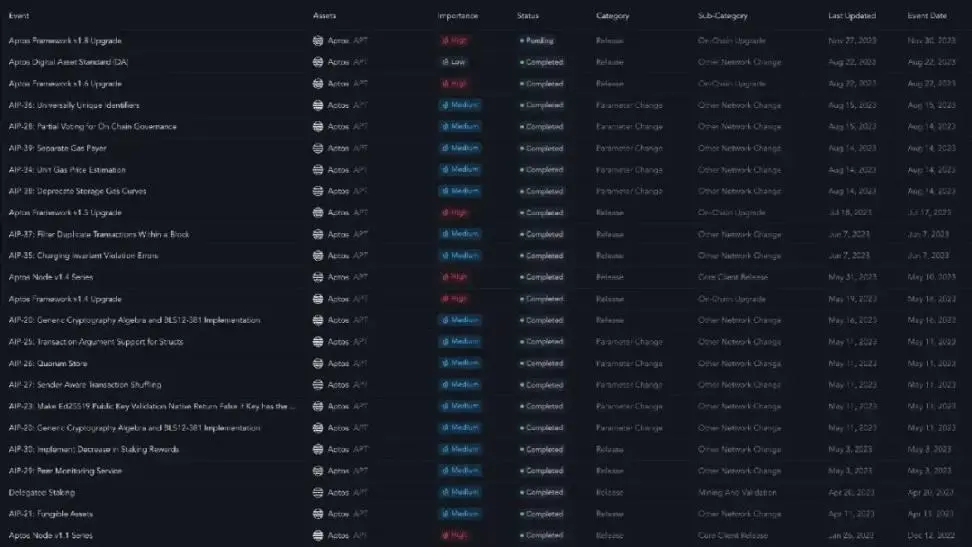
Aptos is defined to support frequent protocol upgrades. This is largely due to the fact that validator management happens on-chain, allowing validators to easily sync to new upgrades. Parts of Aptos itself are also written in Move, which, as mentioned above, reduces time to market. Since its launch, some 46 improvement suggestions have been implemented.
Token Economics
Overview
Aptos’ native token APT is used for security and Sybil resistance (validator and delegator staking), resource consumption (transaction fees), and on-chain governance. Initially, 1 billion APTs were allocated into several buckets with different locks. APT has no fixed supply, the current annual growth rate is 6.895%, and all transaction fees are currently burned.
Initial Allocation
As mentioned before, 1 billion tokens have been distributed at creation. Additionally, 13% are unlocked at genesis and the remainder are subject to a vesting schedule. The distribution is as follows:
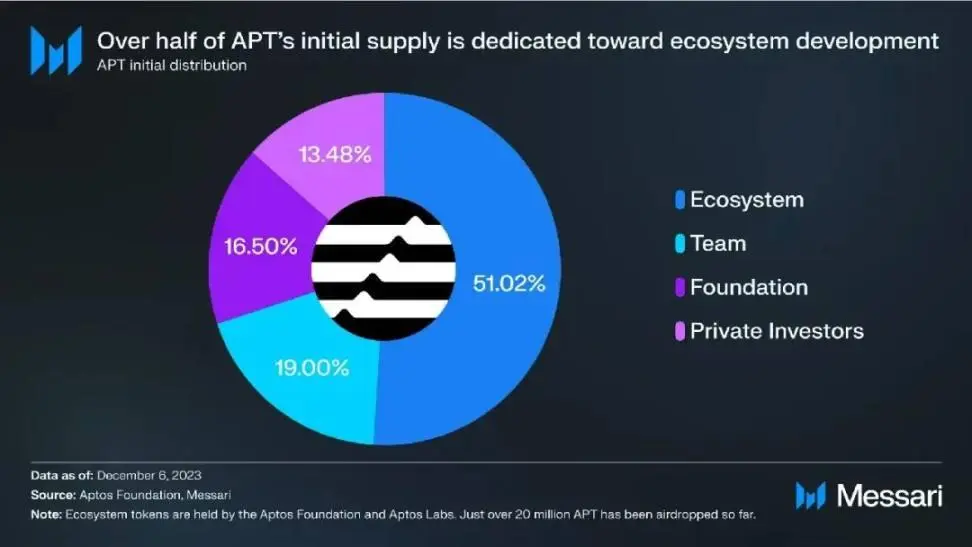
Ecosystem (51.02% of total initial supply): The largest portion of APT’s initial allocation is used for ecosystem development, with about a quarter of these tokens unlocked at genesis and the remainder over the next 10 Unlocked linearly on a monthly basis during the year. Prior to the distribution, approximately 80% of these tokens were held by the Aptos Foundation, with the remainder held by Aptos Labs. The genesis APT airdrop distributed over 20 million tokens from the ecosystem bucket to over 110,000 participants.
Team (19% of initial total supply): These tokens are allocated to Aptos Labs and adhere to the following four-year vesting schedule: one year locked, 6.25% unlocked monthly for the next 6 months, and 6.25% unlocked monthly for the next 30 months Unlock 2.083% every month. Please note that if Aptos Labs employees join after Genesis, they will still be subject to the same four-year schedule.
Foundation (16.5% of total initial supply): These tokens are allocated to the Aptos Foundation, with 3% (5 million tokens) available at genesis and the remaining tokens following the same four-year vesting schedule as team tokens . The foundation plans to use the tokens to host events, fund legal support and sponsor research, and will, among other plans, cover operational costs to help validate node operators and further validate the geographical distribution of nodes.
Private Investors (13.48% of initial token supply): These tokens are allocated to investors who choose to purchase tokens in Aptos Labs’ private financing round and are subject to the same four-year vesting period as team and foundation tokens surface.
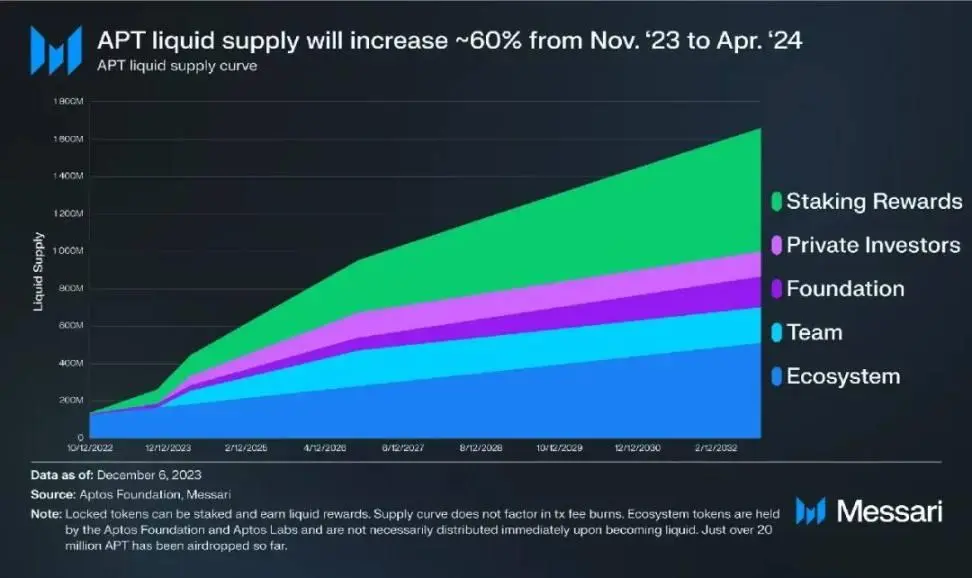
As mentioned above, APT is inflationary and will continue to provide rewards to stakers. The annual inflation rate is set at 7% in the first year after creation, and then decreases by 1.5% each year (i.e., 6.895% in the second year) until it stabilizes at 3.25%. Please note that this rate is based on an initial total supply of 1 billion APT and is subject to governance.
The largest increase in APT liquidity supply will occur during the six-month unlock period from mid-November 2023 to mid-April 2024. Unlocking of the team and private investor portion begins during this period, during which the initial allocated liquid token supply (i.e. excluding staking rewards) will increase from 209 million to 334 million, an increase of approximately 60%.
Network Activity
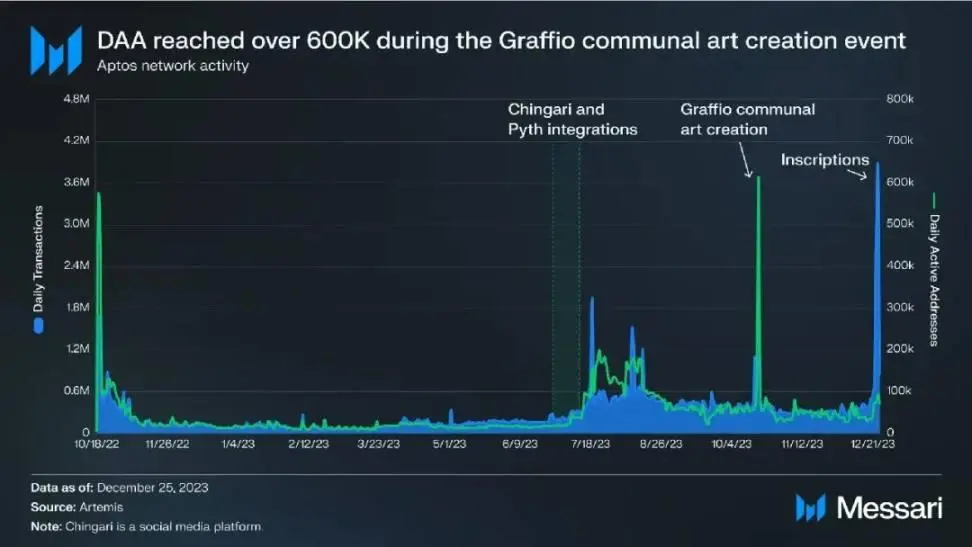
After the launch of the Aptos mainnet, network usage declined and then rebounded in July 2023. Since then, Aptos has averaged over 475,000 daily transactions and over 72,000 daily active addresses. Several factors have contributed to the rise in usage, including the integration of social media platform Chingari and Oracle Python.
Chingari is a video-sharing mobile app similar to TikTok that has been downloaded over 100 million times on the Google Play Store. It was originally launched in 2018 as a Web2 platform and later added on-chain features such as virtual gifts.
Pyth integrated with Aptos on July 13, providing access to its low-latency price feed. Since July 13, Python has accounted for approximately 17.7% of Aptos’ total trading volume. Note that this kind of sharing is not uncommon for the network where Python is located.
On October 19, driven by Graffio’s public art creation activities, the number of daily active addresses exceeded 600,000. To celebrate the network’s first anniversary, Aptos contributors invited community members to paint on a public digital canvas over a 24-hour period, with each individual drawing being registered as an on-chain transaction. Participants then received an NFT version of the final canvas. The campaign resulted in 605,000 unique addresses and 1.3 million transactions.
The increased activity brought about by Graffio caused a network outage and block production ceased on October 18. The incident was resolved in approximately 5 hours. The Aptos Foundation shared a post-mortem on October 20 that the root cause was determined to be non-deterministic code stemming from performance-focused code changes made to the Aptos core codebase on August 22, 2023.
Recently, transaction activity has been driven by inscriptions, a common trend on many blockchains. NFT market BlueMove launched the APT20 standard in mid-December, and from December 23 to 24, the transaction volume totaled 6.8 million.
Security and Decentralization
As of December 26, 2023, the Aptos network has 123 active validators from 27 countries and 54 cities. The number of validator nodes has gradually increased since the launch of the network, which supported approximately 100 validator nodes at that time, and the validator network currently has a Nakamoto coefficient of 18, which is higher than the median of other networks. Since the Aptos Foundation holds a majority of the total supply between its own allocation and tokens held on behalf of the ecosystem allocation, it can help distribute stakes fairly equally among validators.
The number of pledged APTs is 907 million (worth US$9.8 billion as of December 26, 2023), accounting for 84.6% of the total APT supply. As mentioned above, locked tokens can be staked and receive liquid rewards. 296% of the token is staked relative to its circulating supply. On October 5, Coinbase Cloud enabled APT delegation to its validators and added APT staking on Coinbase Prime.
ecosystem
Decentralized Finance
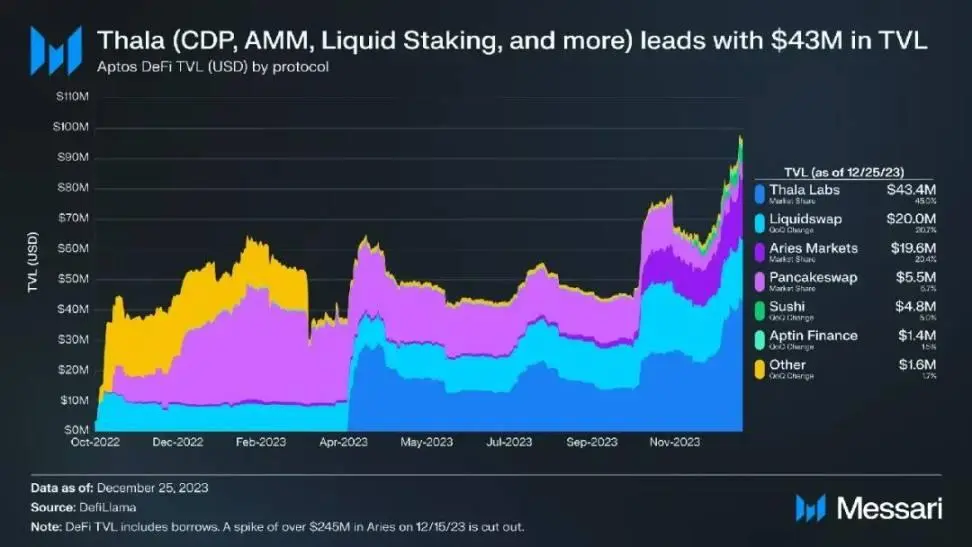
Just over a year after its launch, the Aptos DeFi protocol has accumulated nearly $127 million in TVL through more than 32 protocols, with Aptos ranking 26th among all networks in TVL. Aptos’ DeFi TVL mainly comes from five protocols: Thala Labs, Liquidswap, Aries Markets, PancakeSwap and SushiSwap.
Thala leads the Aptos protocol in TVL with 45% market share. Thala has a suite of DeFi products including CDP, AMM, Liquid Staking Protocol and Token Launchpad. Thala is also currently developing the governance tool Parliament. It raised $6 million in a seed round in Q4’22 and launched its governance token THL at the end of March, followed by mainnet launch shortly after. Its CDP mints Move Dollar (MOD), and as of December 26, 2023, there were 8.3 million tokens in circulation. MOD and THL are both full-chain fungible tokens (OFT). OFT is a multi-chain token standard created by LayerZero Labs that is interoperable with cross-chain interchangeable token standards. Most of MOD’s over-collateralization support is based on LayerZero and Wormhole-based USDC.
At the end of the third quarter, Thala announced that it would cooperate with the Aptos Foundation to establish the DeFi incubator Thala Foundry. The Foundry has $1 million in initial funding and will allocate $50,000 to $250,000 of funding to Aptos DeFi projects, as well as other developer and business development support.
LiquidSwap is one of the first AMMs to be launched on Aptos and is developed by the Pontem Network, which also built the Pontem wallet for Aptos. It has a TVL of US$20 million and a market share of 21%.
Aries Market is a lending and margin trading protocol. It launched shortly after the Aptos mainnet launch, but its TVL has grown significantly recently, jumping from less than $2 million to over $11 million in October 2023. December’s growth brings Aries’ TVL to nearly $20 million, with a market share of 20%. At the end of November, Aries launched a trading product powered by Econia.
Econia is an on-chain order book engine that was initially formed during the inaugural Aptos Hackathon in 2021 and launched at the end of November. Earlier this year, the company raised $6.5 million in seed funding in a deal led by Dragonfly. In addition to Aries, Econia’s infrastructure currently powers trading on Kana Trade, Gator Trade (developed by Pontem), SwapGPT and Hippo Labs.
BNB Chain’s top DeFi protocol PancakeSwap is listed on Aptos as AMM. From the end of 2022 to mid-July 2023, PancakeSwap is Aptos’ top TVL protocol. Now it ranks fourth, with 6% market share.
At the end of November, SushiSwap launched V2 AMM on Aptos, making Aptos the first non-EVM supported by SushiSwap. To date, SushiSwap has garnered nearly $5 million in TVL, occupying 5% of the market share.
Without staking, the value of the APT token will be diluted by approximately 7% with inflation, so the liquidity staking protocol is crucial to continue to grow Aptos’ DeFi ecosystem. In late October, the liquid staking protocol Amnis Finance was launched. It is now Aptos’ leading TVL liquidity staking protocol with nearly $33 million in TVL, ahead of Thala’s liquidity staking protocol with $23 million. To incentivize growth, Amnis has launched a points program that will be used to airdrop upcoming tokens.
Additional projects and integrations include:
- Merkle Trade: Merkle Trade is a permanent DEX launched at the end of October. Since its launch, Merkle Trade’s total trading volume has exceeded $277 million.
- Oasis Pro: Oasis Pro’s FINRA registered marketplace was integrated with Aptos in mid-November.
Social Protocol
As mentioned above, Chingari is one of the most popular applications on Aptos for trading and active addresses. Other social apps that are running or about to launch include TowneSquare and Overmind.
TowneSquare opens its waitlist in August 2023. It is building a mobile app that integrates with on-chain activity and identity systems to support use cases such as on-chain social feeds, ticketing, whitelisting, co-marketing, and more.
Overmind is a platform that features tasks first, where developers can participate in coding challenges and bounties to earn rewards and on-chain credentials. Overmind has partnered with the Aptos Foundation to award approximately $50,000 to developers through its mission. In mid-October, it opened early access to its open source, decentralized social network, and soon after launched “Race to Keys” to incentivize developers to build friend.tech-style Keys functionality.
Gamefi
Chain games have always been another core focus of Aptos Labs and Foundation related to consumers. At the end of February, Aptos Labs released a game SDK for development on Unity, one of the most popular game engines. It is also developing a module for verifiable on-chain randomness, an important aspect for games and other applications. AIP-41 proposes the creation of a new Move module that will allow developers to easily add on-chain randomness to their smart contracts. Once implemented, there are plans to host a hackathon dedicated to building on-chain randomness.
Towards the end of October, the arcade-style shooting game Aptos Arena was launched, with first-week bonuses exceeding $10,000. It attracted more than 12,000 addresses in its first weekend and is being updated to address player feedback.
**Aptos Labs and the Aptos Foundation have established partnerships with several well-known gaming companies and conglomerates, including: **
- NPIXEL: NPIXEL is a Korean 3A game studio. It partnered with Aptos Labs in Q4’22 to bring its METAPIXEL gaming world to the web. In Q3’23, it concluded the second playtest of its upcoming game Gran Saga Unlimited.
*NEOWIZ: NEOWIZ is a Korean game developer and publisher. The Aptos Foundation partnered with NEOWIZ and its Web3 subsidiary Intella X in mid-August.
- MARBLEX: MARBLEX is the Web3 subsidiary of Netmarble, South Korea’s largest mobile gaming company. It partnered with the Aptos Foundation at the end of August to develop the MARBLEX WARP Bridge and integrate its multi-chain gaming world with Aptos. The Bridge connects Aptos to MARBLEX’s existing ecosystem, including its MBX token and in-game NFTs.
- Lotte Group: Lotte Group is one of the largest retail groups in South Korea. At the end of August, it cooperated with the Aptos Foundation to introduce the Bellyland universe of subsidiary Daehong Communication to Aptos.
- Readygg: Readygg is an infrastructure company designed to bring Web2 gamers to Web3, working with Web2 game publishers to help them integrate their games with Web3. As a result of the efforts, four publishers (Minijegos, ToroFun, CimuGames and Aeria Canada) plan to integrate with Aptos by the end of this year.
- BlockGames: BlockGames is building a cross-chain, cross-game network of games and players. It recently announced plans to integrate Aptos.
*GuardianLink: Aptos Labs has partnered with GuardianLink to integrate its Jump.trade NFT marketplace, providing access to Meta Cricket League NFT games.
While many games are still in development, some are already online. Towards the end of October, the arcade-style shooting game Aptos Arena was launched, with first-week bonuses exceeding $10,000. It attracted more than 12,000 addresses in its first weekend and is working on an update to address feedback from initial playthroughs.
NFT
Since launch, NFT trading volume has been approximately $19.4 million, with the majority of activity occurring shortly after launch. More than 74% of the transaction volume is generated through the marketplace Topaz. Since Wapal was launched on August 1, Wapal has accounted for 15% of the sales volume, while Topaz has accounted for 50%. Wapal is an NFT market for “professional traders”, similar to Blur and Tensor, using a points system to incentivize activities, and the points will be used for airdrops. Wapal recently launched a no-code NFT launchpad.
Inscription has brought about an increase in the number of NFTs. Since the launch of the APT20 standard on December 10, BlueMove has captured 41% of the NFT trading volume market share, with a total trading volume of $674,000.
NFTs on Aptos have also been used in multiple real-life use cases. KYD Labs is a Web3 ticketing company that provides ticketing services for multiple live events, including the music festival WonderBus and South Korea’s Blockchain Week closing event SEOULBOUND. Aptos Labs has partnered twice with NBCUniversal to launch digital fan experiences for the films “Renfield” and “The Exorcist: Believer.” In early November, the Aptos Foundation has partnered with South Korean amusement park and media group Seoul Land, and Seoul Land’s digital subsidiary RXMeta will launch Bloom, a new festival experience powered by NFT ticketing and Aptos membership.
Towards the end of August, Aptos Labs launched the Aptos Digital Asset Standard (DA). DA pays special attention to NFTs. Its functions include dynamic NFTs, soul-bound tokens, reduced Gas costs, the ability of NFTs to own other NFTs, simplified airdrop support, etc. .
route map
Technical Improvement
As mentioned above, Aptos is designed to support frequent upgrades, and to test and highlight the multiple upgrades underway, Aptos Labs recently released findings from Previewnet, a testing environment designed to mirror the Aptos mainnet. From November 6 to 21, the environment sustained more than 9 billion transactions, 2 billion of which occurred in a 24-hour period. The peak number of peer-to-peer transactions per second reached 30,000, and more than 1 million limited collection NFTs were minted within 90 seconds.
One of the major upgrades to unlock higher performance is storage sharding, where the state store is divided into multiple RocksDB instances. Storage sharding is planned to be launched on the mainnet in 2024. There are also improvements to the execution engine, state synchronization algorithm, and network stack.
Improved NFT minting performance comes from a new solution called aggregators. Due to their sequential naming (such as “Cryptopunk #4317”), limited-supply NFT minting has traditionally required sequential execution. Aggregators are a novel, conflict-free counter mechanism that essentially performs limited-supply NFT minting in parallel.
Aptos Labs’ next goal is 100,000 TPS, moving towards more than 1 million TPS. In addition to the improvements being tested in Previewnet, another major upgrade in development is the new consensus mechanism Shoal. Shoal combines DAG and BFT qualities to reduce latency and increase throughput.
Finally, Aptos Labs is developing the new Aptos Move compiler, bringing a new set of language features designed to simplify the coding process and expand functionality. These include receiver-style function calls, first-class higher-order functions, and user-defined functions, with Aptos Labs expecting to implement most of the new features in the first half of 2024.
Growth Strategy
To grow the Aptos ecosystem, the Aptos Foundation holds hackathons and launches grant programs. Aptos Labs and the Aptos Foundation also have many partnerships. In addition to these two entities, there are other groups spearheading growth activities, such as India-based developer community Move Developers DAO (MDD).
In addition to the partnerships mentioned in the ecosystem section, major partnerships have been established with:
*Microsoft: In early August, Aptos Labs announced a partnership with Microsoft. The partnership will bring Microsoft Azure AI capabilities to Aptos, starting with Aptos Assistant, a chatbot designed to help users and developers use Aptos. GitHub’s Copilot feature will also support Aptos Move.
- Google Cloud: Aptos Labs has partnered with Google Cloud on several programs and integrations, including Google Cloud running the Aptos validator and indexing Aptos data for BigQuery, an accelerator program offering APT and Google Cloud credits, and co-hosted hackathons and other activities.
- Alibaba Cloud: At the end of November, the Aptos Foundation cooperated with Alibaba Cloud to develop the Web3 developer community in the Asia-Pacific region. The partnership includes the Aptos Foundation serving as the main blockchain sponsor of the Alibaba Cloud Singapore Innovation Accelerator Program, collaborating to launch the Move developer community in Asia, and co-hosting a series of hackathons and other events.
- SK Telecom: In early November, Aptos Labs collaborated with SK Telecom and its technology partner Atomrigs Labs to develop a Web3 wallet service called T wallet. Aptos is SK Telecom’s first non-EVM partner.
- Flowcarbon: In mid-September, the Aptos Foundation partnered with Flowcarbon to make Aptos a carbon-negative blockchain. The Aptos Foundation will purchase and reclaim carbon credits tokenized by Flowcarbon.
- Coinbase Pay: In mid-September, Aptos Labs collaborated with Coinbase Pay to integrate Coinbase’s fiat currency entrance into the wallet Petra developed by Aptos Labs. The mobile Petra wallet was launched on Google Play and Apple App Store in June. Integration with hardware wallet Ledger at the end of October.
Hackathon and grant programs include:
- Aptos World Tour Hackathons: In 2023, the Aptos Foundation hosted hackathons in Seoul, the Netherlands, and Singapore, with prizes totaling more than $760,000 in these three hackathons.
- Aptos Grant Program: The Aptos Foundation announced the Aptos Grant Program ahead of the 2022 mainnet launch. In early May 2023, the foundation announced more than $3.5 million in funding to 50 teams and opened a second wave of applications.
- Artist Grant Program: In April 2022, the Aptos Foundation launched a $20 million grant program for artists and creators.
- Registration Agency Grant Program: In mid-July, the Aptos Foundation released the Registration Agency Grant Program. The registry lists a series of project ideas, initially consisting of seven projects, mainly related to gaming and mobile infrastructure. Applications have closed for all seven projects, which are already in development. The foundation plans to add new projects regularly.
- Outlier Ventures Accelerator: In early August, Outlier Ventures announced the launch of Move Accelerator in partnership with the Aptos Foundation. The 12-week project involving eight teams concluded in early October, with a demo day held later that month.
- Move Developers DAO (MDD): MDD has helped host several hackathons and other events, most recently including Indore Blockchain Day, Pune Blockchain Day and REVA HACK.
- ABCDEhighlight: Asia Web3 venture and accelerator studio ABCDEHighlight has partnered with the Aptos Foundation to launch an Asia-specific funding program and increase community engagement.
- Aptos Winter School: The Aptos Foundation will host a two-week accelerator event for student developers in India in late December.
- Galxe Task: In early December, the Aptos Foundation announced a four-week on-chain task event powered by Galxe.
Summarize
Aptos is a Layer-1 blockchain designed around the core principles of scalability, security, reliability and upgradeability. It was born out of Meta’s Diem and Novi projects and will eventually be launched in October 2022. Aptos’ technology stack features many novel aspects, including the AptosBFTv4 consensus mechanism, the Quorum Store mempool protocol, the Block-STM parallel execution engine, and the programming language Aptos Mobile.
Since July 2023, Aptos has averaged more than 475,000 daily transactions and more than 72,000 daily active addresses. The online event was driven by a day of public art creation on social media platforms Chingari, oracle Pyth, Graffio, and inions. Initiatives to grow the ecosystem include partnerships, hackathons, funding programs, and more, many of which are specific to the Asia-Pacific region.


