Author: Shayon Sengupta, Multicoin Capital; Translation: 0xjs@Jinse Caijing
Today, we are excited to announce that Multicoin, led by Geodnet Foundation, has strategically acquired the native token GEOD of Geodnet network for $8 million.
Geodnet is a precise positioning network that utilizes the decentralized physical infrastructure network (DePIN) economic model to provide key mission positioning services for drones, autonomous driving cars, and the tens of millions of robots that may emerge globally in the coming years.
Physical AI is coming soon
In ‘Blade Runner 2049,’ we see a future world where replicants coexist with humans as contributors to the economy and society. By 2025, our robots are far from being human-like, but various specialized machines have quietly integrated into all aspects of modern life.
Language models are making intelligence commoditized, unleashing new creativity, and changing knowledge work. But artificial intelligence is not just about text, images, and videos. The evolution of artificial intelligence is happening in the physical world, and robots are the next frontier.
As artificial intelligence models become increasingly powerful, their ability to understand and interact with the physical environment will be greatly enhanced. This transformation will give rise to new autonomous systems, from self-driving cars and humanoid robots to drones and industrial automation equipment, operating with unprecedented intelligence and autonomy.
To make these robots work properly, they need to answer a basic question: ‘Where am I?’
Positioning: A $5 billion challenge
With the deployment of tens of millions of autonomous and semi-autonomous devices, they all face the same challenge: spatial awareness. Drones performing delivery tasks, autonomous vehicles driving in dense urban environments, and agricultural machinery for precise planting all require sub-centimeter positioning accuracy to operate safely and efficiently.
To achieve this level of accuracy, these systems rely on sensor fusion technology, combining multiple positioning methods.
LiDAR can provide high-resolution depth maps, but it performs poorly in foggy or rainy weather (and it is heavy, power-hungry, and expensive). RADAR can provide reliable distance measurements, but lacks fine precision.
Vision-based SLAM can achieve real-time map drawing, but its performance will decrease in low-visibility environments.
These methods each have their limitations, and no single system is foolproof. In the field of positioning methods, the use of Real-Time Kinematic (RTK) base stations for correction in Global Navigation Satellite Systems (GNSS) positioning is considered one of the most reliable input methods.
Standard GNSS positioning, inherently inaccurate due to atmospheric disturbances and multipath errors, can have deviations of 5-10 meters. RTK solves this issue by using fixed base stations to compare satellite signals with known positions and transmit real-time correction data. This method can achieve centimeter-level accuracy, a key breakthrough for physical AI applications. Most large robotics and automation companies integrate RTK into their systems, such as DJI for high-precision drones, John Deere for autonomous tractors, Tesla for self-driving cars, and Boston Dynamics for industrial inspection robots.
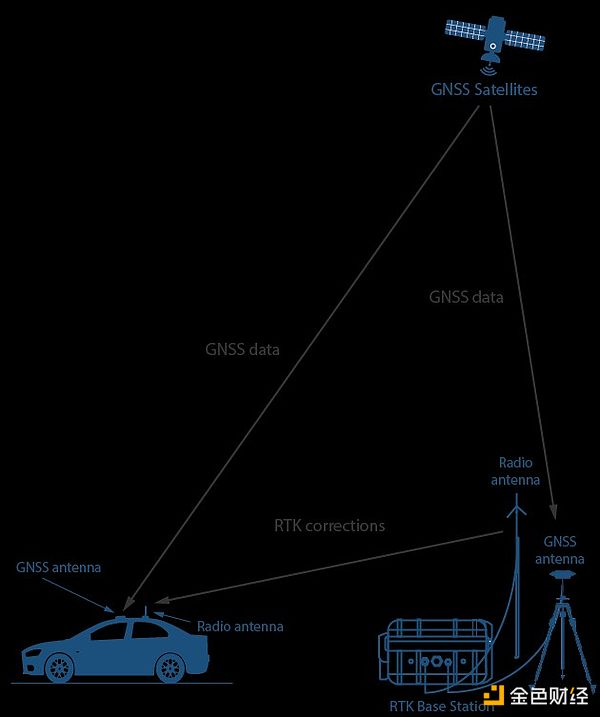
Image source: GNSS Store
One issue with the current RTK is cost. Building and maintaining RTK base stations is capital-intensive, requiring significant investment in hardware, site acquisition, and maintenance. Traditional suppliers such as Trimble, Hexagon, and Topcon establish these stations themselves and charge customers thousands of dollars per tracked device, limiting accessibility and deployment speed. Coverage often focuses on profitable areas, leaving some places without access to high-precision positioning services.
Subverting the Cost Structure through DePIN
We have detailed how DePIN, owned by contributors through token incentives, structurally disrupts the cost structure of global hardware-intensive networks. Geodnet, as the world’s largest precision positioning network, is leveraging these principles to incentivize independent operators to install RTK base stations and provide correction data in exchange for token rewards.
By transferring the cost burden from a single operator to a distributed network, Geodnet is able to deploy production-grade RTK base stations at a small fraction of the cost of traditional suppliers, specifically by eliminating the two biggest costs of building a network: land and labor. Therefore, compared to existing enterprises, Geodnet can expand coverage more quickly, ensure redundancy, and provide more reliable GNSS correction services.
The result is the formation of a global distributed network, which naturally expands while ensuring equal service quality and reducing end-user usage prices.
Geodnet has been actively expanding since last year. The number of network base stations increased from 1400 in November 2022 to 7800 in June 2024, and as of January 2025, it has over 13,000 base stations in 4,377 cities and 142 countries.
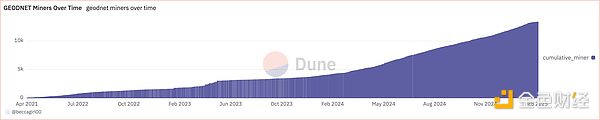
Image source: Dune Analytics
The network has reached a ‘critical scale,’ covering over 60% of the potential GNSS correction market. It is worth noting that the network has achieved this supply with extremely high capital efficiency, with only 11% of the total tokens distributed to contributors in the past three years.
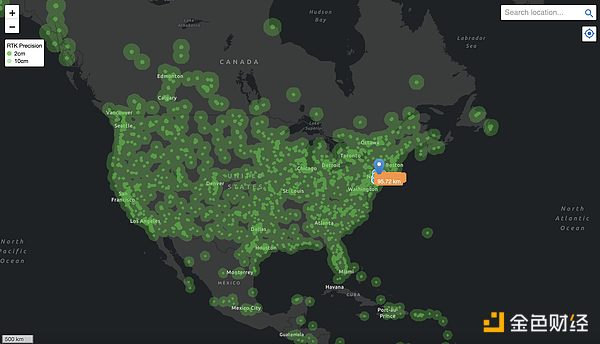
Image source: Geodnet Console
Geodnet is a typical example of the successful application of the DePIN mode in practice, not just theoretically feasible. Geodnet base stations not only have a purchase and deployment cost that is an order of magnitude lower (i.e., $700 consumer-grade devices compared to $12,000 enterprise-grade RTK base stations; denser deployment on consumer-grade networks can achieve coverage comparable to enterprise-grade RTK base stations), but also, due to the elimination of hardware deployment costs, its annual fee is an order of magnitude lower. Undoubtedly, Geodnet is the most scalable and cost-competitive positioning solution in the world today.
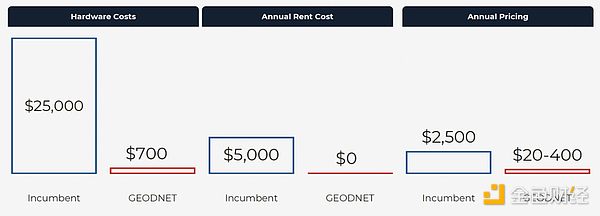
Currently, Geodnet’s annual on-chain revenue is about $3 million, which comes from enterprise service agreements signed with clients such as Propeller, DroneDeploy, Quectel, and the U.S. Department of Agriculture (USDA). In the current DePIN project, Geodnet’s demand-side revenue is growing the fastest.
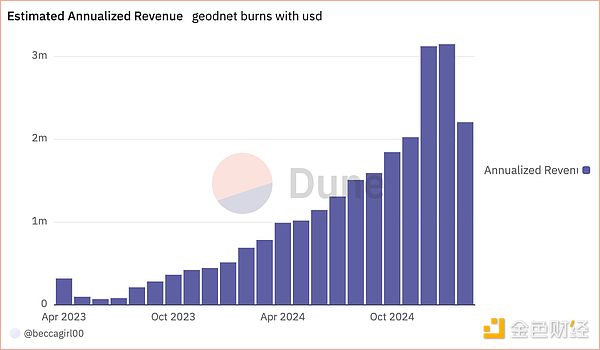
In our early conversations with Geodnet founder Mike Horton, we asked him how he managed to win some of the world’s most renowned customers in the autonomous driving, drone, and agricultural robot industries. His answer was always the same: the core structural cost advantage brought by DePIN.
Turning Point
In the next decade, tens of millions of robots may be deployed in various industries, thereby changing the landscape of logistics, infrastructure, and automation. Drones will conduct real-time inspections of power lines and pipelines. Autonomous vehicles will improve freight and taxi services. Warehouses will reduce reliance on human labor through specialized machines. Human-like robots will emerge to assist with daily household chores.
Without reliable positioning data, these robots cannot operate. Autonomous vehicles driving in dense urban areas where GPS alone cannot work will require RTK-enhanced GNSS. Drones need precise positioning to land accurately at charging stations. We believe that RTK positioning is not only a supplement to other sensor modes such as LiDAR and RADAR, but also essential.
Many robot companies spend millions of dollars each year on purchasing traditional GNSS correction services, which are expensive, have limited coverage, and unstable accuracy. We believe that Geodnet is now offering these customers more cost-effective and higher quality products, and will benefit more customers in the future.
The AI-driven robot craze is not a question of ‘whether it will happen’, but a question of ‘when it will happen’. Where are the robots? They are arriving rapidly. With Geodnet, we will accurately know their locations.


