The regulatory window has opened, and the time left for actors in the market is often limited.
Written by: Iris, Liu Honglin
Since 2024, RWA (Real-World Assets) has become a hot topic in the digitalization of Web3 and traditional finance. From real estate tokens, bills, and supply chain finance to the tokenization of bonds and fund shares, more and more project parties and capital are beginning to seek compliant channels for implementation globally.
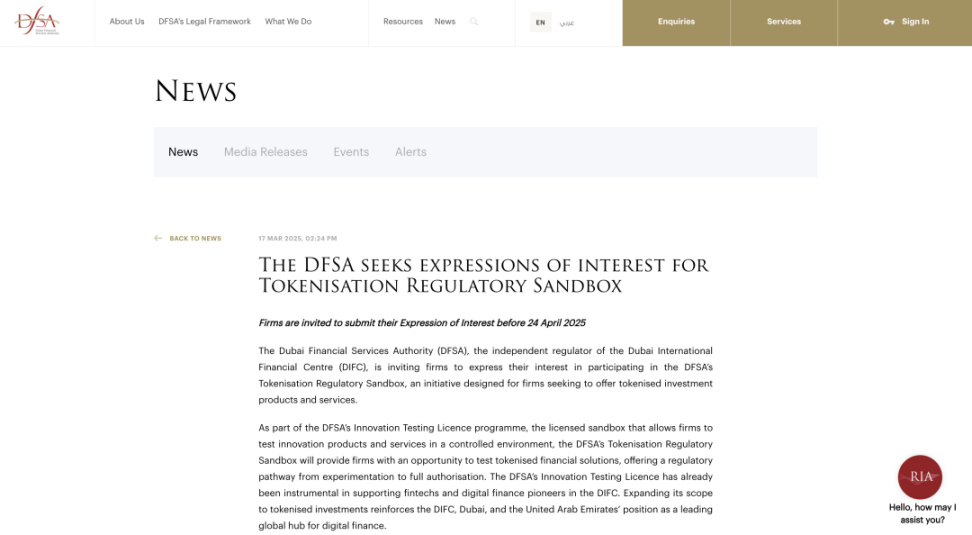
On March 17, 2025, the Dubai Financial Services Authority (DFSA) released the “Tokenisation Regulatory Sandbox Guide,” which for the first time explicitly incorporates tokenization into regulatory focus and introduces an Innovative Testing License (ITL) mechanism, providing a realistic, clear, and practically operable compliance pathway.
Currently, the intention application window is open, only from March 17, 2025, to April 24, 2025. Therefore, for RWA project parties planning to go abroad, this path is an important option worth focusing on and seizing at this stage.
What signals are released by the DFSA tokenized sandbox?
This guide clearly states that the DFSA has incorporated Tokenised Investments into its regulatory framework and has specifically categorized tokens as follows:
- Security Token
- Derivative Token
As a result, tokenized assets will no longer be in a regulatory gray area. RWA projects in the Dubai market, especially the tokenization of traditional assets such as real estate, supply chain finance, bills, and bonds, will also have clearer compliance basis and regulatory guidance.
At the same time, the DFSA’s setup for sandbox applicants provides practical operational space for different types of RWA project parties. According to DFSA guidelines, companies eligible to apply for participation in the sandbox currently include:
- Companies that issue, trade, hold, or settle tokenized investments (such as stocks, bonds, sukuk, and units of collective investment funds);
- Financial institutions that already hold DFSA licenses and plan to expand their tokenization business;
- A company team with a deep understanding of applicable laws and regulatory frameworks.
In other words, both traditional financial institutions with a certain financial background seeking to expand their tokenization business, and entrepreneurial projects in the mode exploration phase focusing on the digitization of RWA assets, can apply to enter through the DFSA sandbox mechanism to gain low-threshold compliance testing opportunities.
Especially for small and medium-sized RWA entrepreneurial teams, the phased regulatory exemptions and supportive policies provided within the sandbox can help the teams validate their business models at a lower cost in the early stages, while also clarifying the future compliance licensing path.
What’s more noteworthy is that DFSA has launched an Innovation Testing Licence called ITL Tokenisation Cohort, which allows RWA project parties to enter the market in advance without fully meeting all capital requirements and risk control obligations, so as to test products and models in a real-world environment with low thresholds, and then transition to the licensing stage.
The overall process is divided into three stages:
- Expression of Intent Stage
The project party needs to submit a letter of intent, indicating plans to carry out Tokenisation business in DIFC (Dubai International Financial Centre). DFSA will conduct a preliminary assessment based on background, governance, technical solutions, etc.
- ITL Testing Phase
After the initial evaluation, projects can enjoy exemptions from certain capital requirements, prudential obligations, and reporting requirements within a 6-12 month window period, allowing for low-cost access to a real market environment to test business models. However, the DFSA also clearly states that participating projects must still be subject to ongoing supervision, and project parties must ensure that critical risk points such as information disclosure, DLT system security, and custody arrangements comply with regulatory requirements.
- Licensed to Regular Stage
After the testing period ends, the project must choose to apply for a full DFSA license or exit the business according to the exit mechanism. The DFSA will strictly enforce market exit for projects that do not meet the “graduation” standards.
It is important to note that this sandbox only serves the tokenization of traditional financial assets and real-world assets. Therefore, other pure cryptocurrency projects (Crypto Tokens) and fiat stablecoins (Fiat Crypto Tokens) are not applicable.
Why is the DFSA Tokenization Sandbox Worth Noting?
Currently, there are clear regulatory frameworks for RWA or tokenized assets mainly concentrated in the markets of Dubai and Hong Kong. Although both are actively promoting the clarification of RWA regulations, there are significant differences in their specific implementations.
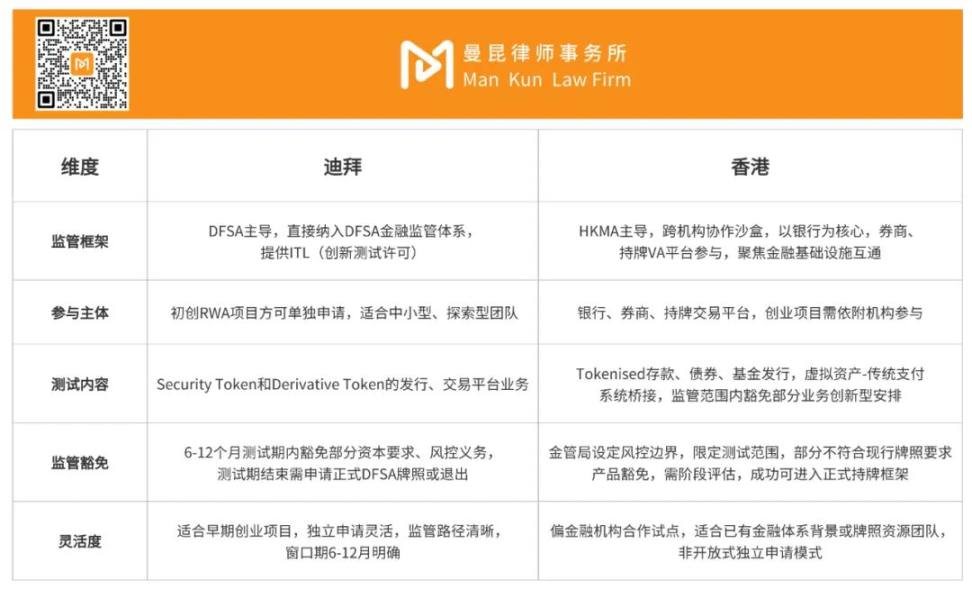
It can be seen that although the Dubai DFSA and the Hong Kong HKMA are both actively promoting the clarity of tokenization regulation, there are significant differences in the participation thresholds and applicable entities between the two regions.
For RWA entrepreneurs, the ITL sandbox mechanism launched by DFSA this time has several practical advantages that are particularly worth noting:
- Suitable for startups and small to medium-sized teams, independently apply flexibly.
Hong Kong Ensemble Sandbox is designed with a focus on the participation of traditional financial system entities, led by licensed institutions such as banks and brokerages. Startups often need to rely on partners to participate, making the application process relatively complex.
In contrast, the ITL mechanism of DFSA allows project parties to apply directly as independent entities, without relying on existing financial institutions. This provides greater autonomy and operational flexibility for RWA projects with limited resources that are in the exploratory phase.
- Phase exemption during the testing period to reduce compliance trial costs
The DFSA clearly provides a testing window of 6-12 months, during which capital requirements and prudent risk management obligations are subject to phased exemptions. This especially allows projects to quickly validate their business models in a real market environment while significantly reducing early-stage trial costs and operational burdens. Therefore, the DFSA ITL mechanism can be considered one of the few practical cases under the current global diversified regulatory system that provides independent application channels, phased exemptions, and a full pathway for graduation to RWA startup projects.
However, the overall compliance threshold for the Hong Kong path is relatively high, especially since the SFC licensing system has strict requirements for capital, governance structures, and other factors, posing significant challenges for startup teams in the short term.
- The regulatory framework is clear, and RWA assets are formally managed
This time, the DFSA has incorporated Security Tokens and Derivative Tokens into the existing financial regulatory system, eliminating the policy gaps and legal risks previously faced by tokenized assets. Project parties only need to follow the existing financial product regulatory framework of the DFSA to legally and compliantly develop issuance, trading, and other businesses, with strong policy predictability.
In comparison, the Hong Kong Ensemble sandbox is currently still in the collaborative pilot stage among banks and financial institutions. Its applicability is more geared towards the financial infrastructure level, and the direct regulatory channels for Web3 projects, especially for startups, are yet to be improved.
It can be seen that the DFSA’s launch of the sandbox this time is not just a simple compliance innovation, but also reflects Dubai’s policy intention to strive for a first-mover advantage in the RWA track as the fintech hub of the Middle East.
Recommendations from Attorney Mankun
Whether choosing Hong Kong or Dubai, the key to the RWA project always lies in how to find the most suitable compliance path for the current stage of the project based on its own stage, resources, and strategic planning.
The tokenization regulatory sandbox launched by the DFSA provides a practical opportunity for RWA project parties in the exploratory phase who wish to quickly validate their models, with a moderate threshold, clear regulatory framework, and controllable costs.
However, it is worth noting that this window is not open for the long term. Project teams not only need to seize the opportunity but also must complete compliance preparations in advance to truly be the first to land.
In this regard, lawyer Mankun suggests focusing on the following points:
- Complete the DIFC registration and legal structure design as soon as possible. Only by establishing a registered entity in the DIFC can one enter the DFSA regulatory framework. It is advisable to plan the equity structure and tax arrangements in advance to avoid missing the application window due to insufficient compliance preparation.
- Prepare technical solutions and risk control materials in advance. The DFSA has detailed requirements for DLT system design, custody mechanisms, and compliance processes. It is recommended to hire a compliance team to assist in preparing the relevant materials to ensure a successful application during the ITL phase.
- Plan the licensed pathway after ITL graduation. The sandbox period is only a temporary convenience; the ultimate goal should be to obtain the full DFSA formal license. It is recommended to simultaneously prepare for capital adequacy and the improvement of governance documents as part of a long-term plan to avoid operational interruptions after the sandbox period ends.
It is foreseeable that the DFSA sandbox will attract a surge of global projects, but those that will be the first to land and graduate are still the teams that have made early preparations in governance, risk control, and compliance.
The regulatory window has already opened, and the time left for market participants to act is often limited.
Are you ready for the next step?


