GateUser-d7bbfb06

vip
Age 0 Yıl
Peak Tier 0
No content yet
#AnthropicvsOpenAIHeatsUp
The AI War That Will Define the Next Decade (Full Strategic Breakdown)
This is no longer a quiet competition between two AI labs.
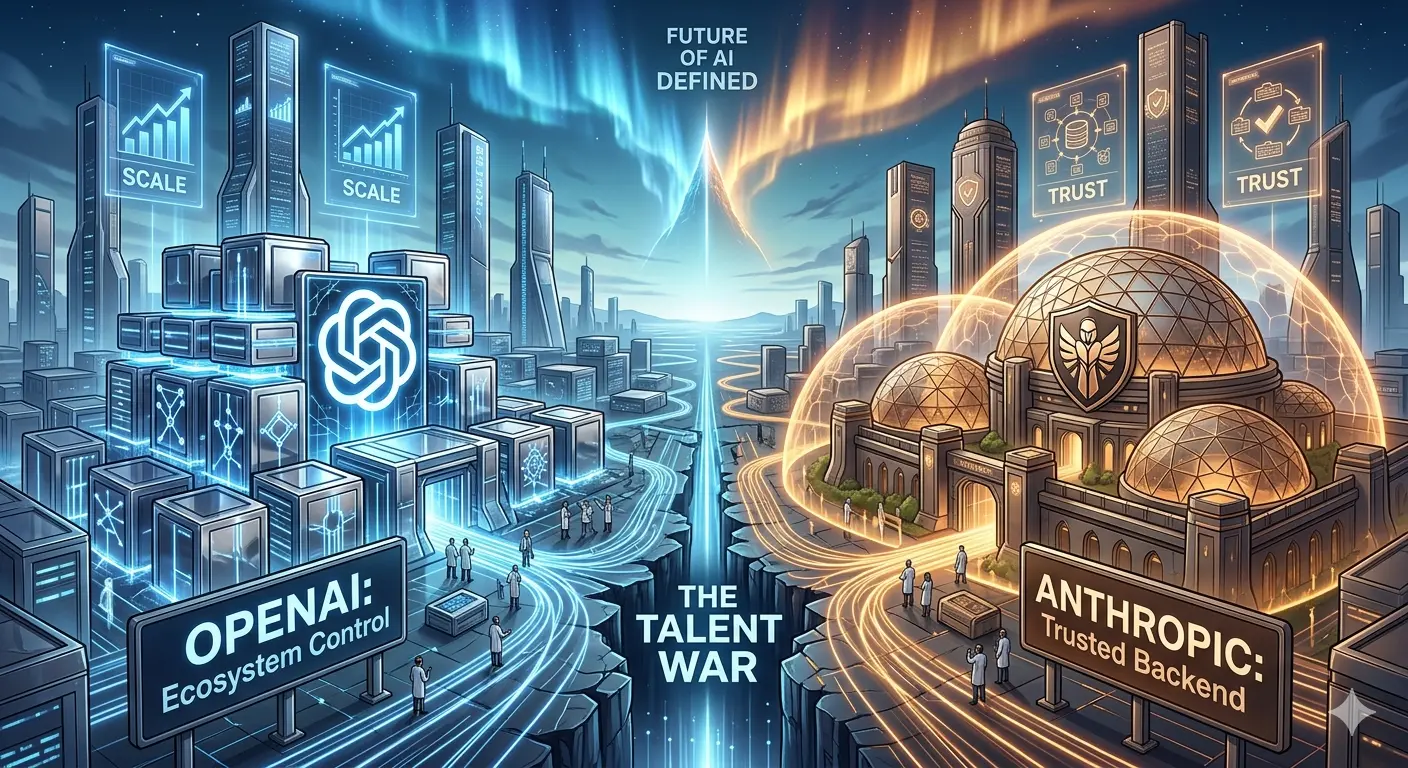
What we are witnessing right now is a full-scale strategic war between two of the most powerful AI companies in the world:
OpenAI
Anthropic
This battle is not just about better chatbots.
It is about:
Who controls the future of artificial intelligence
Which model becomes the global standard
Who captures trillions in enterprise value
And ultimately — who defines how AI interacts with humanity
The stakes are enormous. And the competition is a
View Original
Vortex_King
#AnthropicvsOpenAIHeatsUp
The AI War That Will Define the Next Decade (Full Strategic Breakdown)
This is no longer a quiet competition between two AI labs.
What we are witnessing right now is a full-scale strategic war between two of the most powerful AI companies in the world:
OpenAI
Anthropic
This battle is not just about better chatbots.
It is about:
Who controls the future of artificial intelligence
Which model becomes the global standard
Who captures trillions in enterprise value
And ultimately — who defines how AI interacts with humanity
The stakes are enormous. And the competition is accelerating faster than most people realize.
---
1. The Core Difference: Two Opposite Philosophies
---
Step 1: OpenAI — Scale, Distribution, Dominance
OpenAI’s strategy is clear:
👉 Build the biggest AI platform and distribute it everywhere
Key characteristics:
Mass adoption via ChatGPT
Enterprise expansion via APIs
Monetization via ads and services
Vertical integration across products
OpenAI is playing a Big Tech game.
It wants:
Billions of users
Deep integration into daily life
Platform-level dominance
It is essentially trying to become:
👉 The Google of AI
---
Step 2: Anthropic — Safety, Control, Enterprise Trust
Anthropic is taking a completely different approach:
👉 Build the safest, most controllable AI system
Key pillars:
“Constitutional AI” framework
Safety-first deployment
Enterprise-focused tools (especially coding)
Controlled release of powerful models
Anthropic is positioning itself as:
👉 The “trusted infrastructure layer” of AI
---
Step 3: Strategic Contrast
This difference is fundamental:
OpenAI = Expansion-first
Anthropic = Control-first
As analysts note:
> Anthropic is betting on safety as infrastructure, while OpenAI is betting on vertical integration
---
2. The Revenue War — The Most Important Battlefield
---
Step 1: Anthropic’s Shock Growth
Anthropic is no longer a small competitor.
It is now:
~$30B annualized revenue
Rapid enterprise adoption
Strong growth in developer tools
Even more surprising:
👉 It is closing in on — and in some metrics surpassing — OpenAI.
---
Step 2: OpenAI’s Position
OpenAI still dominates in:
Consumer adoption (ChatGPT scale)
Brand recognition
Ecosystem reach
But:
Revenue growth is under pressure
Monetization strategy is evolving
---
Step 3: Enterprise Is the Real Prize
The key insight:
👉 Enterprise usage > consumer usage
Why?
Higher margins
Recurring revenue
Larger contracts
Deep integration
Anthropic’s strength:
👉 Developers + enterprise tools (like Claude Code)
OpenAI’s challenge:
👉 Converting massive user base into high-value revenue
---
Step 4: The Trend
Anthropic is gaining ground because:
It solves real business problems
It performs strongly in coding + technical tasks
It builds trust with companies
Data shows:
~30.6% enterprise adoption vs ~35.2% for OpenAI — gap closing fast
---
3. Product War — Claude vs GPT
---
Step 1: OpenAI Product Ecosystem
OpenAI builds around:
ChatGPT (core product)
API ecosystem
Codex (coding)
Enterprise tools
This creates a:
👉 Multi-layer platform
---
Step 2: Anthropic Product Strategy
Anthropic builds around:
Claude as central system
Integrated enterprise + API approach
This creates:
👉 A more focused, unified product experience
---
Step 3: Model Competition
Recent developments show:
Both companies releasing competing models simultaneously
Rapid iteration cycles
Focus on coding + automation
This is an arms race in capability.
---
Step 4: The Hidden Difference
OpenAI focuses on:
Versatility
Mass usability
Anthropic focuses on:
Reliability
Control
Predictability
---
4. The Safety vs Growth Debate
---
Step 1: Anthropic’s Safety Narrative
Anthropic has built its brand on:
Ethical AI
Risk mitigation
Controlled deployment
Example:
Restricting powerful models like Mythos due to risk concerns
---
Step 2: OpenAI’s Approach
OpenAI takes a more:
Pragmatic
Deployment-first
approach.
It believes:
👉 Real-world usage drives improvement
---
Step 3: The Criticism
Anthropic critics argue:
Safety messaging may also be marketing
Limited releases create exclusivity perception
---
Step 4: The Reality
This is not just philosophy.
It is strategy:
Anthropic → Trust-first
OpenAI → Adoption-first
---
5. The Political & Regulatory Layer
---
Step 1: Government Tensions
Anthropic has:
Refused certain military uses
Entered disputes with government agencies
---
Step 2: OpenAI’s Flexibility
OpenAI has been more:
Cooperative with government contracts
Willing to integrate into national systems
---
Step 3: Strategic Implication
This creates:
Anthropic → Ethical positioning
OpenAI → Strategic alignment
Both have advantages.
---
6. Infrastructure War — Compute Is King
---
Step 1: Massive Investment
AI is not just software.
It is:
👉 Compute + infrastructure
---
Step 2: Anthropic Partnerships
Anthropic has:
Google TPU access
Microsoft + Nvidia backing
Billions in compute investment
---
Step 3: OpenAI’s Scale Bet
OpenAI plans:
Massive compute expansion
$600B long-term infrastructure investment
---
Step 4: The Key Insight
> The AI leader will be the one who controls compute, not just models.
---
7. Business Strategy War
---
Step 1: OpenAI’s Monetization Push
OpenAI is moving into:
Advertising
Enterprise subscriptions
Platform monetization
---
Step 2: Anthropic’s Model
Anthropic focuses on:
Enterprise contracts
API usage
Developer ecosystem
---
Step 3: Strategic Clash
OpenAI → Scale + ads
Anthropic → Premium enterprise
---
8. Talent War — The Hidden Battlefield
---
Step 1: Global Expansion
Anthropic is expanding aggressively:
London hub
AI talent clustering
---
Step 2: Competition for Talent
Key players:
OpenAI
Anthropic
Google DeepMind
Meta
---
Step 3: Why It Matters
AI progress depends on:
👉 Top researchers + engineers
This is a zero-sum game.
---
9. The Real Battlefield — Ecosystem Control
---
Step 1: OpenAI’s Goal
Become:
👉 Default AI layer for consumers + developers
---
Step 2: Anthropic’s Goal
Become:
👉 Trusted backend for enterprise AI systems
---
Step 3: The Difference
OpenAI → Frontend dominance
Anthropic → Backend dominance
---
10. What Happens Next?
---
Scenario 1: OpenAI Wins
If:
Mass adoption continues
Monetization succeeds
Then:
👉 OpenAI becomes AI’s global platform
---
Scenario 2: Anthropic Wins
If:
Enterprise adoption dominates
Safety becomes critical
Then:
👉 Anthropic becomes AI infrastructure backbone
---
Scenario 3: Dual Dominance
Most realistic outcome:
👉 Both coexist — but dominate different layers
---
11. Final Insight
---
> This is not a product war.
This is a system-level power shift.
The winner will not just:
Build better AI
It will:
👉 Define how intelligence itself is accessed
---
Closing Thoughts
---
The rivalry between OpenAI and Anthropic is accelerating faster than any previous tech competition.
What makes it different:
Speed of innovation
Scale of impact
Depth of integration into society
We are not watching a startup battle.
We are watching:
👉 The foundation of the next technological era being built in real time.
---
Final Question
---
If you had to bet on one:
OpenAI (scale & dominance)
Anthropic (safety & enterprise trust)
Which side are you on — and why?
---
Disclaimer
This analysis is for educational purposes only and reflects current market and industry trends. The AI sector is evolving rapidly, and outcomes may change based on technological, regulatory, and economic developments.
repost-content-media
  • Reward
  • Comment
  • Repost
  • Share
#GatePreIPOsLaunchesWithSpaceX
Gate Square Special Topic Discussion: Gate Pre-IPOs — SpaceX (SPCX) Deep Dive
Preamble
The convergence of crypto-native infrastructure and traditional capital markets has long been anticipated, but rarely executed in a way that meaningfully shifts access for retail participants. The introduction of a Pre-IPO mechanism centered around SpaceX represents a structural attempt to bridge that gap — not through theory, but through an operational product.
At its core, this initiative is not just about one company. It reflects a broader transformation in how financial ac
GUSD0,01%
View Original
Vortex_King
#GatePreIPOsLaunchesWithSpaceX
Gate Square Special Topic Discussion: Gate Pre-IPOs — SpaceX (SPCX) Deep Dive
Preamble
The convergence of crypto-native infrastructure and traditional capital markets has long been anticipated, but rarely executed in a way that meaningfully shifts access for retail participants. The introduction of a Pre-IPO mechanism centered around SpaceX represents a structural attempt to bridge that gap — not through theory, but through an operational product.
At its core, this initiative is not just about one company. It reflects a broader transformation in how financial access is distributed, how private market exposure is packaged, and how digital platforms are beginning to extend beyond crypto into hybrid financial ecosystems.
This discussion addresses two central dimensions of the topic:
A deep analysis of SpaceX and the SPCX Pre-IPO structure
A clear, step-by-step breakdown of the subscription system and allocation mechanics
The goal is not promotion — it is understanding.
---
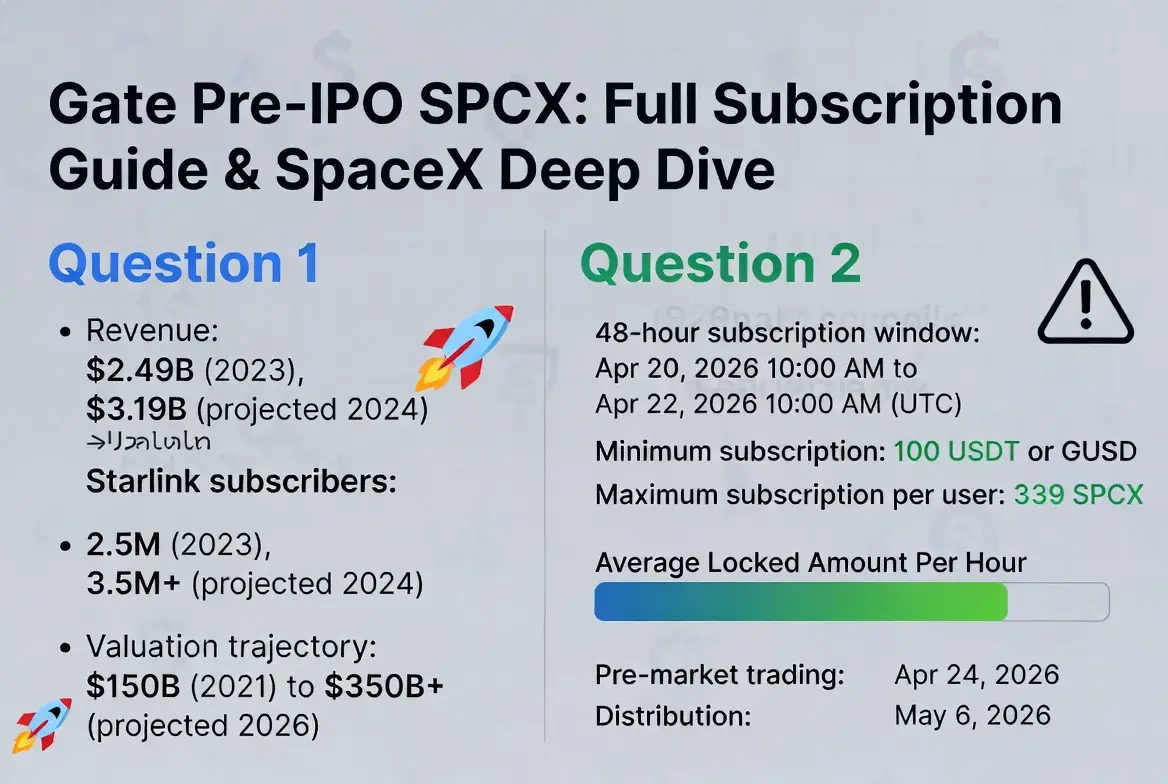
Question 1: Understanding the Pre-IPO Project — SpaceX / SPCX
---
The Strategic Importance of SpaceX
Elon Musk’s SpaceX is not simply another high-growth private company — it is a system-level disruptor operating at the intersection of aerospace, telecommunications, and infrastructure.
Founded in 2002, its original mission — making humanity multi-planetary — may sound visionary, but its present-day business model is grounded in tangible economic output.
Key pillars of its dominance include:
Fully reusable rocket systems reducing launch costs
Rapid engineering iteration cycles
Vertical integration across manufacturing and deployment
Expansion into global satellite-based internet
What makes SpaceX particularly unique is that it has successfully transitioned from a capital-intensive experimental venture into a high-margin commercial enterprise.
---
Financial Trajectory and Scale
By 2025–2026, SpaceX’s numbers reflect a company that has moved well beyond the startup phase:
Estimated revenue (2025): ~$15–16 billion
Estimated net profit: ~$8 billion
Profit margin: ~50%
This margin profile is exceptional — not just in aerospace, but across all industrial sectors.
The primary driver behind this transformation is Starlink, its satellite internet division:
Millions of global users
Rapidly expanding satellite constellation
Strong recurring revenue model
This fundamentally changes how SpaceX should be valued.
It is no longer just:
A launch provider
It is increasingly:
A global communications infrastructure company
---
Valuation Expansion — Pricing the Future
SpaceX’s valuation growth has been exponential:
2024: ~$350 billion
2025: ~$800 billion
Forward estimates: $1.25T – $1.75T
These valuations are not purely speculative — they are driven by:
Real revenue expansion
Market dominance in emerging sectors
Strategic positioning in space infrastructure
However, they also embed high expectations of future growth.
This creates the central investment tension:
> Are participants buying into current performance — or future dominance?
---
What Is SPCX?
SPCX is not equity in the traditional sense.
It is a structured exposure instrument designed to mirror the valuation trajectory of SpaceX.
This means:
No direct ownership of shares
No voting rights
No formal shareholder status
Instead:
Economic exposure is replicated through a hedging structure tied to private market pricing
In simple terms:
SPCX allows participants to track SpaceX’s valuation movement without directly owning its stock.
---
Why This Matters
Historically, access to pre-IPO companies like SpaceX has been restricted to:
Venture capital firms
Institutional investors
Ultra-high-net-worth individuals
Minimum entry barriers were often extremely high.
This model challenges that structure by:
Lowering capital requirements
Digitizing access
Introducing liquidity earlier in the lifecycle
---
Structural Significance
This initiative signals three broader shifts:
1. Democratization of Private Markets
Retail participants gain exposure previously unavailable to them.
2. Expansion of Crypto Platforms
Crypto exchanges evolve into multi-asset financial ecosystems.
3. Emergence of New Asset Types
Pre-market exposure instruments like SPCX introduce a hybrid category between:
Derivatives
Private equity
Speculative trading assets
---
Question 2: Subscription Mechanics — A Complete Breakdown
---
Understanding the mechanics is essential. Without this, participation becomes guesswork.
---
Subscription Timeline
Opening: April 20, 2026
Closing: April 22, 2026
Duration: 48 hours
Post-subscription:
Pre-market trading begins: April 24
Distribution completion target: May 6
This timeline defines:
When capital is locked
When exposure is assigned
When liquidity becomes available
---
Supported Assets
Participants can subscribe using:
USDT
GUSD
This dual-asset support increases accessibility and flexibility.
---
Entry Constraints
Minimum participation: $100
Maximum allocation: 339 SPCX
The cap prevents excessive concentration while ensuring broader distribution.
---
The Core Mechanism: Time-Weighted Allocation
This is the most important concept.
Allocation is based on:
Average locked capital per hour over the full subscription period
---
Practical Interpretation
Two participants:
User A locks $1,000 for 48 hours
User B locks $5,000 for last 2 hours
User A receives higher allocation weight despite committing less total capital.
---
Strategic Implication
Timing matters more than size.
Early participation = higher efficiency
Late participation = reduced allocation impact
This discourages last-minute capital flooding.
---
Post-Subscription Process
After the window closes:
Step 1 — Allocation Calculation
Weighted averages determine final allocation.
Step 2 — Cost Deduction
Only allocated SPCX is charged.
Step 3 — Refund
Unused funds are fully returned.
Step 4 — Distribution
SPCX is credited to user accounts.
Step 5 — Trading Begins
100% unlocked — immediate liquidity.
---
Liquidity Advantage
Unlike traditional pre-IPO investments:
No lock-up period
No delayed vesting
Participants can:
Hold long-term
Trade immediately
---
Risk Analysis — A Necessary Perspective
---
1. Structural Risk
SPCX is not equity.
It is exposure — not ownership.
---
2. Valuation Risk
Private market pricing may not match IPO valuation.
---
3. Timing Risk
IPO timeline is not guaranteed.
Delays impact price dynamics.
---
4. Market Liquidity Risk
Pre-market trading may experience:
Lower volume
Higher spreads
Price inefficiencies
---
5. Behavioral Risk
Time-weighted allocation may encourage:
Early conviction
Or rushed decisions
---
Deeper Insight: What This Represents
---
This model reflects a broader evolution:
Finance is becoming:
More accessible
More hybrid
More experimental
But also:
More complex
More responsibility-driven
Access alone is not an advantage.
Understanding is.
---
Final Perspective
---
The SpaceX / SPCX Pre-IPO structure represents a meaningful shift in financial access.
It combines:
A high-impact underlying asset
A novel distribution mechanism
A liquidity-enabled structure
But it also introduces:
New forms of risk
New decision-making dynamics
The key takeaway:
> This is not simply an opportunity — it is a new category of participation.
---
Closing Discussion Questions
---
1. Do you view SpaceX as a still-underpriced long-term opportunity — or a company already valued for perfection?
2. Is indirect exposure (like SPCX) a valid substitute for equity ownership?
3. Does time-weighted allocation improve fairness — or pressure participants into early decisions?
4. Would you prioritize early allocation — or wait for clearer valuation signals?
---
Conclusion
---
For the first time, a structure is emerging that allows broader participation in one of the most closely held private companies in the world.
Whether this becomes:
A new standard
Or a niche experiment
will depend on how participants engage with it.
Because in the end:
Access changes the game — but understanding determines the outcome.
repost-content-media
  • Reward
  • Comment
  • Repost
  • Share
#Gate13thAnniversaryLive
Gate’s 13th Anniversary: 13 Years of Resilience, Innovation, and a Future Built on iWeb3
Preamble
Thirteen years in crypto is not just a milestone — it is survival against probability.
In an industry where platforms rise and collapse within a single market cycle, longevity is not accidental. It is earned through discipline, infrastructure, and trust built under pressure. Since its founding in 2013, Gate.io has navigated some of the most turbulent periods in financial technology history — and has emerged not only intact, but stronger, more sophisticated, and more relev
BTC0,79%
DEFI0,89%
View Original
Vortex_King
#Gate13thAnniversaryLive
Gate’s 13th Anniversary: 13 Years of Resilience, Innovation, and a Future Built on iWeb3
Preamble
Thirteen years in crypto is not just a milestone — it is survival against probability.
In an industry where platforms rise and collapse within a single market cycle, longevity is not accidental. It is earned through discipline, infrastructure, and trust built under pressure. Since its founding in 2013, Gate.io has navigated some of the most turbulent periods in financial technology history — and has emerged not only intact, but stronger, more sophisticated, and more relevant than ever.
The 13th anniversary is not simply a celebration. It is a validation of a long-term strategy in an industry often dominated by short-term thinking.
---
A Theme That Defines Direction: “Your Gateway to iWeb3”
The anniversary theme — “Your Gateway to iWeb3” — is not branding. It is positioning.
It signals a transition from:
A traditional crypto exchange
to
An intelligent financial ecosystem
At the center of this vision is the idea that Web3 is evolving beyond decentralization alone. It is moving toward intelligent systems, where AI, automation, and blockchain infrastructure converge.
Under the leadership of Dr. Han Lin, Gate has consistently emphasized:
Long-term infrastructure development
Security-first architecture
User-centric product evolution
This is not theoretical. It is reflected in execution across 13 years.
---
Surviving the Cycles That Defined Crypto
To understand the weight of this anniversary, you have to understand the events Gate survived.
The Collapse of Mt. Gox Collapse
This was crypto’s first systemic shock — a failure that erased trust across the ecosystem.
---
The Bear Market of 2018–2019
An extended downturn where:
Market liquidity evaporated
Most projects failed
Exchanges disappeared rapidly
---
The Global Shock of COVID-19 Market Crash
Bitcoin dropped over 50% in a single day, triggering cascading liquidations.
---
The Fallout of FTX Collapse
A defining moment where trust in centralized platforms was fundamentally shaken.
---
Regulatory Pressure (2023–2024)
Global tightening of compliance frameworks challenged the operational models of many exchanges.
---
Through each of these events, Gate maintained:
Operational continuity
Withdrawal integrity
Platform stability
This consistency is not common. It is the result of structural discipline.
---
The 13th Anniversary Live Ecosystem
The #Gate13thAnniversaryLive is not a single event — it is a multi-layered engagement system designed to activate the entire community.
---
WCTC Season 8 — Competitive Trading at Scale
The World Crypto Trading Championship Season 8 introduces an 8,000,000 USDT prize pool, making it one of the largest trading competitions in the industry.
Participants can engage through:
Team-based competition
Individual performance ranking
Direct 1v1 trading challenges
Markets covered include:
Spot
Futures
ETF products
This transforms trading from a solitary activity into a structured competitive environment.
---
The Anniversary Event Hub — Broad Participation Layer
Not all users engage through high-risk trading.
The Event Hub provides:
Daily tasks
Quiz participation
Check-in rewards
Time Capsule engagement
The Time Capsule feature stands out as both:
A reward mechanism
A historical archive of user sentiment
It captures a snapshot of the community at this moment in time.
---
ETF Mega Event — Structured Exposure Incentives
The ETF-focused campaign includes:
80,000 USDT prize pool
Up to 13x reward multipliers
This encourages participation in structured products that sit between:
Spot trading
Leveraged derivatives
---
Livestreams and Direct Engagement
Live sessions hosted by Dr. Han Lin provide:
Strategic insights
Market outlook discussions
Direct user interaction
This reduces the distance between platform leadership and its user base — something rarely done at scale.
---
Why This Anniversary Matters Beyond Rewards
The deeper significance lies not in prizes — but in positioning.
Then vs Now
2013:
Niche exchange
Limited product range
Early-stage crypto adoption
2026:
Multi-asset trading ecosystem
Integration of DeFi and centralized finance
Advanced financial instruments (ETFs, derivatives, staking, lending)
AI-integrated roadmap
This transformation reflects adaptive evolution, not reactive change.
---
The Core Philosophy: Long-Term Over Hype
Crypto markets often reward:
Speed
Speculation
Short-term gains
But long-term dominance requires:
Infrastructure resilience
Risk management discipline
Continuous innovation
Gate’s operating philosophy has consistently prioritized:
Stability over expansion speed
Transparency over opacity
Utility over hype cycles
This is why it has endured.
---
The iWeb3 Vision — What Comes Next
The concept of iWeb3 represents the next phase of platform evolution.
Key Components
AI-driven trading insights
Automated portfolio strategies
Integrated DeFi access
Seamless fiat-to-crypto bridging
---
User-Level Impact
For everyday participants, this means:
Lower technical barriers
Smarter decision-making tools
Unified access to multiple financial layers
The objective is clear:
Make advanced financial systems usable — not just accessible.
---
Community Reflection — The Human Layer
Behind every platform metric are real users.
Gate’s longevity is not just technological — it is communal.
Over 13 years, users have:
Discovered early opportunities
Navigated bull and bear cycles
Built strategies and experience
The platform has served as:
A marketplace
A learning environment
A long-term financial tool
This creates a form of loyalty that cannot be manufactured quickly.
---
Participation Framework
For those engaging with the anniversary:
Explore the event ecosystem
Participate in trading competitions
Engage with daily reward systems
Attend livestream discussions
The structure is designed to accommodate:
Active traders
Passive participants
Long-term holders
---
Final Perspective
Thirteen years is not just a timeline — it is proof of execution.
Gate.io has demonstrated that in an industry defined by volatility:
Stability is a competitive advantage
Trust is a long-term asset
Innovation must be continuous
---
Closing Thought
The crypto industry often celebrates speed.
But history tends to reward endurance.
Gate’s 13th anniversary represents a rare combination of both:
The ability to move forward
And the discipline to survive
---
Conclusion
The significance of this moment is not just in looking back — but in recognizing trajectory.
From a small exchange in 2013 to a comprehensive financial ecosystem in 2026, Gate’s journey reflects:
Strategic patience
Operational resilience
Vision-driven growth
repost-content-media
  • Reward
  • Comment
  • Repost
  • Share
#KalshiFacesNevadaRegulatoryClash
The Legal Battle That Could Define the Future of Prediction Markets
---
Preamble
This is not just a legal dispute.
This is a system-level confrontation between two powerful forces:
State-level gambling regulators
Federal financial market authorities
At the center of this clash is Kalshi — a platform that is attempting to redefine how people interact with uncertainty itself.
The core question is simple, but explosive:
> Are prediction markets financial instruments — or just gambling in disguise?
The answer to this question will not only determine Kalshi’s futu
Vortex_King
#KalshiFacesNevadaRegulatoryClash
The Legal Battle That Could Define the Future of Prediction Markets
---
Preamble
This is not just a legal dispute.
This is a system-level confrontation between two powerful forces:
State-level gambling regulators
Federal financial market authorities
At the center of this clash is Kalshi — a platform that is attempting to redefine how people interact with uncertainty itself.
The core question is simple, but explosive:
> Are prediction markets financial instruments — or just gambling in disguise?
The answer to this question will not only determine Kalshi’s future — it will define the regulatory framework for an entire emerging industry.
---
1. What Is Kalshi — And Why It Matters
---
Step 1: Understanding the Business Model
Kalshi is not a traditional betting platform.
It operates as a regulated event derivatives exchange, allowing users to trade on outcomes such as:
Elections
Economic data
Weather events
Sports results
Policy decisions
Instead of betting, users buy contracts priced between $0 and $1 representing probability.
This structure places Kalshi under the jurisdiction of the
Commodity Futures Trading Commission (CFTC), which oversees derivatives markets.
---
Step 2: The Key Innovation
Kalshi’s core innovation is:
👉 Turning real-world events into tradable financial instruments
This creates:
Price discovery for probabilities
Market-based forecasting
New asset class (event derivatives)
---
Step 3: Why It’s Disruptive
Prediction markets challenge:
Traditional finance (new asset class)
Gambling industry (overlapping products)
Regulatory frameworks (unclear classification)
This is why regulators are reacting aggressively.
---
2. Nevada Steps In — The Trigger Event
---
Step 1: The Ban
In March 2026, Nevada regulators:
Issued a temporary restraining order
Blocked Kalshi from operating in the state
Classified its contracts as illegal gambling
---
Step 2: The Core Argument
Nevada’s position:
Event contracts = betting
Sports + elections = gambling activity
Therefore → requires gaming license
A state judge supported this view, reinforcing the ban and extending restrictions
---
Step 3: The Extended Conflict
The ban was not temporary in spirit.
Nevada:
Continued blocking operations
Strengthened legal stance
Positioned itself as a regulatory leader against prediction markets
---
3. The Core Legal Conflict — Federal vs State Power
---
Step 1: Federal Position (CFTC)
The
Commodity Futures Trading Commission argues:
Kalshi operates as a Designated Contract Market (DCM)
Event contracts = financial swaps
Federal law overrides state gambling laws
---
Step 2: State Position
States like Nevada argue:
These are not financial instruments
They are functionally identical to betting
Therefore fall under state jurisdiction
---
Step 3: Why This Matters
This is a constitutional-level issue:
👉 Federal preemption vs state sovereignty
If federal authority wins:
Prediction markets expand nationwide
If states win:
Fragmented, restricted market
---
4. Not Just Nevada — A Nationwide Battle
---
Step 1: Multi-State Crackdown
Kalshi is facing pressure across multiple states:
Ohio → $5M fine for unlicensed betting
Arizona → criminal charges filed
Michigan → lawsuits over illegal gambling
Washington → legal action initiated
---
Step 2: Conflicting Court Decisions
Some rulings support Kalshi:
Federal courts backing CFTC authority
Others oppose:
State courts labeling contracts as gambling
---
Step 3: Legal Fragmentation
This creates:
Regulatory confusion
Operational uncertainty
Legal inconsistency
---
5. Arizona Case — A Turning Point
---
Step 1: Federal Intervention
A major development:
Federal judge blocked Arizona’s criminal case
CFTC intervened directly
---
Step 2: What This Signals
This indicates:
👉 Federal government is willing to defend prediction markets
---
Step 3: Strategic Implication
If federal protection strengthens:
Kalshi gains legitimacy
States lose enforcement power
---
6. The Bigger Industry — Prediction Markets Explosion
---
Step 1: Rapid Growth
Prediction markets have grown massively:
130x expansion (2024–2025)
Billions in trading volume
---
Step 2: Key Players
Kalshi
Polymarket
---
Step 3: Use Cases Expanding
Markets now include:
Politics
Crypto volatility
Macroeconomics
Sports
---
Step 4: Why Governments Are Concerned
Concerns include:
Gambling addiction
Insider trading risk
Election integrity
---
7. The Core Debate — Gambling vs Finance
---
Step 1: The Gambling Argument
Critics say:
Users are betting on outcomes
No real hedging purpose
Similar to sportsbooks
---
Step 2: The Financial Argument
Supporters argue:
Contracts provide risk hedging
Markets improve forecasting accuracy
Similar to derivatives
---
Step 3: The Reality
The truth lies in between:
👉 These are hybrid instruments
And that’s the problem.
---
8. Economic Implications
---
Step 1: If Kalshi Wins
New asset class emerges
Retail gains access to event trading
Financialization of real-world events
---
Step 2: If States Win
Heavy restrictions
Market fragmentation
Innovation slowdown
---
Step 3: Global Impact
Other countries are already:
Banning platforms
Restricting access
---
9. The Hidden Risk — Insider Trading
---
Step 1: Unique Vulnerability
Prediction markets allow trading on:
Non-public information
Real-world events
---
Step 2: Example Risks
Political insiders
Corporate data leaks
Sports manipulation
---
Step 3: Regulatory Concern
CFTC is already:
Monitoring suspicious trades
Pushing stricter oversight
---
10. The Future — What Happens Next?
---
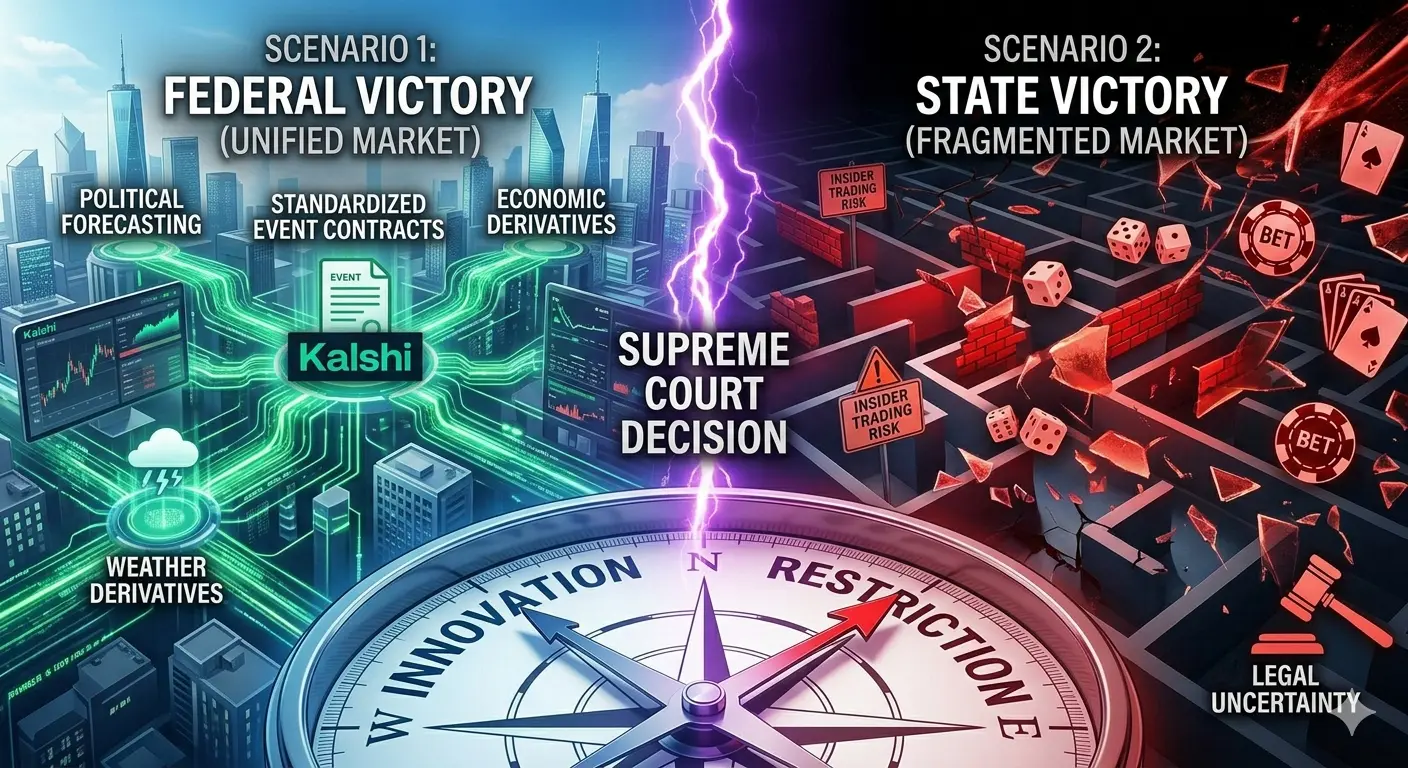
Scenario 1: Federal Victory
Unified national framework
Massive growth
Institutional adoption
---
Scenario 2: State Victory
Patchwork regulations
Limited scalability
Legal uncertainty
---
Scenario 3: Supreme Court Decision
Most likely outcome:
👉 Final resolution at the highest level
---
11. The Bigger Insight
---
> This is not about Kalshi.
This is about:
👉 Who controls the future of probability markets
---
Prediction markets represent:
Financial evolution
Information aggregation
Decentralized forecasting
---
Closing Thoughts
---
The clash between Kalshi and Nevada is a defining moment.
It forces us to confront a deeper question:
👉 Should markets be allowed to price everything?
Because once you allow trading on:
Elections
Wars
Policies
You are not just building markets.
You are reshaping how society interprets reality.
---
Final Question
---
If prediction markets go global:
Would you trade them as investments?
Or avoid them as disguised gambling?
---
Disclaimer
This post is for educational purposes only and does not constitute legal or financial advice. Regulatory outcomes remain uncertain and may significantly impact the prediction market industry.
repost-content-media
  • Reward
  • Comment
  • Repost
  • Share
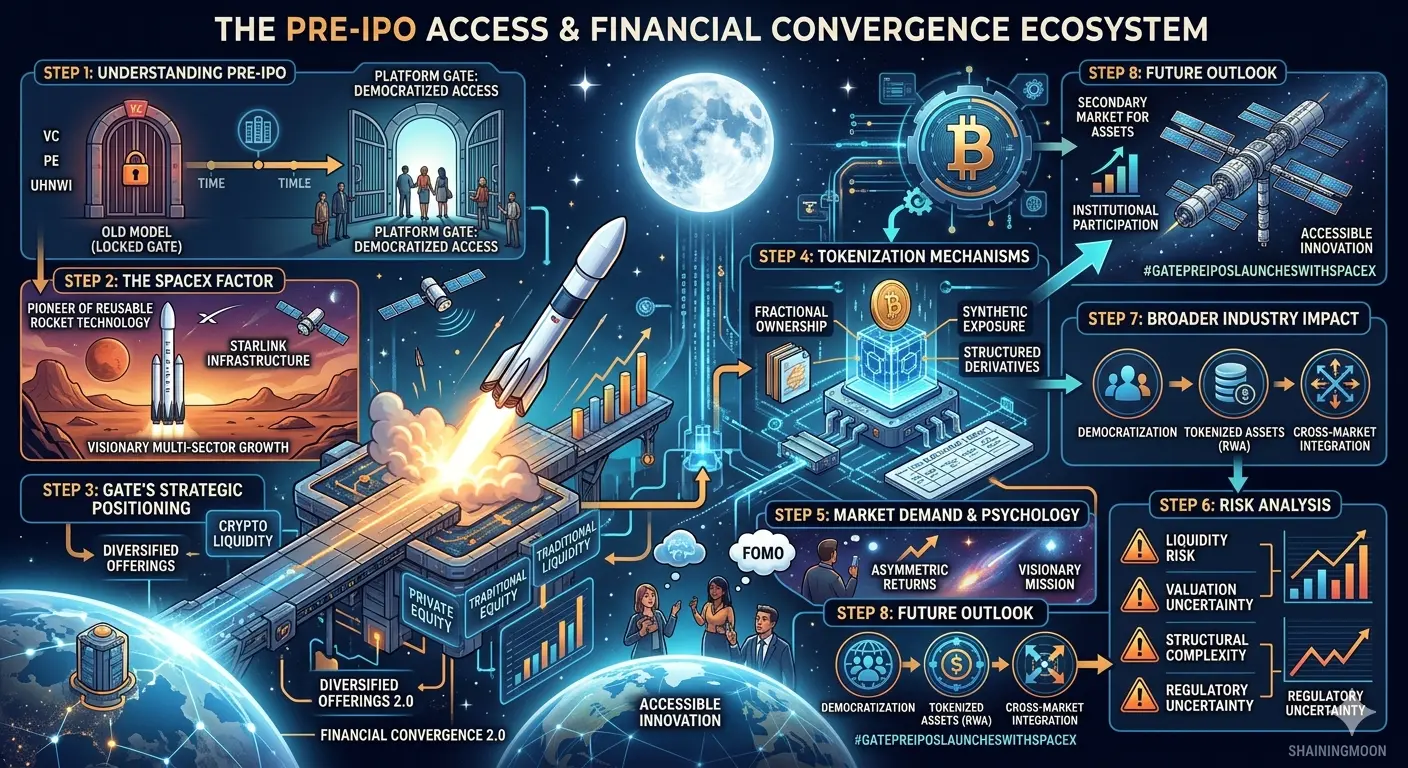
#WCTCTradingChallengeShare8MUSDT Step 1: Understanding the Pre-IPO Concept in Modern Finance
Pre-IPO investing refers to gaining exposure to a company before it becomes publicly listed. Traditionally, this space was dominated by venture capital firms, private equity giants, and ultra-high-net-worth individuals. Retail investors were effectively locked out.
Now, platforms like Gate are attempting to democratize this layer. This shift matters because most exponential value creation happens before IPO. By the time a company goes public, a large portion of gains is already captured by early inside
ShainingMoon
#WCTCTradingChallengeShare8MUSDT Step 1: Understanding the Pre-IPO Concept in Modern Finance
Pre-IPO investing refers to gaining exposure to a company before it becomes publicly listed. Traditionally, this space was dominated by venture capital firms, private equity giants, and ultra-high-net-worth individuals. Retail investors were effectively locked out.
Now, platforms like Gate are attempting to democratize this layer. This shift matters because most exponential value creation happens before IPO. By the time a company goes public, a large portion of gains is already captured by early insiders.
The introduction of blockchain-enabled access to Pre-IPO opportunities signals a transition from closed financial systems to semi-open ecosystems. It reduces friction, increases participation, and aligns with the broader decentralization movement.
Step 2: Why SpaceX is a Game-Changer in This Narrative
SpaceX is not just another private company—it is one of the most influential technological organizations in the world. Its involvement in any Pre-IPO discussion instantly elevates credibility and demand.
Key reasons why SpaceX stands out:
Pioneer of reusable rocket technology
Operator of Starlink, reshaping global internet infrastructure
Strategic partnerships with governments and defense sectors
Long-term vision involving Mars colonization
Unlike traditional companies, SpaceX operates at the intersection of aerospace, telecommunications, AI, and defense, making it a multi-sector growth engine.
This makes it a highly desirable Pre-IPO asset, even if access is indirect or structured through financial instruments.
Step 3: Gate’s Strategic Positioning in the Market
Gate is not simply offering a feature—it is positioning itself as a gateway between crypto liquidity and traditional equity value.
This move serves multiple strategic purposes:
Attracts new user segments beyond crypto traders
Increases platform stickiness through diversified offerings
Enhances brand perception by associating with elite companies
Expands revenue streams beyond trading fees
By introducing Pre-IPO exposure, Gate is effectively building a hybrid financial ecosystem, where users can engage with both digital assets and real-world innovation.
This is a critical step toward what many analysts call “Financial Convergence 2.0.”
Step 4: The Role of Tokenization in Pre-IPO Access
One of the most important underlying mechanisms is tokenization—the process of representing real-world assets as digital tokens on a blockchain.
In this context, tokenization allows:
Fractional ownership of high-value private assets
Increased liquidity compared to traditional private markets
Easier global participation
Transparent tracking via blockchain
However, it’s crucial to understand that tokenized Pre-IPO exposure may not always represent direct equity ownership. It could be:
Synthetic exposure
Structured derivatives
Custodial holding arrangements
This distinction is vital for investors analyzing risk and reward.
Step 5: Market Demand and Investor Psychology
The excitement around this narrative is driven by a mix of FOMO (Fear of Missing Out) and rational investment logic.
Why demand is surging:
Desire to access early-stage growth
Increasing distrust in traditional financial gatekeeping
Rising awareness of companies like SpaceX
Search for asymmetric returns
From a psychological perspective, SpaceX adds a visionary layer. It’s not just about profits—it’s about being part of a futuristic mission.
This emotional factor significantly amplifies market participation and engagement.
Step 6: Risk Analysis — The Hidden Realities
While the opportunity sounds attractive, it’s essential to evaluate the risks carefully:
1. Liquidity Risk
Pre-IPO assets are not as easily tradable as public stocks.
2. Valuation Uncertainty
Private companies do not have transparent, market-driven pricing.
3. Structural Complexity
Tokenized exposure may involve intermediaries, adding layers of risk.
4. Regulatory Uncertainty
Different jurisdictions may treat such offerings differently.
5. Information Asymmetry
Retail investors may not have access to the same level of data as institutions.
Understanding these risks separates informed participants from speculative entrants.
Step 7: Broader Industry Impact
This development has implications beyond a single platform or company:
1. Democratization of Finance
More people gain access to high-value opportunities.
2. Pressure on Traditional Institutions
Banks and venture firms may need to adapt or lose relevance.
3. Acceleration of Tokenized Assets
Real-world asset (RWA) tokenization could become mainstream.
4. Cross-Market Integration
Crypto and traditional finance will increasingly overlap.
5. Competitive Innovation
Other platforms may launch similar offerings, driving rapid evolution.
This could mark the beginning of a new financial paradigm, where access is no longer restricted by legacy systems.
Step 8: Future Outlook — What Comes Next
Looking ahead, several trends are likely to emerge:
Expansion of Pre-IPO offerings beyond SpaceX
Integration with DeFi protocols for enhanced liquidity
Development of secondary markets for tokenized assets
Increased regulatory clarity over time
Greater institutional participation
If executed effectively, this model could redefine investing by making early-stage innovation globally accessible.
However, long-term success depends on:
Transparency
Trust
Regulatory alignment
Technological robustness
Final Insight
The #GatePreIPOsLaunchesWithSpaceX narrative is more than a trend—it is a signal of transformation. It reflects a world where technology removes barriers, capital becomes more fluid, and opportunity expands beyond traditional limits.
For investors, this represents both a powerful opportunity and a complex challenge. The key lies in understanding not just the hype, but the structure behind it.
Those who approach it with knowledge, discipline, and strategic thinking will be better positioned to navigate this evolving landscape.
SHAININGMOON
repost-content-media
  • Reward
  • Comment
  • Repost
  • Share
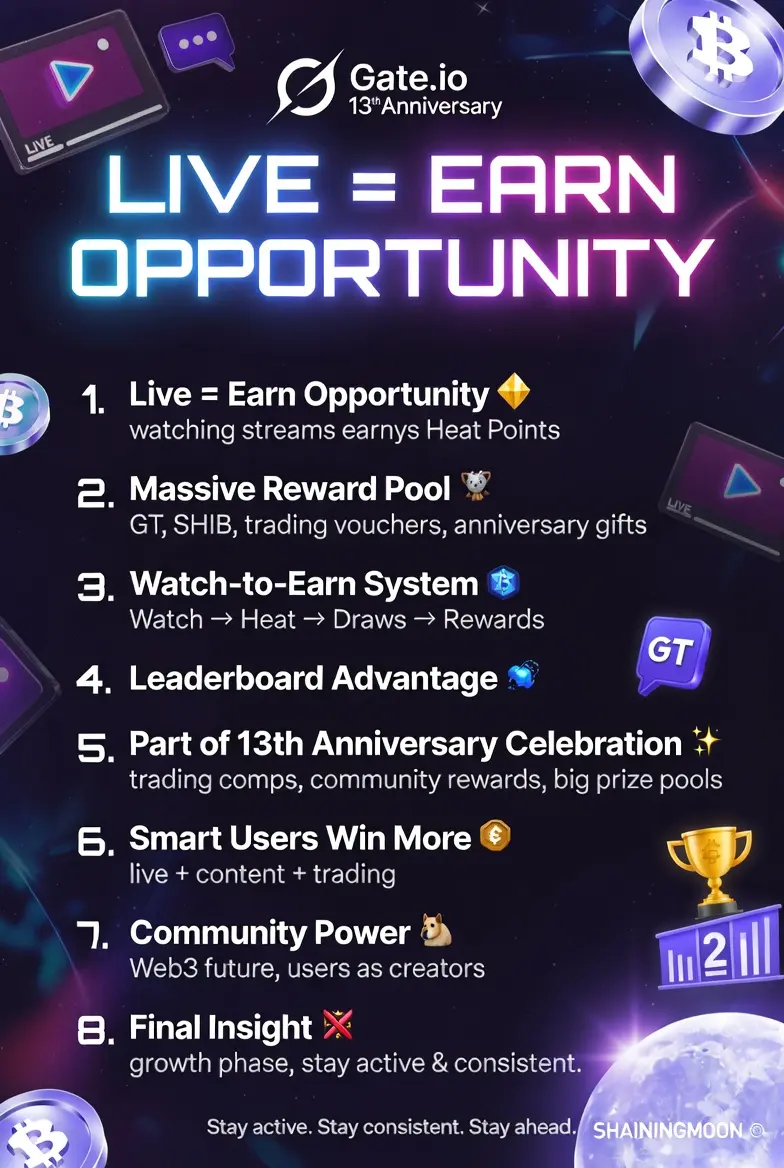
#Gate13thAnniversaryLive 1. Live = Earn Opportunity
Watching live streams is no longer just entertainment — it’s a reward engine.
Earn Heat Points, unlock draws, and step into a system where your attention has value.
🎁 2. Massive Reward Pool
From GT, SHIB, and trading vouchers to exclusive anniversary gifts — rewards are everywhere.
The more active you are, the more chances you unlock.
🚀 3. Watch-to-Earn System
Every action matters.
Watch → Earn Heat → Convert into lucky draws → Win rewards.
A simple loop, but powerful.
🏆 4. Leaderboard Advantage
Top participants don’t just win — they domin
GT-0,82%
SHIB-2,29%
ShainingMoon
#Gate13thAnniversaryLive 1. Live = Earn Opportunity
Watching live streams is no longer just entertainment — it’s a reward engine.
Earn Heat Points, unlock draws, and step into a system where your attention has value.
🎁 2. Massive Reward Pool
From GT, SHIB, and trading vouchers to exclusive anniversary gifts — rewards are everywhere.
The more active you are, the more chances you unlock.
🚀 3. Watch-to-Earn System
Every action matters.
Watch → Earn Heat → Convert into lucky draws → Win rewards.
A simple loop, but powerful.
🏆 4. Leaderboard Advantage
Top participants don’t just win — they dominate.
Higher activity = better ranking = premium rewards.
📊 5. Part of a Bigger Celebration
This live campaign is just one piece of the 13th anniversary ecosystem, which also includes:
Global trading competitions
Community posting rewards
Multi-million dollar prize pools �
U.Today
💡 6. Smart Users Win More
Those who combine:
✔ Live participation
✔ Content creation
✔ Trading activity
…are the ones maximizing rewards.
🌍 7. Community Power
Gate is pushing towards a Web3-powered future, where users are not just traders — they are contributors and creators. �
U.Today
🔥 8. Final Insight
This isn’t just an anniversary…
It’s a growth phase disguised as celebration.
If you’re active, consistent, and strategic —
you’re not just watching… you’re earning your position in the ecosystem.
✨ Stay active. Stay consistent. Stay ahead.
**SHAININGMOON 🌙**
repost-content-media
  • Reward
  • Comment
  • Repost
  • Share
#GatePreIPOsLaunchesWithSpaceX #GatePreIPOsLaunchesWithSpaceX 🚀
The collaboration narrative between Gate.io Pre-IPO opportunities and SpaceX signals a powerful shift in how retail investors engage with high-growth private companies. Traditionally, access to pre-IPO equity in elite firms like SpaceX has been limited to venture capital giants and institutional players. Now, platforms are exploring ways to democratize that access.
1. The Concept of Pre-IPO Access
Pre-IPO investments allow participants to gain exposure to companies before they go public. This phase often carries high potential be
STARL0,16%
ShainingMoon
#GatePreIPOsLaunchesWithSpaceX #GatePreIPOsLaunchesWithSpaceX 🚀
The collaboration narrative between Gate.io Pre-IPO opportunities and SpaceX signals a powerful shift in how retail investors engage with high-growth private companies. Traditionally, access to pre-IPO equity in elite firms like SpaceX has been limited to venture capital giants and institutional players. Now, platforms are exploring ways to democratize that access.
1. The Concept of Pre-IPO Access
Pre-IPO investments allow participants to gain exposure to companies before they go public. This phase often carries high potential because valuations can grow significantly once the company lists on public markets.
2. Why SpaceX Matters
SpaceX is not just another tech company—it represents innovation in space exploration, satellite internet (Starlink), and reusable rocket technology. Its consistent breakthroughs make it one of the most sought-after private investments globally.
3. Gate.io’s Strategic Positioning
Gate.io is positioning itself as a bridge between traditional finance and the digital asset economy. By integrating Pre-IPO narratives, it attracts users looking for diversified opportunities beyond crypto trading.
4. Democratization of Investment
This initiative reflects a broader trend: giving everyday investors access to opportunities that were once restricted. It aligns with the decentralization ethos of blockchain.
5. Risk vs Reward Balance
While the upside can be significant, Pre-IPO investments are inherently risky. Limited liquidity, valuation uncertainty, and regulatory considerations must be understood before participation.
6. Market Sentiment Impact
Announcements like this often drive strong community engagement and speculative interest. Even the association with SpaceX can boost platform visibility and user activity.
7. The Future of Tokenized Equity
This move hints at a future where real-world assets like company shares are tokenized, making them tradable on blockchain platforms with enhanced transparency and accessibility.
8. Final Insight
The #GatePreIPOsLaunchesWithSpaceX trend is more than hype—it reflects an evolving financial landscape where innovation, accessibility, and technology intersect. Investors should stay informed, think strategically, and balance excitement with careful analysis.
— SHAININGMOON 🌙
repost-content-media
  • Reward
  • Comment
  • Repost
  • Share
#CryptoMarketRecovery The crypto market is once again showing signs of life, and the conversation around recovery is getting stronger with every passing day. After a period of uncertainty, corrections, and emotional trading, the market is gradually stabilizing, creating a foundation for a potential long-term uptrend. But this recovery isn’t just about prices going up — it’s about confidence returning, structure rebuilding, and smarter participation from both retail and institutional players.
At its core, a market recovery in crypto is driven by multiple layers working together. First comes sen
BTC0,79%
ShainingMoon
#CryptoMarketRecovery The crypto market is once again showing signs of life, and the conversation around recovery is getting stronger with every passing day. After a period of uncertainty, corrections, and emotional trading, the market is gradually stabilizing, creating a foundation for a potential long-term uptrend. But this recovery isn’t just about prices going up — it’s about confidence returning, structure rebuilding, and smarter participation from both retail and institutional players.
At its core, a market recovery in crypto is driven by multiple layers working together. First comes sentiment. When fear dominates, investors exit positions, liquidity dries up, and prices fall sharply. But once selling pressure slows and buyers begin stepping in at key support levels, the mood starts shifting. This is exactly what we are witnessing now — a transition from panic to cautious optimism.
Another major factor behind the recovery is accumulation. Large holders, often referred to as “whales,” tend to buy during dips when prices are undervalued. This silent accumulation phase doesn’t create immediate price spikes, but it builds strong support zones. Over time, as supply in the market reduces and demand increases, prices begin to move upward more steadily rather than in volatile bursts.
Technology and development also play a critical role. Unlike traditional markets, crypto is deeply tied to innovation. When blockchain networks improve scalability, reduce fees, or introduce new utilities, it strengthens the long-term value of projects. Developers continue building even during bearish phases, and when the market recovers, these improvements become catalysts for growth.
Institutional involvement is another powerful driver. Over the years, more institutions have entered the crypto space, bringing not just capital but also credibility. Their participation reduces extreme volatility and adds a layer of stability to the ecosystem. When institutions accumulate assets, it often signals long-term confidence rather than short-term speculation.
Regulatory clarity is also slowly shaping the recovery narrative. While uncertainty around regulations has historically caused fear, clearer frameworks can actually support growth by attracting more participants who were previously hesitant. A balanced approach to regulation helps legitimize the market without stifling innovation.
One of the most important aspects of this recovery is the shift in investor behavior. Many traders are now more educated and strategic compared to previous cycles. Instead of chasing hype, they focus on research, risk management, and long-term value. This maturity reduces the chances of extreme bubbles and crashes, leading to more sustainable growth.
However, it’s important to stay realistic. Recovery does not mean a straight line upward. There will still be corrections, fake breakouts, and periods of sideways movement. These are natural parts of any healthy market cycle. The key difference now is that these movements are happening within a more structured and informed environment.
The role of Bitcoin remains central in this recovery phase. As the leading asset in the crypto market, its stability often influences the direction of altcoins. When Bitcoin holds strong or trends upward gradually, it creates space for other projects to grow. This interconnected movement is a defining characteristic of the crypto ecosystem.
Liquidity is also returning to the market. Increased trading volume indicates renewed interest and participation. When liquidity improves, price movements become more reliable, and large fluctuations become less erratic. This creates a more favorable environment for both traders and long-term investors.
Community engagement is another underrated but powerful element. Crypto is not just a financial system; it’s a global movement driven by communities. As discussions, collaborations, and innovations increase, they contribute to the overall strength of the market.
In conclusion, the current #CryptoMarketRecovery is not just a temporary bounce — it reflects deeper structural improvements within the ecosystem. From stronger fundamentals and institutional interest to smarter investors and continuous innovation, multiple factors are aligning to support a more stable and sustainable growth phase.
Still, patience remains key. Markets move in cycles, and those who understand this are better positioned to benefit. Instead of reacting emotionally, focusing on long-term trends, proper research, and disciplined strategies can make all the difference in navigating this evolving landscape.
The recovery is happening — not loudly, but steadily. And sometimes, the strongest growth begins quietly before it becomes visible to everyone.
SHAININGMOON
repost-content-media
  • Reward
  • Comment
  • Repost
  • Share
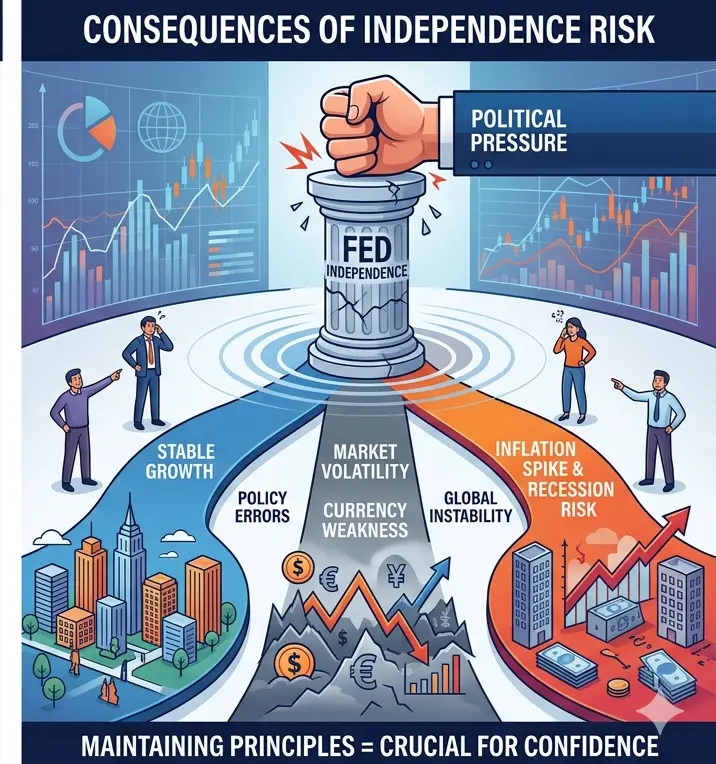
#TrumpUltimatumtoPowell
1. Introduction: When Politics Meets Monetary Power
The phrase #TrumpUltimatumtoPowell captures a high-stakes confrontation at the heart of the global financial system—political authority versus central bank independence.
At its core, this issue is not just about personalities or short-term policy disagreements. It reflects a deeper structural tension:
Governments want faster economic growth
Central banks aim for long-term stability
When these goals diverge, conflict becomes inevitable.
In 2026, this tension has resurfaced dramatically, with renewed pressure from polit
Vortex_King
#TrumpUltimatumtoPowell
1. Introduction: When Politics Meets Monetary Power
The phrase #TrumpUltimatumtoPowell captures a high-stakes confrontation at the heart of the global financial system—political authority versus central bank independence.
At its core, this issue is not just about personalities or short-term policy disagreements. It reflects a deeper structural tension:
Governments want faster economic growth
Central banks aim for long-term stability
When these goals diverge, conflict becomes inevitable.
In 2026, this tension has resurfaced dramatically, with renewed pressure from political leadership on the Federal Reserve—particularly its chairman—to align monetary policy with broader economic and political objectives.
---
2. Understanding the Key Players
To fully grasp the situation, we need to understand the roles of the two central figures:
Donald Trump
Represents political leadership and economic agenda
Focuses on growth, employment, and market performance
Sensitive to public sentiment and electoral outcomes
Jerome Powell
Head of the U.S. central bank
Responsible for monetary policy
Mandate: control inflation and support employment
---
3. What Is the “Ultimatum”?
The term “ultimatum” suggests strong, direct pressure—either explicit or implied—on the Federal Reserve to act in a certain way.
Key Areas of Pressure:
Policy Area Political Demand Fed Perspective
Interest Rates Cut rates quickly Wait for inflation control
Liquidity Inject more money Avoid overheating economy
Growth Accelerate economy Maintain balance
The conflict arises because:
👉 Short-term growth often conflicts with long-term stability
---
4. Why This Conflict Is Happening Now
4.1 Economic Context in 2026
The U.S. economy is in a complex phase:
Growth is slowing but not collapsing
Inflation remains persistent
Labor markets are still relatively strong
This creates a dilemma:
Cutting rates too early risks inflation
Keeping rates high risks slowing growth
---
4.2 Political Incentives
Political leadership prefers:
Lower borrowing costs
Strong stock markets
Rapid economic expansion
These outcomes are more visible to voters and markets.
---
4.3 Federal Reserve Constraints
The Federal Reserve must consider:
Inflation data
Long-term economic stability
Global financial conditions
It cannot act purely based on political demands.
---
5. Central Bank Independence: Why It Matters
Central bank independence is one of the most important principles in modern economics.
Why Independence Exists:
Reason Explanation
Credibility Markets trust unbiased decisions
Stability Avoids politically driven inflation
Long-term focus Prevents short-term manipulation
If central banks lose independence:
👉 Inflation can spiral
👉 Currency confidence can weaken
👉 Markets can become unstable
---
6. Historical Context: This Isn’t New
Pressure on the Federal Reserve is not unprecedented.
Past examples show similar tensions:
Political leaders pushing for rate cuts
Disagreements during economic slowdowns
Public criticism of Fed decisions
However, what makes the current situation unique is:
👉 The intensity and public nature of the pressure
---
7. Market Reaction: Why Investors Care
Markets closely monitor any tension between political leadership and the Federal Reserve.
7.1 Stock Market Impact
Rate cut expectations → bullish
Policy uncertainty → volatility
7.2 Bond Market Impact
Yields fluctuate based on rate expectations
Increased uncertainty raises risk premiums
7.3 Currency Impact
Perceived political interference can weaken the dollar
Confidence in monetary policy becomes critical
---
8. The Core Conflict: Growth vs Inflation
This entire situation boils down to a fundamental economic trade-off.
Growth Focus:
Lower interest rates
More liquidity
Higher consumption and investment
Inflation Control:
Higher interest rates
Reduced liquidity
Controlled demand
The Balance:
Scenario Outcome
Too much growth Inflation spike
Too much control Economic slowdown
---
9. Strategic Interpretation: What Trump Wants vs What Powell Must Do
Political Strategy:
Push for aggressive rate cuts
Stimulate economic activity
Support financial markets
Central Bank Strategy:
Wait for clear inflation decline
Avoid premature easing
Maintain credibility
Key Insight:
👉 Both sides are rational—but operating under different priorities
---
10. Risks of Escalation
If pressure intensifies, several risks emerge.
10.1 Policy Mistakes
Premature rate cuts
Over-tightening
10.2 Market Volatility
Sudden shifts in expectations
Increased uncertainty
10.3 Institutional Damage
Loss of trust in Federal Reserve independence
Long-term credibility risks
---
11. Global Implications
The U.S. Federal Reserve is not just a domestic institution—it affects the entire world.
Global Effects:
Emerging markets depend on U.S. rates
Global liquidity influenced by Fed policy
Currency stability tied to dollar strength
If Conflict Escalates:
👉 Global markets could experience increased volatility
---
12. Crypto Market Connection
Interestingly, situations like this often impact crypto markets.
Why?
Crypto seen as alternative to traditional systems
Hedge against monetary instability
Reaction to fiat currency uncertainty
Potential Outcomes:
Scenario Crypto Reaction
Fed loses credibility Bullish crypto
Stable policy Neutral
Tight liquidity Bearish short-term
---
13. Possible Scenarios Going Forward
Scenario 1: Compromise
Gradual rate cuts
Balanced messaging
Market stability
Scenario 2: Continued Tension
Mixed signals
Volatile markets
Delayed decisions
Scenario 3: Policy Shift Under Pressure
Faster rate cuts
Short-term market rally
Long-term risks
---
14. What Investors Should Watch
Key indicators to monitor:
Inflation data
Federal Reserve statements
Political messaging
Bond yields
Dollar strength
These signals will reveal which direction policy is moving.
---
15. Final Insight: Power vs Principle
The #TrumpUltimatumtoPowell situation represents more than a policy debate.
It is a test of:
Institutional independence
Economic discipline
Political influence
---
16. Conclusion: A Defining Moment
The outcome of this conflict will shape:
U.S. economic trajectory
Global financial markets
Trust in central banking systems
Final Thought:
Markets can handle bad news.
They struggle with uncertainty.
Right now, this situation creates exactly that—uncertainty.
---
Final Line:
This is not just about interest rates.
It is about who controls the future of money—
politics
repost-content-media
  • Reward
  • Comment
  • Repost
  • Share
#AllbirdsPivotstoAI
1. Introduction: A Surprising Pivot That Signals a Bigger Trend
The phrase #AllbirdsPivotstoAI might sound unexpected at first.
A company known for eco-friendly footwear suddenly shifting focus toward artificial intelligence raises an important question:
👉 Why would a sustainable shoe brand move into AI?
The answer lies not just in Allbirds’ internal challenges, but in a broader transformation happening across industries. In 2026, AI is no longer limited to tech companies—it has become a core operational tool for survival, efficiency, and growth.
This is not a random pivo
Vortex_King
#AllbirdsPivotstoAI
1. Introduction: A Surprising Pivot That Signals a Bigger Trend
The phrase #AllbirdsPivotstoAI might sound unexpected at first.
A company known for eco-friendly footwear suddenly shifting focus toward artificial intelligence raises an important question:
👉 Why would a sustainable shoe brand move into AI?
The answer lies not just in Allbirds’ internal challenges, but in a broader transformation happening across industries. In 2026, AI is no longer limited to tech companies—it has become a core operational tool for survival, efficiency, and growth.
This is not a random pivot. It is a strategic response to pressure, competition, and the need to reinvent.
---
2. Understanding Allbirds
Before analyzing the pivot, it’s important to understand where Allbirds stands.
Company Identity:
Founded as a sustainable footwear brand
Known for eco-friendly materials (wool, sugarcane, recycled fibers)
Positioned as a premium yet minimalist lifestyle brand
Original Strengths:
Strength Description
Sustainability Strong environmental narrative
Brand Identity Clean, simple, ethical
Direct-to-Consumer Strong online presence
Emerging Problems:
Slowing sales growth
Increasing competition
Profitability challenges
Changing consumer behavior
👉 In simple terms: strong brand, but weakening business momentum
---
3. Why the Pivot Became Necessary
3.1 Market Reality in 2026
Retail and consumer brands are facing a new reality:
Rising customer acquisition costs
Demand volatility
Supply chain inefficiencies
Margin compression
Traditional strategies are no longer enough.
---
3.2 Competitive Pressure
Allbirds is no longer alone in its niche.
Competitors now include:
Established giants adopting sustainability
Fast fashion brands replicating designs
New startups with stronger tech integration
👉 Differentiation is shrinking.
---
3.3 Internal Financial Pressure
Like many modern brands, Allbirds has faced:
Declining margins
Inventory challenges
Operational inefficiencies
This creates urgency:
👉 Optimize or fall behind.
---
4. What Does “Pivot to AI” Actually Mean?
This is where many misunderstand the story.
Allbirds is not becoming a tech company.
Instead, it is becoming an AI-powered consumer brand.
Key Areas of AI Integration:
Area Application
Supply Chain Demand forecasting
Marketing Personalized campaigns
Inventory Smart stock management
Design Data-driven product development
Customer Experience AI recommendations
👉 AI is not the product—it is the engine behind the business
---
5. Step-by-Step Breakdown of the AI Strategy
Step 1: Data Collection and Integration
AI starts with data.
Allbirds is likely focusing on:
Customer purchase behavior
Website interactions
Product performance
Regional demand patterns
Goal:
👉 Build a centralized data ecosystem
---
Step 2: Predictive Analytics
Using AI models to forecast:
Which products will sell
When demand will rise
Where inventory is needed
Impact:
Reduced overproduction
Lower costs
Higher efficiency
---
Step 3: Personalization Engine
AI allows hyper-personalized experiences:
Product recommendations
Email targeting
Dynamic pricing strategies
Result:
👉 Higher conversion rates
---
Step 4: AI in Product Design
This is one of the most interesting areas.
AI can analyze:
Consumer preferences
Material performance
Market trends
Outcome:
👉 Faster, smarter product development
---
Step 5: Operational Automation
AI reduces manual processes:
Logistics optimization
Customer service chatbots
Inventory allocation
Benefit:
👉 Cost reduction + scalability
---
6. Strategic Advantage of the AI Pivot
6.1 Efficiency Gains
AI helps eliminate waste:
Better inventory control
Reduced returns
Optimized production
---
6.2 Margin Improvement
By reducing inefficiencies:
👉 Profit margins improve without raising prices
---
6.3 Competitive Differentiation
AI creates a new edge:
Faster decision-making
Better customer targeting
Smarter operations
---
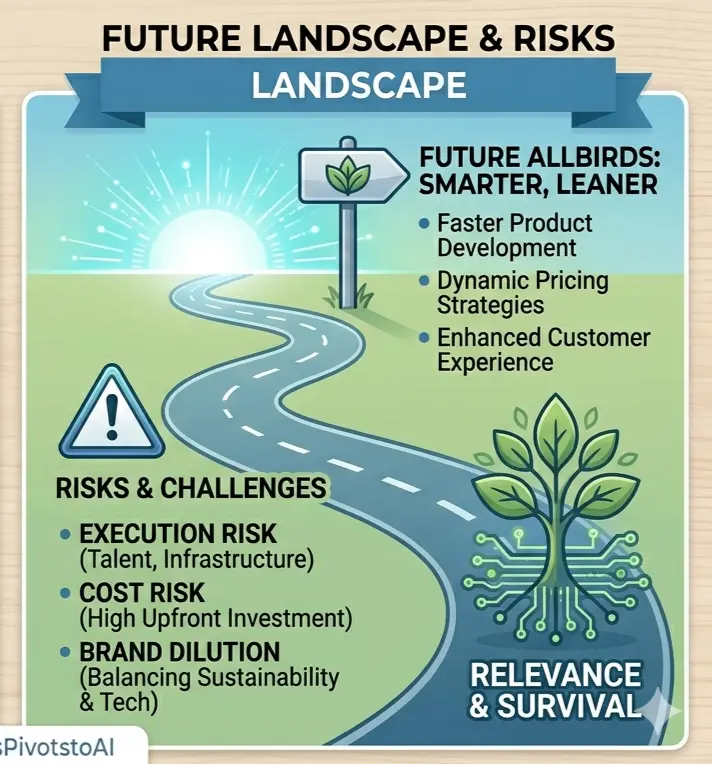
7. Risks of the Pivot
No strategy is without risk.
7.1 Execution Risk
AI implementation is complex
Requires talent and infrastructure
7.2 Cost Risk
High upfront investment
Delayed return on investment
7.3 Brand Risk
Allbirds’ identity is sustainability.
👉 Over-focusing on tech could dilute brand perception
---
8. Industry Trend: AI is Reshaping Retail
Allbirds is not alone.
Across industries, companies are adopting AI to survive and grow.
Broader Trend:
Retail → Data-driven
Marketing → Algorithmic
Supply chains → Predictive
Key Insight:
👉 AI is becoming the backbone of modern business
---
9. Investor Perspective
Why Investors May Like This Move:
Signals innovation
Shows proactive strategy
Addresses efficiency issues
Concerns:
Execution timeline
Cost vs benefit
Impact on growth
---
10. What This Means for the Future of Allbirds
The success of this pivot depends on:
Speed of implementation
Quality of AI models
Alignment with brand identity
Possible Outcomes:
Scenario Outcome
Successful pivot Strong recovery
Partial success Moderate improvement
Failed execution Continued decline
---
11. Lessons from This Pivot
Lesson 1:
👉 Even strong brands must evolve
Lesson 2:
👉 Sustainability alone is not enough—efficiency matters
Lesson 3:
👉 AI is not optional anymore
---
12. Strategic Insight: This Is Not About Shoes
At a deeper level, this pivot represents something bigger:
👉 The transformation of traditional companies into tech-enabled ecosystems
Allbirds is not changing what it sells.
It is changing how it operates.
---
13. Final Conclusion
The story is a reflection of modern business reality.
Markets are more competitive
Consumers are more demanding
Margins are tighter
In this environment:
👉 AI is not innovation—it is survival
---
Final Line:
Allbirds is not becoming a tech company.
It is becoming a smarter company.
repost-content-media
  • Reward
  • Comment
  • Repost
  • Share
#US-IranTalksVSTroopBuildup
US–Iran Geopolitics: Markets Are Pricing Peace — But Is It Real?
This isn’t just another geopolitical headline.
It’s a live macro event shaping global markets, oil flows, inflation expectations, and crypto sentiment — all at once.
Let’s break it down clearly 👇
---
🌍 What’s Actually Happening Right Now?
A real conflict began roughly 7 weeks ago, and since then, the situation has evolved into a high-stakes geopolitical chess game.
Key Timeline:
April 7: A temporary ceasefire (2 weeks) triggered a sharp rally in the S&P 500
April 11–12: US–Iran talks in Islamabad co
BTC0,79%
ETH0,2%
USDC-0,02%
Vortex_King
#US-IranTalksVSTroopBuildup
US–Iran Geopolitics: Markets Are Pricing Peace — But Is It Real?
This isn’t just another geopolitical headline.
It’s a live macro event shaping global markets, oil flows, inflation expectations, and crypto sentiment — all at once.
Let’s break it down clearly 👇
---
🌍 What’s Actually Happening Right Now?
A real conflict began roughly 7 weeks ago, and since then, the situation has evolved into a high-stakes geopolitical chess game.
Key Timeline:
April 7: A temporary ceasefire (2 weeks) triggered a sharp rally in the S&P 500
April 11–12: US–Iran talks in Islamabad collapsed — major disagreements remained unresolved
April 14–15: Renewed optimism pushed markets higher → S&P 500 hit a fresh all-time high
April 16 (Now): Reports suggest an “in-principle” ceasefire extension, but no official US confirmation yet
⚠️ Meanwhile:
US naval blockade on Iranian ports is still active
Strait of Hormuz tensions remain unresolved
---
⚠️ The 3 Core Issues Blocking a Deal
1. Nuclear Program (Uranium Enrichment Limits)
2. Strait of Hormuz Control (Oil Flow Lifeline)
3. War Damage Compensation
These are not minor disagreements — they are structural conflicts.
---
❓ Q1 — Peace or Escalation?
📊 Realistic View: Fragile Stability (Not Full Peace)
Both sides WANT a deal:
Iran’s economy is under pressure due to oil export restrictions
The US wants to avoid prolonged war amid inflation concerns
Regional players (Pakistan, Qatar) pushing mediation
BUT…
🚧 Major Barriers:
Nuclear enrichment = red line for both sides
US reluctant to lift blockade without concessions
Trust gap remains extremely high
🧭 Most Likely Outcome:
Ceasefire gets extended (short-term relief)
No full agreement yet
Risk of escalation still exists (low probability, high impact)
---
📈 Q2 — Market Reaction: Rally or “Sell the News”?
Here’s the key insight:
👉 Markets have already priced in optimism.
S&P 500 at all-time highs
Bitcoin around $74K
Risk sentiment recovering
🟢 If Peace Deal Succeeds:
Oil drops → inflation pressure eases
Risk assets spike briefly
Then likely profit-taking (3–7% pullback)
🔴 If Talks Fail:
Oil spikes sharply
Inflation fears return
Stocks drop
Crypto follows short-term downside
Safe havens like Gold benefit
🎯 Bottom Line:
Upside is limited, downside risk is stronger right now
---
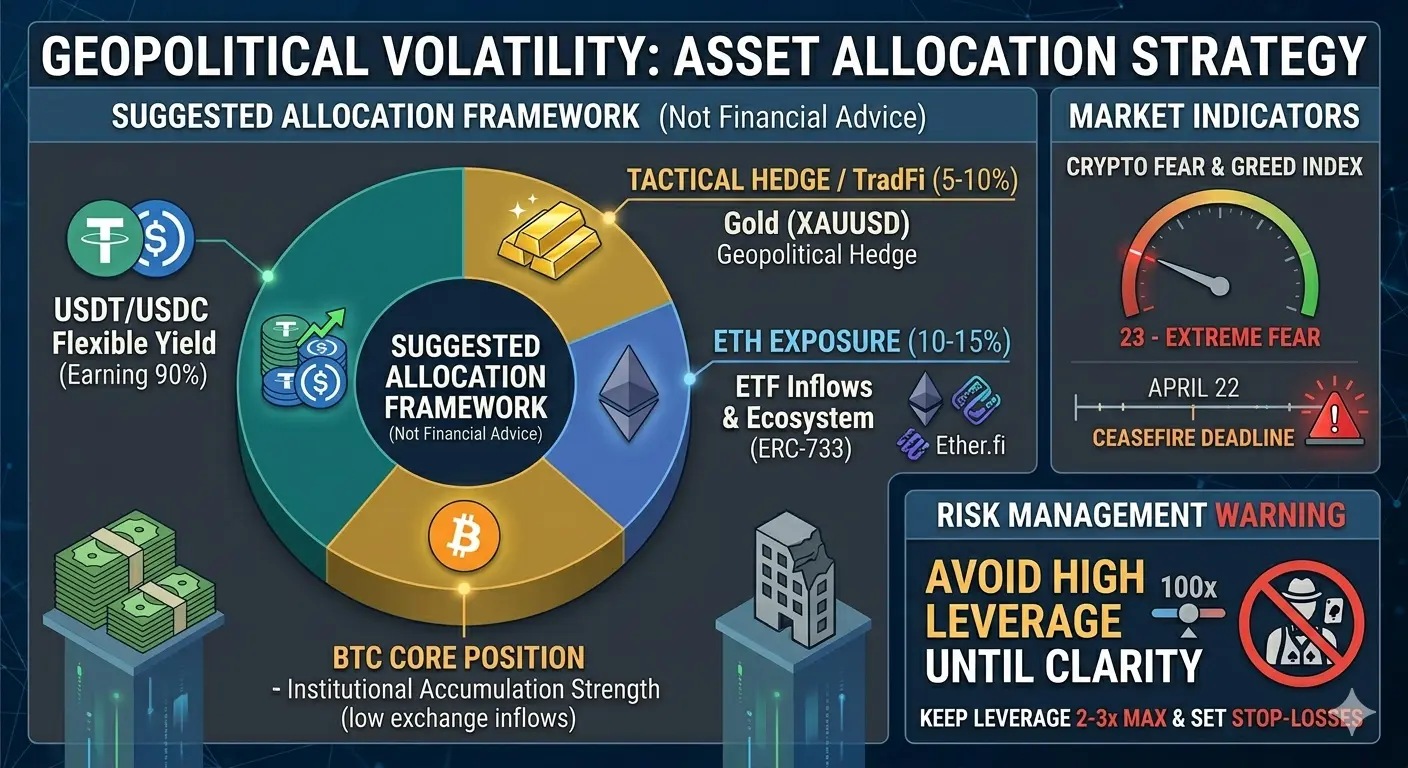
💼 Q3 — Smart Asset Allocation Strategy
🧠 Current Sentiment:
Fear & Greed Index: Extreme Fear (23)
→ historically a buy zone, but volatility still high
---
🪙 Suggested Strategy Framework:
1️⃣ Stable Base (40–50%)
USDT / USDC
Earn passive yield
Keep liquidity for dips
---
2️⃣ BTC Core (25–35%)
Bitcoin = strongest macro asset
Institutional accumulation remains strong
Key zone: $73K–$76K
---
3️⃣ ETH Exposure (10–15%)
Ethereum still undervalued vs BTC
Strong ecosystem growth
Better upside potential
---
4️⃣ Hedge Layer
Add Gold exposure
Protects against geopolitical shocks
---
5️⃣ Avoid High Leverage ⚠️
April 22 = key catalyst
High leverage = high risk
If used → keep it minimal (2–3x max)
---
🧭 Key Market Insight
This is not a “clear trend” market.
It’s a headline-driven volatility market.
👉 Peace = already priced
👉 Conflict = not fully priced
---
🧠 Final Take
Markets are betting on stability…
But stability is not guaranteed.
---
🎯 One-Line Summary
Hold your core positions, keep liquidity ready, and don’t chase highs — April 22 could decide the next major
repost-content-media
  • Reward
  • Comment
  • Repost
  • Share
#GatePreIPOsLaunchesWithSpaceX
SpaceX is not just a company — it represents a shift in how humanity approaches technology, exploration, and long-term ambition. From reusable rockets to interplanetary vision, it has redefined what is considered possible in the private sector. What once belonged only to governments is now being executed — and accelerated — by a single commercial entity.
Over the past decade, SpaceX has evolved from a high-risk startup into arguably the most influential aerospace company in the world. Its achievements are not incremental; they are exponential. The successful dev
GUSD0,01%
Vortex_King
#GatePreIPOsLaunchesWithSpaceX
SpaceX is not just a company — it represents a shift in how humanity approaches technology, exploration, and long-term ambition. From reusable rockets to interplanetary vision, it has redefined what is considered possible in the private sector. What once belonged only to governments is now being executed — and accelerated — by a single commercial entity.
Over the past decade, SpaceX has evolved from a high-risk startup into arguably the most influential aerospace company in the world. Its achievements are not incremental; they are exponential. The successful development of reusable launch systems has dramatically reduced the cost of space access. Its satellite network ambitions are reshaping global connectivity. And its long-term goal — making humanity a multi-planetary species — pushes it far beyond the boundaries of a typical corporation.
Now, something equally significant is happening on the financial side: access to SpaceX-like exposure before a traditional IPO structure becomes available to broader participants.
This opens up a serious discussion — not just about SpaceX itself, but about how investment access is evolving.
---
1. What Are Your Thoughts on SpaceX / SPCX?
Let’s begin with the bigger picture.
SpaceX operates in a domain where barriers to entry are extremely high. Aerospace is capital-intensive, technologically complex, and historically dominated by government contracts and legacy institutions. Yet SpaceX has managed to outperform many incumbents through innovation, speed, and vertical integration.
Its core strengths include:
Reusable rocket technology (cost disruption)
Strong government and private contracts (revenue stability)
Rapid iteration cycles (engineering advantage)
Expansion into satellite internet (diversification)
From an investment perspective, this creates a unique narrative: a company that is both visionary and already commercially viable.
However, the central question remains:
Does early exposure to such a company actually translate into long-term financial advantage?
Traditionally, early-stage or pre-IPO investors have enjoyed significant upside — but they also bear elevated risk. In SpaceX’s case, the risk profile is unusual. It is not an unproven startup, yet it is also not a publicly regulated, fully transparent entity.
This places it in a gray zone:
Less risk than early startups
More uncertainty than public companies
Another key factor is valuation.
The implied valuation sits around $1.4 trillion, which immediately raises questions.
Is this justified?
To answer that, we need to think in layers:
A. Current Business Value
SpaceX already generates billions in revenue through launch services and contracts. This provides a solid baseline.
B. Future Growth Potential
Its satellite network and space infrastructure ambitions could unlock entirely new markets.
C. Strategic Positioning
It has a first-mover advantage in several critical areas of space commercialization.
But even with all of that, a trillion-dollar valuation implies massive future expectations are already priced in.
So the real debate becomes:
Are you paying for what SpaceX is today?
Or for what it might become over the next 10–20 years?
If it successfully dominates multiple verticals (launch, satellite internet, deep space logistics), the valuation could be justified — even conservative.
If growth slows or competition increases, the valuation may appear overstretched.
This is where personal conviction plays a role.
Some investors see SpaceX as:
The “next-generation infrastructure layer” of humanity
Others see it as:
A highly ambitious company already priced for perfection
---
2. How the Subscription Model Works (In Simple Terms)
Now let’s simplify the structure behind SPCX.
SPCX is designed as a mirror instrument — meaning it reflects the valuation movement of SpaceX both before and after a potential IPO event.
Think of it like this:
You are not directly owning SpaceX equity, but you are gaining exposure to its valuation trajectory through a structured financial product.
Here are the key elements:
Entry Mechanics
Price per SPCX: $590
Minimum participation: $100 (USDT or GUSD)
Maximum allocation per user: 339 SPCX
This creates a relatively accessible entry point while still capping large-scale concentration.
Allocation System
The most critical feature is time-weighted allocation.
This means:
The earlier you subscribe, the higher your allocation weight
Late participants receive smaller portions
This system rewards early decision-making rather than last-minute entry.
In simple terms:
Early commitment = stronger positioning
This is very different from traditional IPO allocations, where retail participants often receive minimal shares regardless of timing.
Subscription Window
Total duration: 48 hours
This creates urgency, but also forces participants to make quick decisions based on limited information.
That alone introduces an important behavioral factor:
Some will act early with conviction
Others will hesitate and risk reduced allocation
Distribution Structure
100% unlocked at distribution
No lock-up period
No delayed vesting
This is significant.
In many traditional investment structures, early participants are subject to lock-ups, meaning they cannot exit for a fixed period.
Here, that restriction is removed.
So participants retain full liquidity from the start.
This creates flexibility — but also introduces volatility, since participants are free to enter and exit immediately.
---
Key Considerations Before Forming a View
To make a balanced judgment, it helps to step back and evaluate both sides.
Potential Advantages
Early exposure to a high-impact company
Lower entry barrier compared to traditional private markets
Liquidity without lock-ups
Time-based allocation rewards early action
Potential Risks
Indirect exposure (not actual equity ownership)
Valuation uncertainty
Limited transparency compared to public markets
Short decision window (48 hours)
Market sentiment-driven pricing behavior
This is not a typical investment scenario.
It sits somewhere between:
Venture capital access
Structured financial product
Speculative opportunity
And because of that, it requires a different mindset.
---
The Bigger Question
Beyond the mechanics, there is a deeper shift happening here.
Access to high-profile, pre-IPO opportunities is gradually expanding beyond traditional elite circles.
Historically, such opportunities were limited to:
Institutional investors
Venture capital firms
Ultra-high-net-worth individuals
Now, that barrier is being challenged.
But with increased access comes increased responsibility.
The key question is no longer just:
“Is this a good opportunity?”
It becomes:
“Do I understand what I’m participating in?”
Because accessibility without understanding can quickly turn into misjudgment.
---
Final Thoughts — Your Perspective Matters
This discussion is not about giving a definitive answer.
It’s about exploring perspectives.
Some participants will see this as:
A rare early entry into a generational company
Others will see it as:
A high-risk structure built around future expectations
Both views can be valid.
What matters is how you interpret:
The valuation
The structure
The timing
The long-term vision
---
Discussion Questions
Let’s bring it back to you:
1. Do you believe SpaceX is still an early opportunity — or is most of its growth already priced in?
2. How do you feel about mirror-based exposure like SPCX compared to direct equity ownership?
3. Does the “early subscription advantage” system encourage smart participation — or rushed decision-making?
4. Would you prioritize early allocation, or wait for more clarity even if it means reduced
repost-content-media
  • Reward
  • Comment
  • Repost
  • Share
#GateMarchTransparencyReport
Gate March 2026 Transparency Report: Key Highlights and Insights
Gate, one of the world’s leading digital asset exchanges, continues to strengthen user trust through high transparency and robust risk management. The March 2026 Transparency Report outlines its latest performance across reserves, trading activity, user growth, security, and platform innovation.
Below is a clear breakdown of the most important updates.
---
Step 1: Review of Reserves and Proof of Reserves
Gate maintains a strong reserve position well above industry standards.
Total reserve ratio incre
BTC0,79%
ETH0,2%
GT-0,82%
Vortex_King
#GateMarchTransparencyReport
Gate March 2026 Transparency Report: Key Highlights and Insights
Gate, one of the world’s leading digital asset exchanges, continues to strengthen user trust through high transparency and robust risk management. The March 2026 Transparency Report outlines its latest performance across reserves, trading activity, user growth, security, and platform innovation.
Below is a clear breakdown of the most important updates.
---
Step 1: Review of Reserves and Proof of Reserves
Gate maintains a strong reserve position well above industry standards.
Total reserve ratio increased to 125%
Total reserves reached $9.478 billion
Covers approximately 500 user assets
Key asset coverage:
BTC: 140.69%
ETH: 124.22%
USDT: 109.47%
GT: Over 100%
The platform uses Merkle Tree verification, allowing users to independently confirm that their assets are fully backed.
---
Step 2: Trading Volume and Market Position
Gate continues to rank among the top global exchanges.
Spot trading volume: $74 billion (Feb 2026)
Global spot ranking: Top 3
Derivatives ranking: Top 4 (11% market share)
TradeFi system performance:
Total volume exceeded $70 billion
Daily peak surpassed $10 billion
This highlights Gate’s growing strength in bridging traditional finance and crypto markets.
---
Step 3: User Growth and Ecosystem Expansion
While exact active user numbers are undisclosed, the platform shows strong ecosystem engagement.
Expansion of content platforms like Gate Square and Gate Live
Increased creator and institutional participation
Active presence at global industry events such as Consensus Hong Kong
These initiatives enhance user engagement and long-term retention.
---
Step 4: Security and Compliance Progress
Security and regulatory alignment remain core priorities.
All major assets are overcollateralized
Regular Proof of Reserves reporting ensures transparency
Third-party verification strengthens credibility
Compliance milestone:
Gate Technology Ltd obtained a Payment Institution (PI) license from the Malta Financial Services Authority under PSD2
This supports expansion into the European market.
---
Step 5: Technology and Product Innovation
Gate continues to invest in infrastructure and next-generation features.
Launch of CrossEx cross-exchange trading system
Introduction of natural language trading
Deployment of 17 MCP tools for advanced users
Ongoing API and system performance upgrades
---
Step 6: AI and Web3 Strategy
Gate is accelerating its vision for intelligent finance.
Integration of AI-driven trading tools
Expansion of TradeFi + Web3 ecosystem
Focus on automation, analytics, and smarter user experience
This positions the platform at the forefront of the next wave of financial innovation.
---
Step 7: Risk Considerations
Despite strong fundamentals, users should remain cautious.
Crypto markets remain volatile
Regulatory environments continue to evolve
Security risks still exist across the industry
Best practices:
Diversify assets
Use stop-loss strategies
Manage risk exposure carefully
---
Step 8: Overall Assessment
Gate demonstrates strong performance across all key metrics:
High reserve coverage ensures user fund safety
Competitive trading volume and rankings
Expanding ecosystem and global presence
Ongoing compliance and licensing progress
Continuous innovation in AI and Web3
---
Final Takeaway
The March 2026 Transparency Report reinforces Gate’s position as a leading global digital asset platform. Its commitment to transparency, security, and innovation provides a solid foundation for future growth.
As AI and Web3 continue to reshape the industry, Gate is well-positioned to remain a major player in the evolving financial landscape.
repost-content-media
  • Reward
  • Comment
  • Repost
  • Share
#Web3SecurityGuide #Web3SecurityGuide
The rise of Web3 has unlocked a new era of digital ownership, decentralization, and financial freedom. But with this innovation comes responsibility—especially when it comes to security. Unlike traditional systems where institutions safeguard your assets, in Web3, you are your own bank. That means protecting your funds, identity, and access is entirely in your hands.
🚨 Why Web3 Security Matters
The decentralized world operates without intermediaries, making transactions faster and permissionless. However, this also means there’s no “customer support” to r
ShainingMoon
#Web3SecurityGuide #Web3SecurityGuide
The rise of Web3 has unlocked a new era of digital ownership, decentralization, and financial freedom. But with this innovation comes responsibility—especially when it comes to security. Unlike traditional systems where institutions safeguard your assets, in Web3, you are your own bank. That means protecting your funds, identity, and access is entirely in your hands.
🚨 Why Web3 Security Matters
The decentralized world operates without intermediaries, making transactions faster and permissionless. However, this also means there’s no “customer support” to recover lost funds. Hacks, phishing attacks, rug pulls, and smart contract exploits have already cost users billions. Understanding how to stay secure is not optional—it’s essential.
🔑 Protect Your Private Keys
Your private key is the master key to your crypto wallet. Never share it with anyone, under any circumstances. Store it offline using hardware wallets or secure backups. Avoid saving it in screenshots, cloud storage, or notes apps, as these can be compromised.
🧠 Beware of Phishing Attacks
Scammers often impersonate trusted platforms, sending fake links via email, social media, or messaging apps. Always double-check URLs before connecting your wallet. Bookmark official websites and avoid clicking on suspicious links—even if they look legitimate.
🛡️ Use Hardware Wallets
Hardware wallets provide an extra layer of security by keeping your private keys offline. Even if your computer is infected with malware, your funds remain protected. For long-term holders or large investments, this is one of the safest options available.
🔍 Verify Smart Contracts
Before interacting with any DeFi platform, do your research. Check if the project has been audited by reputable firms. Read user reviews, analyze tokenomics, and avoid projects that promise unrealistic returns. If something sounds too good to be true, it probably is.
🔐 Enable Multi-Factor Authentication (MFA)
Whenever possible, enable MFA on your crypto exchanges and wallets. This adds an extra verification step, making it harder for attackers to gain access even if your password is compromised.
📱 Stay Updated & Educated
The Web3 space evolves rapidly, and so do security threats. Follow trusted sources, join communities, and stay informed about the latest scams and vulnerabilities. Knowledge is your strongest defense.
⚠️ Avoid Public Wi-Fi for Transactions
Public networks can expose your data to hackers. Always use a secure, private connection when accessing your crypto accounts or signing transactions.
🧾 Final Thoughts
Web3 is powerful, but it demands awareness and caution. By following basic security practices, you can significantly reduce risks and enjoy the benefits of decentralization with confidence.
Stay safe, stay smart, and always verify before you trust.
✍️ SHAININGMOON
repost-content-media
  • Reward
  • Comment
  • Repost
  • Share
#OilPricesRise
#OilPricesRise
Deep Macro, Supply-Demand, Geopolitics & Crypto Market Impact Analysis
Oil price movements are not random.
They are one of the strongest signals of global macro stress, liquidity shifts, and geopolitical tension.
When oil rises, it affects:
Inflation
Interest rates
Corporate profits
Risk appetite
And indirectly—crypto markets
This is not just an energy story.
👉 It is a global financial system story.
🌍 PART 1 — WHY OIL PRICES RISE
🧠 1. Supply-Side Constraints
Oil prices (e.g., Crude Oil) rise when supply is restricted.
Key factors:
Production cuts by major prod
BTC0,79%
Vortex_King
#OilPricesRise
#OilPricesRise
Deep Macro, Supply-Demand, Geopolitics & Crypto Market Impact Analysis
Oil price movements are not random.
They are one of the strongest signals of global macro stress, liquidity shifts, and geopolitical tension.
When oil rises, it affects:
Inflation
Interest rates
Corporate profits
Risk appetite
And indirectly—crypto markets
This is not just an energy story.
👉 It is a global financial system story.
🌍 PART 1 — WHY OIL PRICES RISE
🧠 1. Supply-Side Constraints
Oil prices (e.g., Crude Oil) rise when supply is restricted.
Key factors:
Production cuts by major producers
Geopolitical tensions in oil-producing regions
Sanctions on exporting countries
Refinery or transportation disruptions
👉 Reduced supply + stable demand = higher prices
📈 2. Demand Strength
Oil demand increases when:
Global economy is growing
Industrial activity rises
Travel and transportation increase
👉 Strong demand pushes prices upward
⚠️ 3. Geopolitical Risk Premium
Markets price in risk.
When conflict or instability rises:
Oil supply becomes uncertain
Traders price in potential disruption
👉 This creates a “risk premium” in oil prices
📊 PART 2 — MACRO ECONOMIC IMPACT
🔥 1. Inflation Pressure
Oil is a core input in:
Transportation
Manufacturing
Agriculture
When oil rises:
👉 Cost of goods increases → inflation rises
🏦 2. Central Bank Response
Central banks react to rising inflation by:
Increasing interest rates
Tightening liquidity
👉 Higher rates = pressure on risk assets
📉 3. Impact on Global Growth
High oil prices can:
Slow economic growth
Reduce consumer spending
Increase business costs
👉 This creates a drag on global markets
📊 PART 3 — IMPACT ON FINANCIAL MARKETS
📉 1. Stock Market Reaction
Equities may react negatively because:
Costs increase for companies
Profit margins shrink
Economic uncertainty rises
🟡 2. Gold Reaction
Gold (e.g., Gold) may:
Rise as a hedge against inflation
Attract safe-haven demand
But:
👉 Behavior depends on real interest rates
₿ 3. Crypto Market Reaction
Crypto assets like Bitcoin (e.g., Bitcoin) react in complex ways:
🟢 Bullish Scenario
Rising oil → inflation hedge narrative
Bitcoin viewed as “digital gold”
Capital flows into BTC
🔴 Bearish Scenario
Rising oil → higher interest rates
Liquidity tightens
Risk assets fall
👉 Crypto is caught between:
Inflation hedge
And risk asset behavior
🔄 PART 4 — CAPITAL FLOW DYNAMICS
🧠 1. Liquidity Tightening
Higher oil prices can lead to:
Central bank tightening
Reduced liquidity
Less speculative capital
👉 This affects crypto first
🔁 2. Capital Rotation
When oil rises:
Capital moves into energy sector
Moves away from speculative assets
👉 Risk assets may underperform
📊 3. Sector Rotation
Investors may:
Increase exposure to energy stocks
Reduce exposure to tech and crypto
👉 Market structure shifts
⚙️ PART 5 — TRADING IMPACT & STRATEGY
🧠 1. Understanding Correlation
Oil and crypto are not directly correlated, but:
👉 They are linked through liquidity and macro conditions
📉 2. Bearish Crypto Scenario (Oil Rising + Tight Liquidity)
If oil rises and central banks tighten:
BTC may face resistance
Altcoins may underperform
Volatility increases
👉 Strategy:
Trade defensively
Focus on capital preservation
🟢 3. Bullish Crypto Scenario (Oil Rising + Inflation Narrative)
If oil rises due to inflation:
BTC can benefit as hedge
Long-term investors accumulate
Narrative strengthens
👉 Strategy:
Accumulate on dips
Focus on strong assets
⚠️ 4. Volatility Opportunities
Oil spikes often create:
Market uncertainty
Rapid price swings
👉 Opportunities:
Breakout trades
Liquidity sweeps
Mean reversion setups
📊 PART 6 — SUPPORT & RESISTANCE THINKING
📈 Oil Resistance Zones
Previous highs
Supply zones
Geopolitical resolution points
📉 Oil Support Zones
Production cost levels
Demand zones
Strategic reserves impact
👉 Traders watch these levels to anticipate:
Breakouts
Reversals
Trend continuation
🧱 PART 7 — KEY RISK FACTORS
⚠️ 1. Demand Shock
Economic slowdown
Reduced consumption
👉 Can quickly reverse oil uptrend
⚠️ 2. Supply Recovery
Increased production
Resolution of geopolitical issues
👉 Can cause sharp oil declines
⚠️ 3. Central Bank Aggression
Higher interest rates
Liquidity tightening
👉 Risk assets suffer
🧠 PART 8 — MARKET SENTIMENT ANALYSIS
📊 1. Fear vs Inflation Narrative
Oil rising creates two competing narratives:
Fear (economic slowdown)
Inflation hedge (asset protection)
👉 Market direction depends on which dominates
🧠 2. Smart Money Behavior
Institutional investors:
Hedge inflation
Adjust portfolios early
Move capital strategically
👉 Retail often reacts late
🔑 KEY TAKEAWAYS
Oil prices rise due to supply constraints, demand strength, or geopolitical risk
Rising oil increases inflation and central bank pressure
Risk assets (stocks, crypto) are affected through liquidity changes
Bitcoin may act as both risk asset and inflation hedge
Market direction depends on macro balance between growth and inflation
🧠 FINAL STRATEGIC INSIGHT
Oil is not just an energy commodity.
👉 It is a global macro signal
When oil rises:
Inflation rises
Liquidity tightens
Markets become more volatile
And in this environment:
👉 The smartest traders do not guess direction
👉 They adapt to macro conditions
🏁 Closing Thought
Oil price increases are not just about barrels and supply.
👉 They are about the cost of the entire global economy
And the traders who understand this:
👉 Can anticipate shifts before they happen
👉 And position themselves with precision
repost-content-media
  • Reward
  • Comment
  • Repost
  • Share
#CreatorLeaderboard
📉 Ultra-Deep Market Analysis — Gold & Silver Under Macro and Structural Pressure
The current pullback in precious metals is not a simple correction—it is the result of a complex interaction between global macroeconomics, central bank policy, liquidity cycles, industrial demand, and technical market positioning.
To truly understand what is happening, we must break the market into layers: macro forces, financial flows, structural positioning, and sentiment cycles.
🌍 1. Macro Liquidity Cycle — The Core Driver
Precious metals move in cycles that are heavily influenced by glo
Vortex_King
#CreatorLeaderboard
📉 Ultra-Deep Market Analysis — Gold & Silver Under Macro and Structural Pressure
The current pullback in precious metals is not a simple correction—it is the result of a complex interaction between global macroeconomics, central bank policy, liquidity cycles, industrial demand, and technical market positioning.
To truly understand what is happening, we must break the market into layers: macro forces, financial flows, structural positioning, and sentiment cycles.
🌍 1. Macro Liquidity Cycle — The Core Driver
Precious metals move in cycles that are heavily influenced by global liquidity conditions.
💧 Liquidity Expansion Phase (Bullish for Metals)
Central banks inject money into the system
Interest rates are low
Credit is easily available
Investors seek inflation hedges
👉 This environment drives gold and silver higher.
💧 Liquidity Contraction Phase (Bearish for Metals)
Central banks tighten policy
Money supply growth slows
Credit becomes expensive
Risk assets face pressure
👉 This is exactly where the market is now.
🏦 Central Role of the Federal Reserve
The policies of the Federal Reserve are central to this cycle.
When the Fed:
Keeps rates high → metals struggle
Signals tightening → metals decline
Reduces liquidity → downside pressure increases
👉 Precious metals are liquidity-sensitive assets.
💵 2. Dollar Strength — The Silent Pressure Engine
Gold and silver are inversely correlated with the U.S. dollar.
Why the Dollar Matters
Metals are priced globally in USD
Strong dollar = higher cost for foreign buyers
Weak dollar = cheaper metals internationally
📊 Impact of the U.S. Dollar Index
The U.S. Dollar Index measures dollar strength.
Rising DXY → bearish for gold & silver
Falling DXY → bullish for metals
🔁 Current Situation
Dollar strength remains elevated
Safe-haven flows are shifting into USD
Global liquidity remains tight
👉 This creates consistent downward pressure on precious metals.
📈 3. Interest Rates and Real Yields — The Hidden Driver
📉 Nominal vs Real Rates
Nominal rates = stated interest rates
Real rates = interest rates adjusted for inflation
👉 Gold is most sensitive to real yields, not just nominal rates.
🔗 Why Higher Real Yields Hurt Gold
Gold:
Produces no yield
Has storage costs
Relies on price appreciation
When real yields rise:
👉 Holding gold becomes less attractive
🏦 Role of Treasury Markets
U.S. bond yields, especially the 10-year, influence gold heavily.
When yields rise:
Capital flows into bonds
Demand for gold weakens
📉 4. Institutional Positioning & Smart Money Behavior
🧠 Hedge Funds and Asset Managers
Large players are not reacting emotionally—they are positioning strategically.
They track macro signals
They adjust exposure based on policy expectations
They lock profits at key levels
📊 ETF Flows — A Key Indicator
Gold-backed ETFs act as a proxy for institutional demand.
When ETF flows:
Increase → bullish signal
Decrease → bearish signal
Current trend suggests: 👉 Outflows or reduced inflows during pullback
💼 Profit-Taking Phase
After strong rallies:
Institutions take profits
Positions are unwound
Short-term selling pressure increases
👉 This is a normal redistribution phase, not panic selling.
⚙️ 5. Gold vs Silver — Diverging Behavior
🟡 Gold: Monetary Asset
Gold is driven by:
Inflation expectations
Central bank policy
Currency strength
👉 Gold is the “safe haven anchor”.
⚪ Silver: Hybrid Asset
Silver behaves as both:
A monetary asset
An industrial commodity
🏭 Industrial Sensitivity
Silver demand is heavily tied to:
Manufacturing
Electronics
Solar energy
EV production
👉 When global growth slows:
➡ Silver tends to drop harder than gold
📊 Gold-to-Silver Ratio
This ratio indicates relative strength:
High ratio → silver is undervalued or weak
Low ratio → silver is strong
👉 Current behavior suggests silver is underperforming gold.
📡 6. Global Economic Signals
🌐 Growth Expectations
When global growth improves:
Investors move into equities
Risk appetite increases
Safe havens lose demand
👉 This creates selling pressure on metals.
📉 Recession vs Expansion
Scenario
Impact on Metals
Recession
Bullish
Expansion
Bearish or neutral
Uncertainty
Strong bullish
🏦 Central Bank Gold Demand
Central banks continue to:
Accumulate gold as reserves
Diversify away from USD exposure
This creates a long-term structural bullish base, even during pullbacks.
📊 7. Technical Market Structure
📉 Market Phases
Markets move in cycles:
Accumulation
Markup (rally)
Distribution
Markdown (correction)
👉 The current pullback may represent:
Late distribution or early markdown phase
🔻 Key Technical Signals
Price rejection at resistance
Lower highs forming
Weak momentum
Increased volatility
🔁 Support & Liquidity Zones
Markets tend to:
Revisit previous liquidity zones
Fill inefficiencies
Balance order flow
👉 Pullbacks often target liquidity below key levels.
⚠️ 8. Risk Factors Driving Downward Pressure
💣 1. Unexpected Policy Shifts
If the Federal Reserve maintains restrictive policy longer:
👉 Metals remain under pressure
🌐 2. Geopolitical Stability
Conflict increases gold demand
Peace reduces safe-haven demand
👉 Current easing tensions = bearish pressure
💰 3. Liquidity Crunch Events
During financial stress:
Assets are sold to raise cash
Gold can be temporarily sold
👉 This creates sharp downside spikes
🔮 9. Future Scenarios — Where Are We Headed?
🚀 Bullish Case
Metals surge if:
Inflation rises again
Interest rates are cut
Dollar weakens
Global instability increases
👉 This would trigger a new strong rally phase
⚖️ Neutral Case
Sideways consolidation
Range-bound trading
Accumulation phase
👉 This often precedes the next big move
📉 Bearish Case
Further downside if:
Dollar strengthens
Rates stay elevated
Risk assets outperform
Liquidity remains tight
🧠 10. Strategic Insight — What Smart Money Knows
📌 1. This Is a Cycle, Not a Collapse
Pullbacks are:
Healthy
Necessary
Structural
👉 Markets do not move in straight lines.
📌 2. Liquidity Dictates Everything
Liquidity expansion = bullish
Liquidity contraction = bearish
👉 Always track liquidity before price.
📌 3. Metals Are Long-Term Assets
Gold and silver are not just trades—they are:
Monetary hedges
Systemic risk protection
Long-term wealth stores
🧠 Final Conclusion
The current pressure on precious metals is driven by:
Stronger U.S. dollar
Elevated interest rates
Liquidity contraction
Institutional profit-taking
Shifting global risk sentiment
However:
👉 This is not the end of the bull case.
Instead, it is a strategic reset phase within a larger macro cycle.
📌 Final Thought
Markets are controlled by:
👉 Liquidity, not emotions
👉 Macro, not noise
👉 Positioning, not headlines
#Gate广场 #GateSquare #创作者冲榜 #内容挖矿
repost-content-media
  • Reward
  • Comment
  • Repost
  • Share
#GateSquareAprilPostingChallenge
📊 The April Crypto Narrative — Deep Market Structure, Psychology & Opportunity
April is not just another month in crypto markets—it is often a transition point where liquidity, sentiment, and positioning align to create major moves. The is more than a trend; it is a reflection of how traders, analysts, and creators interpret market conditions through structure, psychology, and data.
🌍 1. The Macro Environment — Why April Matters
Crypto markets are deeply tied to global macro liquidity. Every major move in Bitcoin and altcoins is influenced by:
Central bank p
BTC0,79%
Vortex_King
#GateSquareAprilPostingChallenge
📊 The April Crypto Narrative — Deep Market Structure, Psychology & Opportunity
April is not just another month in crypto markets—it is often a transition point where liquidity, sentiment, and positioning align to create major moves. The is more than a trend; it is a reflection of how traders, analysts, and creators interpret market conditions through structure, psychology, and data.
🌍 1. The Macro Environment — Why April Matters
Crypto markets are deeply tied to global macro liquidity. Every major move in Bitcoin and altcoins is influenced by:
Central bank policy
Dollar strength
Global liquidity flows
Risk appetite shifts
When liquidity expands, capital flows into risk assets like crypto. When liquidity contracts, markets struggle and volatility increases.
👉 This is why April often becomes a pivot month—a time when markets reassess direction after Q1 positioning.
💧 2. Liquidity Is the Real Market Driver
Markets do not move randomly. They move toward liquidity.
Buy-side liquidity sits above resistance
Sell-side liquidity sits below support
Smart money hunts these zones to execute large positions.
👉 This creates:
Fake breakouts
Stop hunts
Sudden reversals
Understanding liquidity is the difference between:
reacting emotionally
and trading strategically
🧠 3. Smart Money Behavior — What Institutions Are Doing
Institutions don’t chase price. They:
Accumulate at lows
Distribute at highs
Manipulate in between
This creates the illusion of randomness, but in reality, the market is structured.
Key behaviors include:
Liquidity sweeps before reversals
False breakouts to trap retail
Gradual accumulation during low volatility
👉 If you follow structure, you follow smart money.
📊 4. Market Structure — The Foundation of Every Trade
Every market is built on structure:
Higher highs & higher lows = bullish
Lower highs & lower lows = bearish
Break of structure = trend confirmation
Change of character = potential reversal
Without understanding structure, trading becomes guesswork.
👉 Structure tells you:
Direction
Strength
Continuation or reversal
🔁 5. The Psychology of Retail Traders
Retail traders often behave in predictable ways:
Buy after large green candles
Sell after panic
Enter too early or too late
Over-leverage trades
This is exactly what institutions exploit.
👉 Markets are designed to take money from emotional participants.
⚙️ 6. Volatility — The Opportunity Engine
Volatility is often misunderstood as risk.
In reality:
👉 Volatility = Opportunity
Sharp moves create:
Liquidity gaps
Fair value gaps
Imbalance zones
These become high-probability entry points when combined with structure.
📉 7. The Role of Support & Resistance
Support and resistance are not just lines—they are:
Psychological levels
Liquidity pools
Decision zones
Price reacts at these levels because:
Orders are concentrated there
Market participants make decisions there
👉 The best trades happen at extremes—not in the middle.
🔥 8. Market Phases — Where Are We Now?
Markets move in cycles:
Accumulation
Expansion
Distribution
Correction
Most traders fail because they trade against the phase.
👉 Identifying the phase is critical:
Accumulation → prepare
Expansion → ride
Distribution → exit
Correction → wait or accumulate
🧩 9. Strategy Framework — How to Approach the Market
A professional trading approach includes:
1. Macro Analysis
Understand global conditions
Track liquidity cycles
2. Structure Analysis
Identify trend direction
Wait for confirmations
3. Liquidity Mapping
Mark highs and lows
Identify stop zones
4. Entry Execution
Enter after confirmation
Never predict—react
5. Risk Management
Control risk per trade
Focus on consistency
🚀 10. The Real Edge in Trading
The biggest edge is not indicators.
It is:
Patience
Discipline
Structure understanding
Emotional control
👉 Consistency beats intelligence in trading.
📌 Final Thought
The #GateSquareAprilPostingChallenge is not just about posting content—it’s about understanding the market at a deeper level.
Markets reward:
Prepared traders
Disciplined traders
Structured thinkers
And punish:
Emotional decisions
Random entries
Overconfidence
🧠 Closing Insight
👉 The market is a game of probabilities, not certainty
👉 Smart money controls direction
👉 Liquidity dictates movement
Trade with structure. Trade with logic. Trade with patience.
🔥 VORTEX KING
🔥 VORTEX KING
repost-content-media
  • Reward
  • Comment
  • Repost
  • Share
#CreatorLeaderboard
🐶 DOGE Market Analysis — Current Situation (Deep Breakdown)
Dogecoin is currently moving in a tight consolidation phase after a period of volatility. The market is showing indecision, meaning neither bulls nor bears have full control yet.
📊 Market Behavior Right Now
Price is hovering around a key psychological zone near $0.09
Volume is declining, indicating weak momentum
Market structure is forming a range between support and resistance
Traders are waiting for a clear breakout before committing capital
DOGE is still heavily influenced by Bitcoin direction and overall cry
DOGE-2,89%
BTC0,79%
Vortex_King
#CreatorLeaderboard
🐶 DOGE Market Analysis — Current Situation (Deep Breakdown)
Dogecoin is currently moving in a tight consolidation phase after a period of volatility. The market is showing indecision, meaning neither bulls nor bears have full control yet.
📊 Market Behavior Right Now
Price is hovering around a key psychological zone near $0.09
Volume is declining, indicating weak momentum
Market structure is forming a range between support and resistance
Traders are waiting for a clear breakout before committing capital
DOGE is still heavily influenced by Bitcoin direction and overall crypto sentiment
👉 This phase is often called “accumulation or distribution zone” depending on who controls liquidity.
📉 KEY SUPPORT LEVELS (Demand Zones)
These are areas where buyers are expected to step in and defend price.
🔹 1. Immediate Support: $0.090 – $0.088
This is the current battle zone
Price has tested this level multiple times
If held → confirms short-term strength
If broken → triggers stop losses and liquidity sweep
👉 This level is critical because it defines the current structure
🔹 2. Secondary Support: $0.085 – $0.088
Acts as a buffer zone
Often used for accumulation by smart money
A breakdown here suggests weak market confidence
🔹 3. Strong Support: $0.079 – $0.080
Historical accumulation zone
Represents value area for long-term buyers
If price reaches here:
Expect strong reaction (bounce or reversal)
Market becomes oversold
🔹 4. Deep Support: $0.070
Major psychological and structural level
Seen as a panic zone
If reached:
Could trigger mass liquidation
But also potential high-risk accumulation
📈 KEY RESISTANCE LEVELS (Supply Zones)
These are areas where sellers are likely to enter.
🔹 1. Immediate Resistance: $0.100
The most important level right now
Strong psychological barrier
Break above this = bullish confirmation
👉 This is the make-or-break level
🔹 2. Mid Resistance: $0.102 – $0.116
Area where previous selling pressure appeared
Often leads to:
Fake breakouts
Liquidity traps
Needs strong volume to break
🔹 3. Strong Resistance: $0.15 – $0.18
Long-term supply zone
Historically rejected multiple rallies
Represents:
Profit-taking zone
Institutional sell pressure
🔹 4. Major Resistance: $0.20+
Long-term breakout region
Requires:
Strong Bitcoin rally
High market liquidity
Retail FOMO (fear of missing out)
👉 Breaking this could signal a new macro uptrend
📊 MARKET STRUCTURE ANALYSIS
🧠 Current Structure
Market is in a sideways consolidation
Forming a range between $0.088 and $0.100
This is a compression phase
👉 Compression usually leads to a strong breakout
🔍 What This Means
The longer the consolidation:
The stronger the eventual move
Liquidity builds above resistance and below support
Smart money is likely:
Accumulating at support
Distributing near resistance
🔮 NEXT POSSIBLE MARKET MOVES
🟢 Bullish Scenario (Upside Breakout)
Trigger:
Strong breakout above $0.100 with volume
Expected Moves:
First target: $0.102 – $0.116
Next target: $0.15
Extended rally: $0.18 – $0.20
Confirmation Signals:
Increasing volume
Strong bullish candles
Break of local highs
👉 This could start a new mini uptrend
🔵 Neutral Scenario (Range Trading)
Range:
$0.088 → $0.100
Behavior:
Price moves sideways
Rejections at both ends
Low volatility environment
Strategy:
Buy near support
Sell near resistance
Avoid breakout traps
👉 This is the most likely short-term scenario
🔴 Bearish Scenario (Breakdown)
Trigger:
Break below $0.088 support
Expected Moves:
Drop toward: $0.080
Further downside: $0.070
Confirmation Signals:
High selling volume
Breakdown with strong candles
Failure to reclaim support
👉 This may lead to a market correction phase
🧠 ADVANCED MARKET INSIGHT (SMART MONEY VIEW)
📌 Liquidity Concept
Above $0.100 = liquidity zone (buy stops)
Below $0.088 = liquidity zone (sell stops)
👉 Price often moves to hunt liquidity before reversing
📌 Likely Manipulation Pattern
Fake breakdown below support
Liquidity grab (stop-loss hunting)
Sharp reversal upward
OR
Fake breakout above resistance
Trap retail buyers
Strong dump afterward
📊 FINAL STRUCTURE SUMMARY
Type
Level
Current Price Zone
~$0.09
Immediate Support
$0.088 – $0.090
Strong Support
$0.079 – $0.080
Deep Support
$0.070
Immediate Resistance
$0.100
Breakout Target
$0.102 – $0.116
Major Resistance
$0.15 – $0.18
Macro Target
$0.20+
🧩 CONCLUSION
Dogecoin is currently in a decision zone:
Holding support = bullish continuation potential
Losing support = downside correction
Breaking resistance = new bullish momentum
👉 The next big move depends on $0.088 and $0.100 levels
#Gate广场 #GateSquare #创作者冲榜 #内容挖矿
repost-content-media
  • Reward
  • Comment
  • Repost
  • Share
#GateSquareAprilPostingChallenge
🪙 Silver (XAG/USD) Market Analysis — April 2026
Silver is one of the most dynamic assets in the global financial market. It sits at the intersection of precious metals, industrial demand, inflation hedging, and speculative trading. In April 2026, silver is experiencing a highly sensitive phase driven by macroeconomic uncertainty, monetary policy expectations, and global geopolitical tensions.
📊 Current Price Situation
As of early April 2026:
Silver Price (XAG/USD): ≈ $27 – $29 per ounce
Market structure: Sideways to slightly bullish consolidation
Volatility:
Vortex_King
#GateSquareAprilPostingChallenge
🪙 Silver (XAG/USD) Market Analysis — April 2026
Silver is one of the most dynamic assets in the global financial market. It sits at the intersection of precious metals, industrial demand, inflation hedging, and speculative trading. In April 2026, silver is experiencing a highly sensitive phase driven by macroeconomic uncertainty, monetary policy expectations, and global geopolitical tensions.
📊 Current Price Situation
As of early April 2026:
Silver Price (XAG/USD): ≈ $27 – $29 per ounce
Market structure: Sideways to slightly bullish consolidation
Volatility: Moderate but expanding
👉 Silver has recently rebounded from lower levels near $25 and is now testing upper resistance zones. The market is in a compression phase, which often leads to a strong breakout.
📉 Technical Structure Overview
🔹 Trend Analysis
Short-term (1D – 4H): Bullish consolidation
Mid-term (1W): Range-bound
Long-term: Gradual uptrend since 2023 lows
Silver is forming a base structure, indicating accumulation by institutional players.
📊 Key Support Levels
Support levels are critical zones where buyers step in:
🟢 Strong Support Zones:
$26.00 – $26.50
Major demand zone
Previous breakout retest area
$25.00 – $25.30
Psychological + structural support
High liquidity zone
$23.80 – $24.20
Long-term support
Smart money accumulation zone
👉 If price drops into these zones, expect buying pressure and reversals.
📈 Key Resistance Levels
Resistance zones where selling pressure appears:
🔴 Major Resistance Levels:
$29.50 – $30.00
Strong psychological resistance
Previous rejection area
$31.20 – $32.00
Breakout zone from 2021–2022 highs
$34.50+
Long-term macro resistance
Potential bull cycle expansion target
👉 A clean breakout above $30 can trigger a strong bullish rally.
🧠 Smart Money (ICT) Perspective
From an institutional trading viewpoint:
🔍 Liquidity Zones:
Equal highs near $30 → liquidity pool
Equal lows near $25 → stop hunt zone
💡 Market Behavior:
Price is likely to:
Sweep liquidity below $26 (fake drop)
Then push upward aggressively
👉 This is classic accumulation → manipulation → expansion cycle
🌍 Fundamental Analysis
Silver is not just a metal—it’s a hybrid asset influenced by multiple sectors:
🏦 1. Interest Rates & US Dollar
When interest rates fall → silver rises
Weak USD → bullish for silver
Current situation:
Markets expect rate cuts in 2026
USD showing signs of weakness
👉 This supports bullish silver outlook
⚡ 2. Industrial Demand
Silver is heavily used in:
Solar panels ☀️
Electric vehicles 🚗
Electronics 📱
Green energy expansion is boosting long-term demand.
👉 Industrial demand = strong fundamental backbone
🛢️ 3. Geopolitical Tensions
War and instability increase safe-haven demand.
Silver benefits alongside gold
Investors shift to metals during uncertainty
👉 Current global instability = bullish factor
📉 4. Inflation Hedge
Silver acts as protection against:
Currency devaluation
Inflation spikes
👉 With ongoing inflation concerns, silver remains attractive.
📊 Market Sentiment
🟢 Bullish Factors:
Weak USD
Rate cut expectations
Industrial demand growth
Institutional accumulation
🔴 Bearish Risks:
Strong USD rebound
Economic slowdown reducing industrial demand
Rejection at $30 resistance
🔮 Price Scenarios (Next Move)
🟢 Bullish Scenario
If silver breaks $30:
Target 1: $31.50
Target 2: $33.00
Target 3: $35.00+
👉 Momentum-driven rally likely
🔴 Bearish Scenario
If silver fails at resistance:
Drop to: $26.50
Possible deeper pullback: $25.00
👉 This would be a liquidity grab before upside
📊 Trading Strategy (Professional Setup)
📈 Buy Setup (Preferred)
Entry: $26.50 – $27.00
Stop Loss: $25.40
Take Profit:
TP1: $29.50
TP2: $31.50
TP3: $34.00
📉 Sell Setup (Counter-Trend)
Entry: $29.50 – $30.00
Stop Loss: $31.20
Take Profit:
TP1: $27.50
TP2: $26.00
🧩 Market Psychology
Retail traders:
Often sell at support
Buy at resistance
Institutions:
Do the opposite
👉 Current structure suggests:
Smart money accumulating below $28
Retail traders trapped in range
🧠 Deep Insight: Why Silver Moves Differently Than Gold
Factor
Silver
Gold
Volatility
High
Moderate
Industrial Use
High
Low
Speculation
High
Medium
Safe Haven
Medium
Very High
👉 Silver = Gold + Technology Demand
🚀 Long-Term Outlook (2026–2028)
Silver could enter a super cycle due to:
Green energy expansion
Supply shortages
Inflation persistence
📊 Long-Term Targets:
$35 (mid-term)
$40+ (bull cycle)
Extreme scenario: $50
⚠️ Risk Management
Always remember:
Silver is highly volatile
Fake breakouts are common
News-driven spikes can trap traders
👉 Use:
Proper stop-loss
Position sizing
Confirmation entries
🧾 Final Summary
Current Price: $27–$29
Trend: Bullish consolidation
Strong Support: $26 / $25
Resistance: $30 / $32
Outlook: Bullish if breakout happens
🏁 Final Verdict
Silver is currently in a high-probability accumulation phase. The market is preparing for a major move, and all signs suggest that upside potential outweighs downside risk in the medium term.
However, patience is key.
https://www.gate.com/announcements/article/50520
👉 The real move begins after breakout above $30
repost-content-media
  • Reward
  • Comment
  • Repost
  • Share
  • Pin