What is KAS: A Comprehensive Guide to Kaspa's Native Cryptocurrency and Its Role in Blockchain Technology
Kaspa's Positioning and Significance
In 2021, Kaspa (KAS) was introduced as a fast, open-source, decentralized, and fully scalable Layer-1 blockchain. It aims to address the scalability and speed limitations of traditional blockchain networks.
As a proof-of-work cryptocurrency implementing the GHOSTDAG protocol, Kaspa plays a crucial role in the blockchain scalability sector. Unlike traditional blockchains, GHOSTDAG allows parallel block creation, enabling them to coexist and be sorted in consensus.
As of 2025, Kaspa has become a notable player in the cryptocurrency market, ranking 74th by market capitalization. It boasts an active developer community and a real-time block DAG visualizer that demonstrates the operation of GHOSTDAG. This report will analyze its technical architecture, market performance, and future potential.
Origin and Development History
Birth Background
Kaspa was created in 2021 to tackle the scalability issues faced by many blockchain networks. It emerged during a period of increasing demand for high-performance blockchain solutions, aiming to provide a fast and scalable alternative to existing cryptocurrencies.
The project's goal was to revolutionize blockchain technology by implementing the GHOSTDAG protocol, allowing for parallel block creation and faster transaction processing. Kaspa's launch opened new possibilities for applications requiring high throughput and quick finality.
Important Milestones
- 2021: Mainnet launch, implementing the GHOSTDAG protocol for improved scalability and speed.
- 2022-2025: Continuous development and improvement of the Kaspa network, attracting attention from the cryptocurrency community.
- August 1, 2024: Kaspa reached its all-time high price of $0.207411.
Supported by its community and development team, Kaspa continues to optimize its technology, security, and real-world applications.
How Does Kaspa Work?
No Central Control
Kaspa operates on a decentralized network of computers (nodes) spread globally, free from control by banks or governments. These nodes collaborate to validate transactions, ensuring system transparency and attack resistance, granting users greater autonomy and enhancing network resilience.
Blockchain Core
Kaspa's blockchain is a public, immutable digital ledger that records every transaction. Transactions are grouped into blocks and linked through cryptographic hashes, forming a secure chain. Anyone can view the records, establishing trust without intermediaries.
Kaspa's unique GHOSTDAG protocol allows for parallel block creation, significantly enhancing performance compared to traditional blockchain structures.
Ensuring Fairness
Kaspa uses a proof-of-work consensus mechanism to validate transactions and prevent fraudulent activities like double-spending. Miners maintain network security through computational work and receive Kaspa rewards for their efforts.
The innovation lies in the GHOSTDAG protocol, which allows for higher transaction throughput and faster block times compared to traditional proof-of-work blockchains.
Secure Transactions
Kaspa employs public-private key cryptography to protect transactions:
- Private keys (like secret passwords) are used to sign transactions
- Public keys (like account numbers) are used to verify ownership
This mechanism ensures fund security while maintaining transaction pseudonymity. The use of the GHOSTDAG protocol further enhances the efficiency and speed of transaction processing without compromising security.
Kaspa's Market Performance
Circulation Overview
As of December 16, 2025, Kaspa's circulating supply is 26,777,148,610.50726 KAS, with a total supply of 27,019,134,041.28027 KAS. The maximum supply is capped at 28,704,026,601 KAS, indicating a deflationary model.
Price Fluctuations
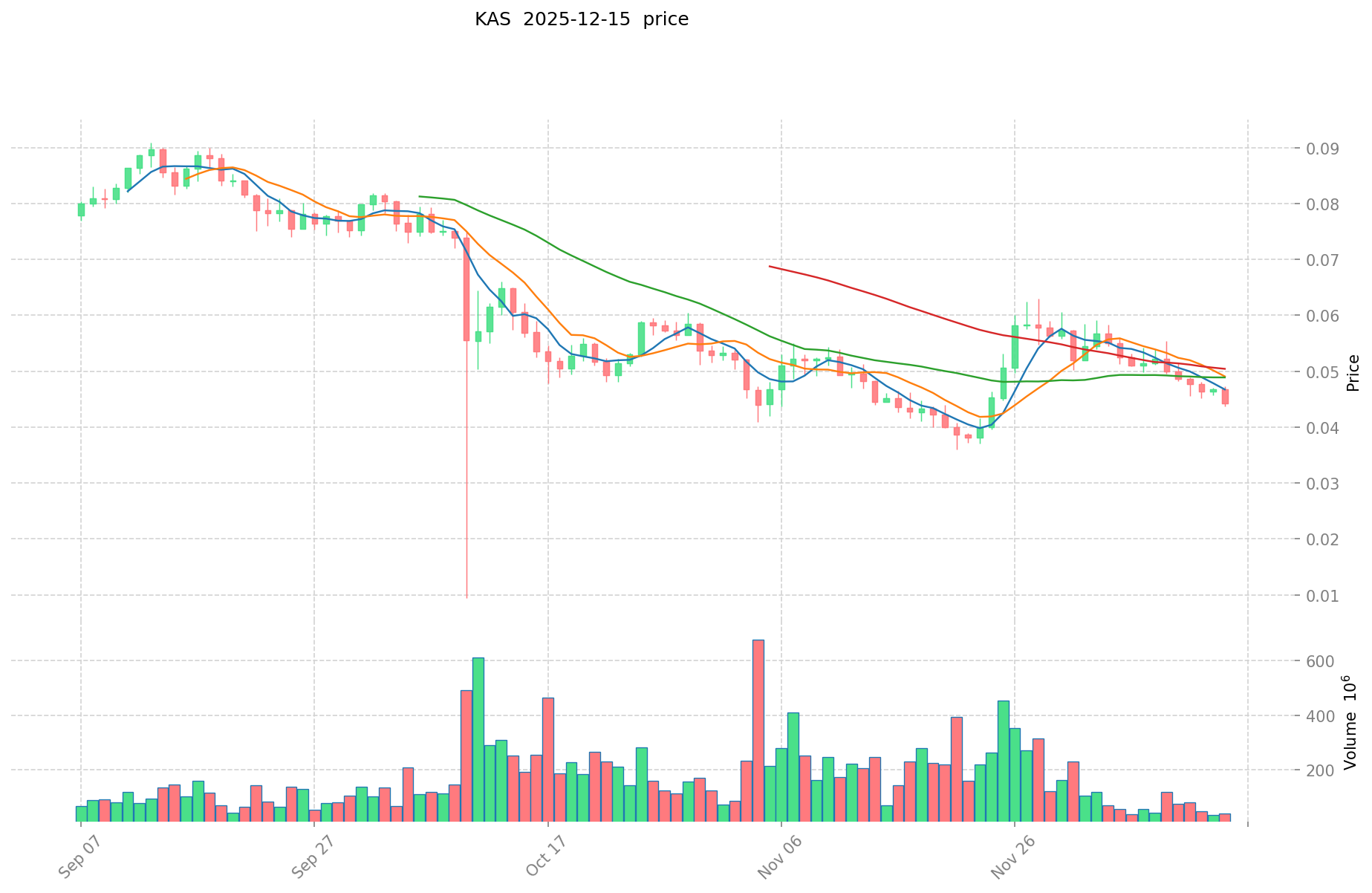
Kaspa reached its all-time high of $0.207411 on August 1, 2024, driven by overall market bullishness and increasing adoption of Layer-1 solutions.
Its lowest price was $0.00017105, occurring on May 26, 2022, likely due to the broader crypto market downturn experienced that year.
These fluctuations reflect market sentiment, adoption trends, and external factors affecting the cryptocurrency space.
Click to view the current KAS market price
On-chain Metrics
- Daily Transaction Volume: $4,162,167.106697 (indicating network activity)
- Market Capitalization: $1,134,815,558.1132977 (reflecting overall valuation)
- Circulating Supply Ratio: 93.2870812263475% (showing the proportion of coins in circulation)
Kaspa Ecosystem Applications and Partnerships
Core Use Cases
Kaspa's ecosystem supports various applications:
- Layer-1 Blockchain: Kaspa provides a fast, open-source, decentralized, and fully scalable Layer-1 solution.
- Proof-of-Work Cryptocurrency: Implements the GHOSTDAG protocol for efficient consensus.
Strategic Collaborations
Kaspa's partnerships and collaborations are not explicitly mentioned in the provided information.
Controversies and Challenges
Kaspa faces the following challenges:
- Technical Challenges: Implementing and maintaining the GHOSTDAG protocol in a scalable manner.
- Market Volatility: Significant price fluctuations, with a 73.06% decrease over the past year.
- Competitive Pressure: Competing with other established and emerging Layer-1 solutions in the blockchain space.
These issues drive ongoing discussions within the community and market, prompting continuous innovation for Kaspa.
Kaspa Community and Social Media Atmosphere
Fan Enthusiasm
Kaspa's community shows activity across various platforms:
- On X (formerly Twitter), Kaspa uses the handle @KaspaCurrency.
- The project maintains a presence on Reddit at r/Kaspa.
- Kaspa has official accounts on Facebook and Instagram.
Social Media Sentiment
Detailed sentiment analysis is not provided in the given information. However, the recent price trends and market performance may influence community discussions.
Hot Topics
While specific trending topics are not mentioned, discussions likely revolve around:
- GHOSTDAG protocol implementation and benefits
- Price performance and market cap fluctuations
- Kaspa's position as a fast and scalable Layer-1 solution
More Information Sources for Kaspa
- Official Website: Visit Kaspa's official website for features, use cases, and latest updates.
- White Paper: The Kaspa white paper details its technical architecture, goals, and vision.
- X Updates: On X, Kaspa uses @KaspaCurrency to share updates.
- GitHub: Explore Kaspa's open-source development at github.com/kaspanet/kaspad.
Kaspa's Future Roadmap
Specific future plans are not provided in the given information. However, as a Layer-1 blockchain, Kaspa's goals likely include:
- Continued development and optimization of the GHOSTDAG protocol
- Expanding the ecosystem and attracting more developers and users
- Improving scalability and transaction throughput
How to Participate in Kaspa?
- Purchase Channels: Buy Kaspa (KAS) on Gate.com and other supported exchanges.
- Storage Solutions: Use compatible wallets for secure storage of KAS tokens.
- Participate in Governance: Stay updated on Kaspa's social media for community involvement opportunities.
- Contribute to the Ecosystem: Visit Kaspa's GitHub repository to contribute to the project's development.
Summary
Kaspa redefines digital currency through blockchain technology, offering a fast, open-source, and decentralized Layer-1 solution with the innovative GHOSTDAG protocol. Its active community, rich resources, and unique market position set it apart in the cryptocurrency landscape. Despite facing challenges such as market volatility and competition, Kaspa's innovative spirit and focus on scalability secure its important role in the future of decentralized technology. Whether you're a newcomer or an experienced player, Kaspa is worth watching and participating in.
FAQ
What do you mean by KAS?
KAS refers to a Dutch-style cupboard or wardrobe popular in 17th-18th century America, particularly in the New Netherlands colony. Often paneled, it was a common furniture piece of that era.
What is KAS used for?
KAS is used to pay transaction fees, provide miner incentives, and is tradable on exchanges.
What is KAS drink?
KAS is a soft drink brand by PepsiCo, known for flavors like grapefruit, orange, lemon, and bitter. It's no longer widely produced.
What is the salary of a KAS officer?
KAS officers earn between INR 9,400 to 34,800 per month, based on the 7th pay commission scale for entry-level positions.
Share
Content
Kaspa's Positioning and Significance
Origin and Development History
How Does Kaspa Work?
Kaspa's Market Performance
Kaspa Ecosystem Applications and Partnerships
Controversies and Challenges
Kaspa Community and Social Media Atmosphere
More Information Sources for Kaspa
Kaspa's Future Roadmap
How to Participate in Kaspa?
Summary
FAQ
How to Buy Cryptocurrency


Trending Cryptocurrencies



XZXX: A Comprehensive Guide to the BRC-20 Meme Token in 2025

Bitcoin Fear and Greed Index: Market Sentiment Analysis for 2025
Top Crypto ETFs to Watch in 2025: Navigating the Digital Asset Boom
5 ways to get Bitcoin for free in 2025: Newbie Guide

Bitcoin Market Cap in 2025: Analysis and Trends for Investors
2025 Bitcoin Price Prediction: Trump's Tariffs' Impact on BTC

What is PENGU token holder concentration and exchange fund flows in 2025?
Top Wallets for Safely Storing Your Polygon MATIC
How does macroeconomic policy affect cryptocurrency prices in 2025?
How to Use Technical Indicators Like MACD, RSI, and Bollinger Bands to Trade NEAR Protocol?

How to Earn $1000 Monthly in Crypto Through Passive Income Strategies