Galaxy: Der aktuelle Stand der Ethereum Blobs und der Blob-Markt nach der Pectra-Ära
Autor: Zack Pokorny, Forschungsanalyst bei Galaxy; Übersetzung: AIMan@Jinse Finance
Einleitung
Am 7. Mai 2025 wurde das Ethereum Pectra Upgrade im Mainnet gestartet. Im implementierten Ethereum Improvement Proposal (EIP) erhöht EIP-7691 die Anzahl der Zielblobs und die maximale Anzahl von Blobs pro Block. Im letzten Jahr wurden mit EIP-4844 (ehemals Danksharding) Blobs eingeführt, um einen dedizierten Datenveröffentlichungsbereich für Rollups bereitzustellen. Seit der Einführung von Dencun hat das Ethereum-Netzwerk eine Zielanzahl von 3 Blobs pro Block und eine maximale Anzahl von Blobs beibehalten; Basierend auf einer Datengröße von 128 KB pro Blob bedeutet dies, dass die über das Blob übertragene Datenmenge etwa 5,5 GB pro Tag beträgt. Nach dem Pectra-Upgrade wurde die Anzahl der Zielblobs und die maximale Anzahl von Blobs pro Block auf 6 bzw. 9 erhöht, und die Blobdatenkapazität wurde auf etwa 8,15 GB pro Tag erhöht. Diese Änderung hat sich auf den Blob-Marktplatz, Rollups und Ethereum-Validatoren ausgewirkt, mit einer Erhöhung, die die Knappheit der Menge an festem Blob-Speicherplatz verringert, um die Rollups konkurrieren, und die Datenverfügbarkeit des Netzwerks durch Blobs (DA) Kapazität erhöht. Im folgenden Artikel werden die Auswirkungen der Änderungen der Ethereum-Blob-Parameter durch das Pectra-Upgrade auf den Blob-Marktplatz, Rollups und deren Benutzer, Ethereum-Validatoren und das ETH-Angebot untersucht.
Schlüsselpunkt
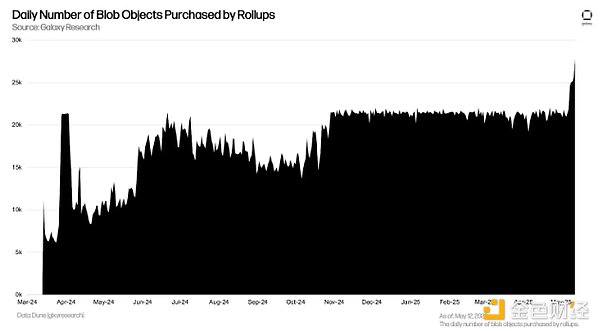
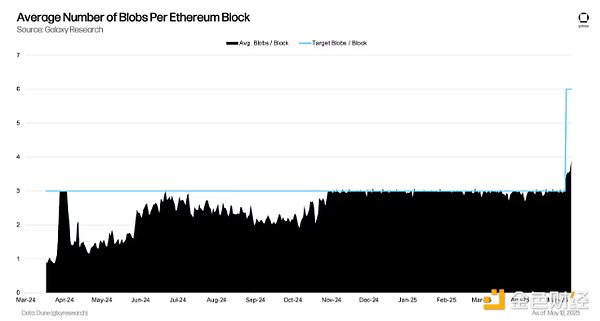
- In den fünf Tagen nach dem Start von Pectra hat sich die Anzahl der täglich gekauften Blobs durch Rollup von etwa 21.200 auf 25.600 erhöht. Trotz des Anstiegs liegt die durchschnittliche Anzahl der Blobs pro Block jedoch immer noch 33 % unter dem neuen Ziel (6 Blobs pro Block).
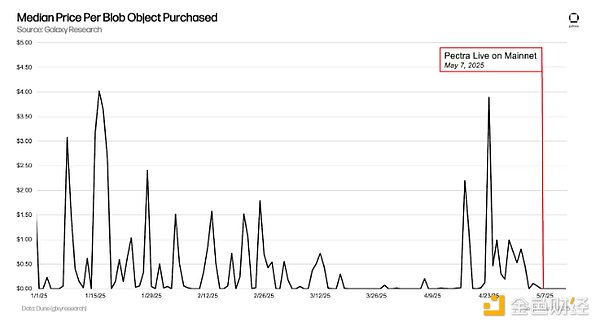
- Da die tatsächliche Anzahl der Blobs pro Block weit unter der aktualisierten Zielgebühr liegt, sind Blobs seit Mitte April 2025 erstmals nahezu kostenlos. Seit dem Start von Pectra betragen die täglich über Rollup gezahlten Gebühren weniger als ein Tausendstel Cent, und die Gesamtkosten der Blob-Objekte liegen nur bei vier Tausendstel Cent. Dies hat die Menge an ETH, die zum Kauf und zur Veröffentlichung von Rollup-Datenraum auf Ethereum über Blobs verbraucht wird, erheblich reduziert.
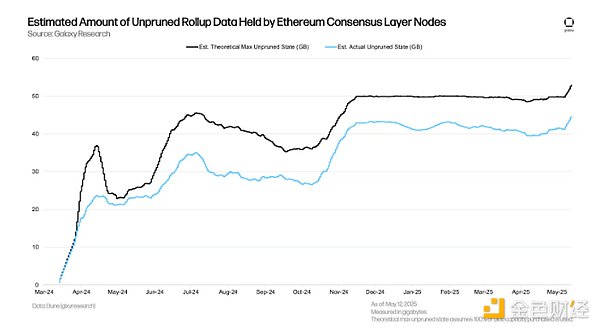
- Knoten müssen die Rollup-Blob-Daten mindestens 18 Tage lang aufbewahren, bevor sie diese von ihren Maschinen entfernen können. Der Anstieg der täglich gekauften Blob-Menge hat dazu geführt, dass die Datenmenge, die die Konsensschichtknoten zwischen zwei Kürzungen aufrechterhalten müssen, mit 44,6 GB einen neuen Höchststand erreicht hat.
- Die Senkung der Blob-Kosten hat die relative und absolute Rentabilität von Rollups erhöht, wobei Base der größte Nutznießer in Bezug auf das Nettoeinkommen nach Abzug der On-Chain-Kosten ist. In der Zwischenzeit sind die Transaktionskosten einiger führender Rollups seit dem Start von Pectra stabil geblieben oder sogar leicht gestiegen.
- Alle verwendeten Daten stammen aus dem öffentlichen Dashboard von Galaxy Research über den Ethereum Blob-Markt und dessen Einfluss auf Rollups.
Blob Markt
Seit dem Start von Pectra am 7. Mai 2025 hat die Anzahl der täglich gekauften Blobs auf der Rollup-Plattform im Vergleich zu vor dem Upgrade um 20,8 % zugenommen. In den 60 Tagen vor dem Upgrade kaufte die Rollup-Plattform täglich 21.200 Blobs. In den fünf Tagen nach dem Upgrade kauften sie im Durchschnitt täglich 25.600 Blobs. Das bedeutet, dass die tägliche Kaufkapazität der Daten vor dem Upgrade bei 2,7 GB lag, während sie jetzt bei 3,3 GB liegt.
Trotz der gestiegenen Anzahl gekaufter Blobs beträgt der durchschnittliche tägliche Blob-Verbrauch pro Block seit dem Start von Pectra nur zwei Drittel des neuen Ziel-Blob-Limits. Daher bleibt, obwohl die durchschnittliche Blob-Anzahl pro Block vor der Erhöhung der Blobs in Pectra stets auf dem Zielniveau war, die Nachfrage nach Rollups hinter dem Niveau zurück, das erforderlich wäre, um das neue Zielniveau kontinuierlich zu erreichen.
Daher ist das Blob tatsächlich kostenlos, da jedes Block nur zwei Drittel des Blob-Ziels verwendet hat. Dies ist das erste Mal, dass Blob seit Mitte April 2025 so günstig ist. Seit der Einführung von Pectra beträgt die mediane Kosten pro Blob-Objekt nur 0.0000000035 Dollar (neun Nullen). Dies hat dazu geführt, dass die Gebühren, die Rollups seit der Aktivierung von Pectra täglich zahlen, 0.0000092 Dollar (fünf Nullen) nicht überschreiten; in den gesamten fünf Tagen nach der Aktivierung von Pectra wurden insgesamt nur 0.0000395 Dollar an Blob-Objektgebühren gezahlt. Du hast dich nicht vertan, seit der Einführung von Pectra zahlen Rollups täglich weniger als ein Zehntel Cent, während die Gesamtkosten der Blob-Objekte vier Hundertstel Cent betragen. Bitte beachte, dass diese Zahl die Kosten für die Typ 3 Transaktionen, die für die Ausführung von Blob auf der Blockchain erforderlich sind, nicht umfasst, sondern nur die Kosten des Blob-Objekts selbst.
Das bedeutet, dass die Gebühren für Blob-Objekte, die von Rollups an Ethereum gezahlt werden, um fast 100 % gesenkt wurden - in den 60 Tagen vor den Pectra Rollups wurden durchschnittlich täglich 16.250 US-Dollar an Blob-Gebühren gezahlt, insgesamt 1,095 Millionen US-Dollar.
Nutzung der Datenkapazität und deren Auswirkungen auf Ethereum-Knoten
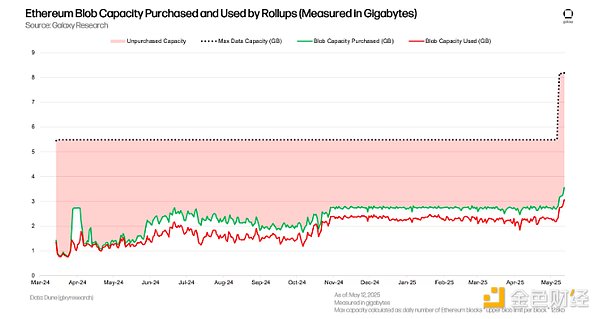
Im Nach-Pectra-Zeitalter ist ein größerer Teil der täglichen Gesamtdatenkapazität, die von Ethereum über Blob bereitgestellt wird, ungenutzt geblieben. Daher, obwohl Rollups mehr Blob aus dem Netzwerk kaufen und dadurch mehr Datenraum gewinnen, ist der Anteil der gekauften täglichen Gesamtblob-Datenkapazität seit dem Start von Pectra relativ gering. Sobald die Nachfrage nach Rollups die aktualisierte Zielrate erreicht, wird der Blob-Markt aus Kapazitätssicht effizienter funktionieren, da die neue Zielrate nur 33 % unter dem Maximum liegt, während es unter den alten Parametern 50 % betrug.
Die aktualisierte Blob-Kapazität beträgt 9 Blobs pro Block, die Anzahl der Ethereum-Blöcke pro Tag beträgt etwa 7.100, und Ethereum kann bis zu 8,17 GB Blob-Speicherplatz pro Tag und 5,45 GB entsprechend der Zielanzahl von Blobs pro Block verkaufen; Dieser Wert schwankt mit der tatsächlichen Anzahl der Blöcke pro Tag. Bisher wurden jedoch nur 3,3 GB Datenspeicher verkauft – nur 40 % der maximal verfügbaren Datenkapazität pro Tag und nur 61 % der Zielmenge. Im Gegensatz dazu betrug das durchschnittliche verkaufte Tagesvolumen im Monat vor der Implementierung des Pecra-Programms, als die Zielanzahl an Blobs (3 Blobs pro Block) erreicht wurde, 50 % der Gesamtkapazität und 99 % des Zielvolumens.
Jedes Blob-Objekt kann maximal 128 Kilobyte (KB) aufnehmen. Rollup-Daten müssen nicht den gesamten Platz von 128KB in jedem Blob beanspruchen (zum Beispiel kann jedes Blob bei Bedarf 100KB verwenden), jedoch darf die Kapazität eines einzelnen Blobs nicht die Grenze von 128KB überschreiten. Der Unterschied zwischen der gekauften Blob-Kapazität (grüne Linie im Diagramm) und der genutzten Blob-Kapazität (rote Linie im Diagramm) hebt hervor, wie viele Blob-Objekte täglich mit der Obergrenze von 128KB durch Rollup-Daten gefüllt werden. Nach dem Upgrade auf Pectra beträgt die durchschnittliche Auslastung der Blobs 86%, während sie in den 60 Tagen vor dem Upgrade bei 82% lag.
Die Zunahme der täglich gekauften Blob-Daten führt dazu, dass die Konsensschicht-Knoten mehr Rollup-Daten auf ihren Maschinen speichern müssen. Die Knoten müssen die Rollup-Blob-Daten mindestens 18 Tage lang behalten, bevor sie sie von der Maschine entfernen (trimmen) können. Vor Pectra bedeutete dies, dass die Knoten kontinuierlich 40 GB bis 44 GB an Daten tragen mussten. In den Tagen nach Pectra ist diese Zahl gestiegen, da Rollup mehr Blobs kauft, und mit der Sättigung der neuen Blob-Parameter könnte diese Zahl weiter steigen. Zum 12. Mai 2025 wird geschätzt, dass die nicht getrimmten Rollup-Daten, die von den Konsensschicht-Knoten gehalten werden, ein historisches Hoch von 44,6 GB erreicht haben. Wenn die Nachfrage nach Blobs auf dem aktuellen Niveau bleibt, müssen die Konsensschicht-Knoten etwa 60 GB Rollup-Daten tragen; bei der Zielrate müssten sie etwa 95 GB bis 100 GB an Daten tragen.
Rollup Kosten und ETH Verbrennung
Seit dem Start von Pectra zahlen Rollups im Durchschnitt täglich 11.015 US-Dollar an Blob-bezogenen Gebühren, einschließlich der Kosten für Blob-Objekte und Transaktionskosten der Type-3-Ausführungsebene. Im Vergleich dazu wurden in den 60 Tagen vor dem Update im Durchschnitt täglich 20.660 US-Dollar gezahlt, was bedeutet, dass die täglichen Gesamtkosten für den Kauf und die Ausführung von Blobs um 51 % gesunken sind.
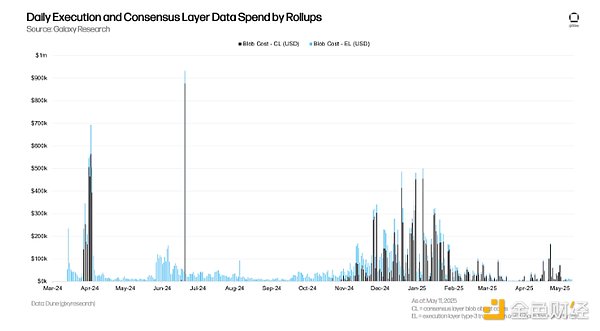
Der deutliche Anstieg der Ethereum-Layer-1-Gebühren hat zu hohen Kosten geführt, die durch Rollups bei Blob-Ereignissen gezahlt werden. Innerhalb weniger Tage nach der Aktivierung von Pectra stiegen die Grundgebühren für Ethereum Layer 1 im Wochenvergleich um mehr als 650 %. Ohne diese Spitze hätten Rollups weniger zu tun gehabt, um Blobs auszuführen, und die Rollup-Blob-Aktivität hätte weniger ETH verbraucht.
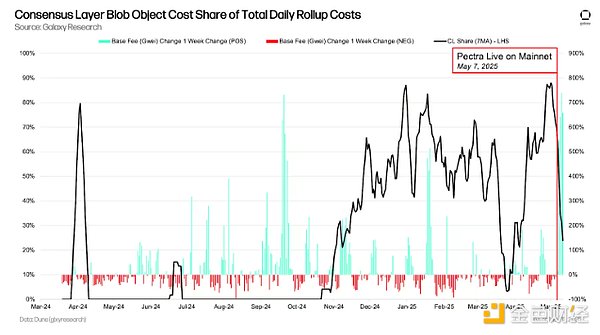
Seit der Aktivierung von Pectra ist die Menge an ETH, die für die Veröffentlichung von Rollup-Daten über Blob verbraucht wurde (einschließlich der ETH, die zum Kauf von Blob verwendet und durch Typ-3-Transaktionen auf Ethereum Layer 1 ausgeführt wurde), erheblich gesunken. In den 60 Tagen vor dem Upgrade betrug der durchschnittliche tägliche Verbrauch insgesamt 11,22 ETH, wobei die Gebühren der Ausführungsschicht nur 37,1% des täglichen Gesamtverbrauchs ausmachten. Seit der Aktivierung von Pectra werden täglich nur noch 3,26 ETH verbraucht (ein Rückgang von 71%), wobei 99,99% des Gesamtverbrauchs aus den Grundgebühren der Typ-3-Ausführungsschichttransaktionen stammen.
! RoQfaqkasimhQSTC9QeYDYGV9LKeJRg7oI2dFfbB.png
Einfluss auf L2
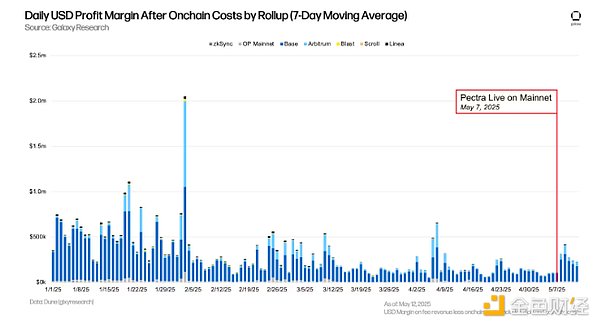
Nach dem Start von Pectra haben sowohl die relative als auch die absolute Rentabilität des Rollups nach Abzug der On-Chain-Kosten erheblich zugenommen. Bei den beobachteten Rollups hatten Linea und Base die höchsten Rentabilitätsprozentsätze nach Abzug der On-Chain-Kosten, berechnet mit einem gleitenden Sieben-Tage-Durchschnitt von 98,86 % bzw. 98,54 %. Blast zeigte den signifikantesten Anstieg der Rentabilitätsprozentsätze nach Abzug der On-Chain-Kosten; in den Tagen vor dem Start von Pectra stieg sein Rentabilitätsprozentsatz von einem hohen Wert von 50 % auf einen niedrigen Wert von 60 % und übersteigt mittlerweile 80 %.
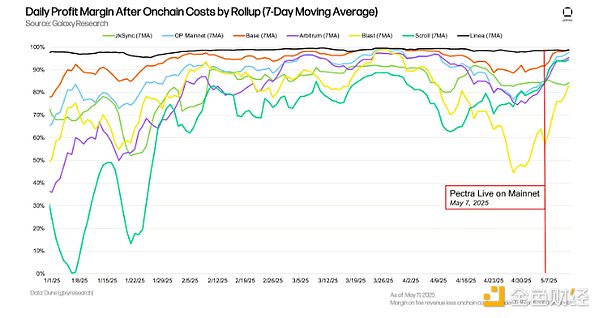
Nachdem Pectra live gegangen ist, sind die On-Chain-Kosten gestiegen, aber die Nettoerträge, die durch Rollups entstehen, sind zurückgegangen. Dies ist hauptsächlich das Ergebnis der gemeinsamen Wirkung von gesunkenen Datenkosten (wie oben beschrieben) und gestiegenen Aktivitäts- und Transaktionskosten. Die beobachteten Einnahmen und der Nettogewinn nach Abzug der On-Chain-Kosten jeder Rollup-Plattform haben sich leicht verdoppelt, aber in absoluten Zahlen ist Base in jüngster Zeit der größte Nutznießer. Die Einnahmen von Base betragen 1,22 Millionen US-Dollar, und nach Abzug der On-Chain-Kosten beträgt der Nettogewinn 1,12 Millionen US-Dollar.
Schlussfolgerung
Rollup hat die durch das Pectra-Upgrade gebotene Verbesserung der Datenverfügbarkeit von Ethereum noch nicht vollständig genutzt. Daher senkt es die täglichen Kosten für DA-Aktivitäten, die Ethereum über Blob schuldet. Dieses Upgrade macht Rollup zumindest momentan finanziell vorteilhafter für den Betrieb, während die Anzahl der täglich genutzten Blobs erhöht wird. Die Änderungen der Blob-Parameter von Pectra zu den Anforderungen an die Knoten, die Blob-Daten speichern, sind ebenfalls ein entscheidender Punkt. Da Ethereum beginnt, seine Blob DA zu skalieren, könnte dies Auswirkungen auf die Betreiber von Knoten haben, die höhere Anforderungen an die Blob-Datenhaltung erfüllen müssen.


