


Aave's key contributor announces departure! BGD Labs criticizes v4 development for becoming a one-man show, governance conflicts escalate

Aave Core Technology Team BGD Labs Announces Exit, Citing Governance Centralization and v4 Development Disputes, Impacting Community Confidence and Token Performance
Core Technology Team BGD Labs Announces Departure, Aave v3 Era Likely to End
The leading decentralized lending protocol Aave’s ecosystem has recently experienced significant personnel upheaval. As the most important technical pillar of Aave over the past four years, the core contributor team BGD Labs officially issued a statement on February 20, announcing that after the current service contract expires on April 1, they will not seek renewal and will fully withdraw from Aave DAO development work.
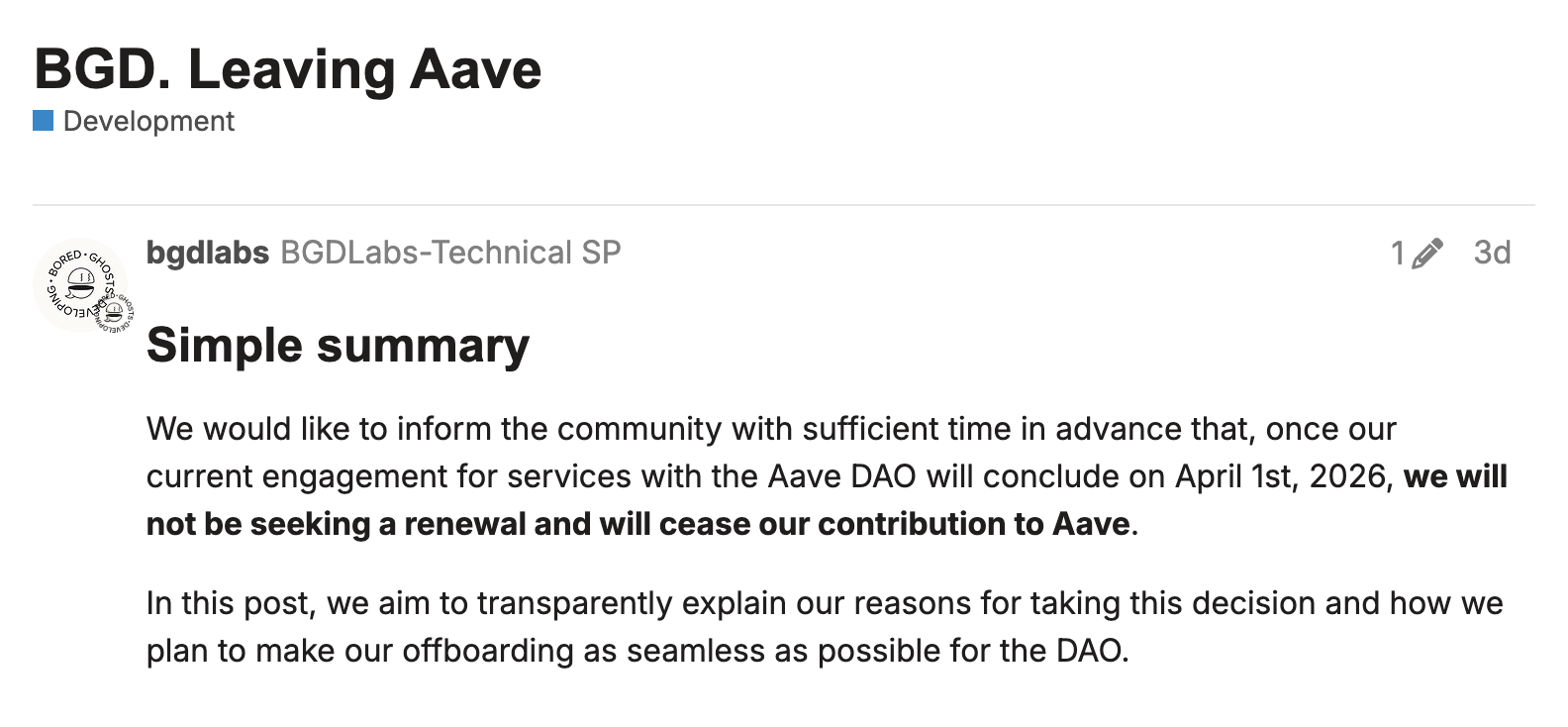
Image source: Aave Governance BGD Labs Statement
This professional team, founded in 2022 by former Aave CTO Ernesto Boado, was regarded as the soul of Aave’s technological innovation. They built the Aave v3 version, praised as the “jewel” of the protocol, and played a decisive role in the governance system, security mechanism “Umbrella” subsystem, cross-chain expansion, and asset onboarding processes.
In a post on the official forum, BGD Labs clearly stated that although they will give early notice to the community to ensure a smooth transition, the decision to exit is final. The team emphasized that Aave’s current infrastructure has been highly refined, is very mature, stable, and forward-looking. Even without their ongoing participation, the existing governance framework can operate indefinitely without major changes.
To be responsible to the community, BGD Labs committed that during the last month before the contract ends, they will continue to complete the planned v3 improvements and security maintenance tasks, and will publish detailed technical documentation and maintenance guides, handing over to other potential contributors to ensure the protocol system does not become paralyzed due to their departure.
Governance Power Imbalance Causes Rift, Tech Team Criticizes v4 Development as a One-Man Show
The core reason behind the split of this long-term partnership points to the increasingly serious “organizational asymmetry” within the Aave ecosystem. BGD Labs pointed out that as Aave Labs, which initially developed the protocol, reclaims dominance and shifts strategic focus entirely to v4 development, the entire ecosystem’s decentralization and collaborative spirit are rapidly disintegrating.
In their statement, BGD Labs bluntly criticized that Aave Labs is transforming from an independent tech company into a central driver manipulating the entire ecosystem. This excessive concentration of power is reflected not only in monopolizing brand assets and communication channels but also in controlling voting rights that can influence major DAO decisions.
Regarding the development collaboration on v4, BGD Labs expressed strong dissatisfaction. They believe that Aave Labs, with its large development budget, only positions other technical contributors as “advisors” providing “public opinions,” rather than genuine partners. This lack of substantive participation and feedback mechanisms makes BGD Labs feel their technical potential is being seriously wasted.
What further chilled the team was that, during the promotion of v4, Aave Labs adopted a somewhat “confrontational stance,” frequently criticizing v3’s shortcomings either implicitly or explicitly, to justify the necessity of developing v4. BGD Labs angrily stated that when all technical improvements for v3 are subjected to artificially imposed restrictions, and the development environment no longer aligns with their operational philosophy, leaving is the only option.
Scandal and Unequal Profit Sharing Escalate Conflict Between Aave Labs and DAO Members
This collective resignation of technical contributors is actually the culmination of long-standing internal grievances within the Aave ecosystem. As early as late 2025, Aave Labs was heavily criticized by the community for allegedly misappropriating front-end swap fees, an event seen as the starting point of trust collapse.
Later, Ernesto Boado proposed transferring brand assets to DAO management to maintain decentralization, but this was forcibly blocked by Aave Labs during the Christmas holiday through a vote, which was ultimately rejected with 55% opposition. This move was criticized by community members as “dishonorable” power manipulation, exposing Aave Labs and related entities’ high level of control over voting outcomes.
Recently, Aave Labs proposed the “Aave Will Win Framework,” which further intensified the conflict. The proposal requests DAO to pay up to 42.5 million USDT and 75,000 $AAVE as development funds, and plans to phase out v3 within 8 to 12 months after v4 launches, forcing users to migrate.
Meanwhile, founder Stani Kulechov was revealed to have spent 30 million USD (about 22 million GBP) to purchase a London mansion one month before this governance turmoil erupted. The stark contrast between this luxurious lifestyle of senior executives and the internal governance crisis further heightened community unease. Although Kulechov publicly expressed regret and respect for BGD Labs’ departure, community members clearly did not buy into this formal politeness, believing that Aave Labs’ overexpansion is the main reason for talented teams being marginalized.
Further Reading
Aave DAO Governance Internal War! A Brand Asset Transfer Proposal Sparks Strong Backlash
Only 3.5% Support! Aave Brand Sovereignty Proposal Rejected by Overwhelming Majority, but Systemic Issues Remain
Will DeFi Protocol Aave Share Revenue? Officially Opens Up on Income Sharing and Governance Disputes
Market Confidence Dented, Token Declines, Transition Reserve Plan Pending Review
The news of BGD Labs’ departure quickly impacted the market. The $AAVE token price immediately dropped over 6%. Since the internal conflict between “Labs and DAO” began, the token has fallen by a total of 40%, performing worse than ETH during the same period.
Community key member Marc Zeller described BGD Labs’ exit as “catastrophic” for Aave, because most of the revenue generated by v3 comes from the team’s code innovations. Many users worry that losing this most familiar underlying team will pose serious challenges to Aave’s technological leadership and security.
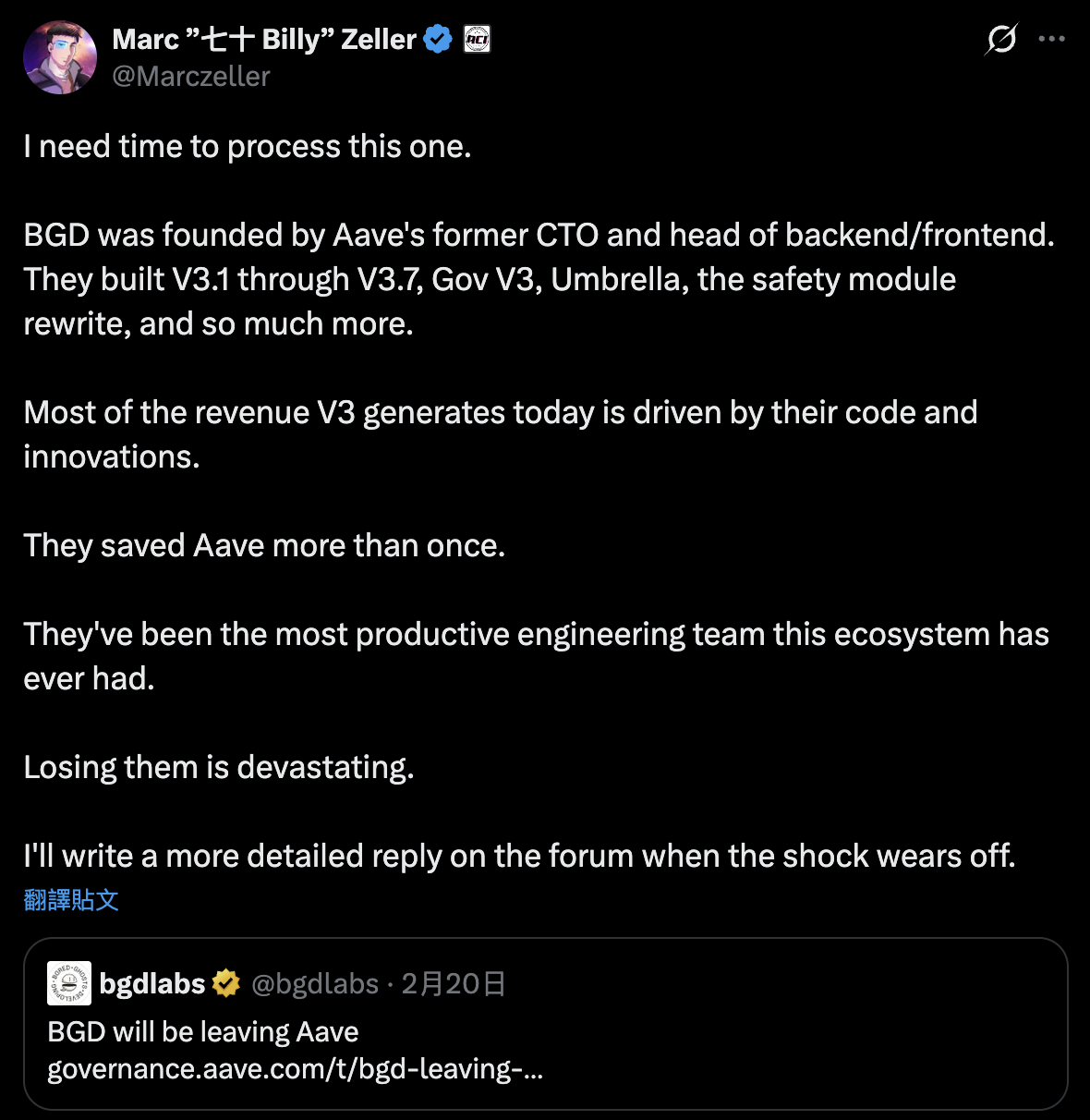
Image source: X/@Marczeller Community member Marc Zeller describes BGD Labs’ departure as “catastrophic” for Aave
To reduce potential technical risks, BGD Labs proposed a compromise: they are willing to provide technical support in the form of a “security reserve fund” for two months after service ends in April (from April to June 2026), specifically handling emergency security incidents related to Aave v3, governance system, and Umbrella subsystem. The service is priced at $200,000 and is currently being prepared as an independent governance proposal for DAO approval.
Although this fee is modest compared to the multi-million dollar budget requested by Aave Labs, for the turbulent Aave community, it may be the last insurance to prevent protocol collapse during the transition period. The final outcome of this power struggle will directly determine whether Aave can continue to maintain its dominance in the DeFi industry.
Related Articles
Fluid Moves to Establish Foundation for Long-Term DAO Control
SBI Issues First Security Token Bond Offering Direct XRP Exposure
VeChain Introduces ReCircleRewards to Verify and Reward Real-World Mobility