


Vitalik Ethereum Scalability Plan Revealed: Preventing Large Operators from Monopolizing Nodes

Ethereum co-founder Vitalik Buterin posted a new blog on X, outlining a three-phase vision for expanding Ethereum’s underlying network, marking a clear shift back to strengthening the Layer 1 base layer. This comes shortly after the Ethereum Foundation’s initial “Strawmap” roadmap release, aiming to enable Ethereum to handle more transactions and prevent high node operation costs from limiting participation to only large, well-funded institutions.
Short-term Strategy: Parallel Validation and ePBS Upgrade to Maximize Block Capacity
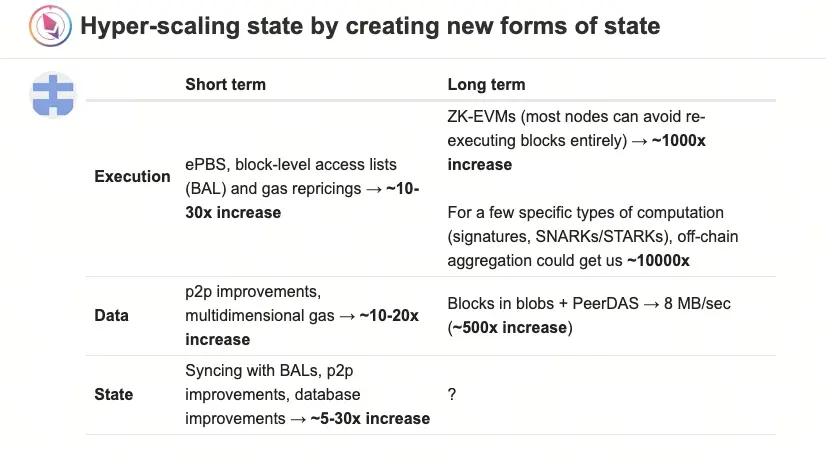
(Source: Ethereum Research)
Buterin suggests that in the short term, Ethereum can safely increase throughput by optimizing block validation processes without increasing the risk of errors or instability.
The core changes involve two directions: first, enabling nodes to validate different parts of a block simultaneously (parallel validation), rather than sequentially; second, introducing ePBS (Enshrined Proposer-Builder Separation), which changes how blocks are constructed to make more efficient use of each 12-second processing window. Currently, due to conservative considerations, blocks are often completed before the window is fully utilized, leading to underused capacity. ePBS will be implemented in the upcoming Glamsterdam upgrade.
Vitalik’s Three Core Layers of Ethereum L1 Scalability
Short-term (Glamsterdam upgrade): Use parallel validation and ePBS to allow each block to contain more transactions without increasing network instability risk.
Mid-term (Gas fee restructuring): Separate “temporary computational costs” from “permanent data storage” costs, increasing long-term storage costs to free up more space for daily transactions.
Long-term (ZK and Blob-led): Rely more on zero-knowledge proofs (ZK Proofs) and Blob data extension to enable validators to verify transaction activity without re-executing each transaction.
Long-term Vision: Gas Fee Restructuring and Blob-Driven Verification Revolution
Another core aspect of this expansion plan is rethinking how Gas fees are calculated. Buterin points out that temporary computational usage and permanent data addition (such as deploying new contracts) impose very different pressures on the network, yet currently these costs are mostly bundled together. Since permanent data must be stored long-term by all nodes, accumulating large amounts of permanent data will continually raise node operation costs, eventually pushing out small operators and undermining network decentralization.
His proposal is to increase the costs of permanent data storage while freeing up more space for daily transaction processing, allowing Ethereum to handle more transactions without significantly accelerating blockchain bloat.
From a longer-term perspective, Blob will evolve from a tool that helps Layer 2 networks reduce costs into a core infrastructure that directly carries Ethereum mainnet transaction data. Coupled with zero-knowledge proofs, this will enable validators to verify transactions without re-executing each one—fundamentally changing Ethereum’s verification architecture and greatly increasing throughput limits.
Related Articles
ETH short-term increase of 1.10%: Whales adding positions and leveraged short liquidations trigger a structural rebound
Machi Suffers Another Liquidation as ETH Drops Following Israel-Iran Strike
Ethereum price approaches $1,900 support, buy-sell ratio rebounds hinting at a potential key turning point for ETH
