# JustinSunSuesWorldLibertyFinancial

1.07M
#JustinSunSuesWorldLibertyFinancial
A Defining Legal Clash in Crypto: Power, Control, and the Illusion of Decentralization
The lawsuit filed by Justin Sun against World Liberty Financial is more than a dispute over $75 million—it is a confrontation that exposes one of the deepest contradictions in the cryptocurrency industry: the gap between what projects claim to be and how they actually operate. At a time when the market is maturing and institutional capital is entering the space, this case arrives as a stress test for trust, governance, and accountability.
At its core, the conflict revolve
BTC-0.01%
ETH-1.97%
TRX-0.32%
WLFI-0.47%
MrFlower_XingChen
#JustinSunSuesWorldLibertyFinancial
A Defining Legal Clash in Crypto: Power, Control, and the Illusion of Decentralization
The lawsuit filed by Justin Sun against World Liberty Financial is more than a dispute over $75 million—it is a confrontation that exposes one of the deepest contradictions in the cryptocurrency industry: the gap between what projects claim to be and how they actually operate. At a time when the market is maturing and institutional capital is entering the space, this case arrives as a stress test for trust, governance, and accountability.
At its core, the conflict revolves around control. Crypto was built on the promise of decentralization—removing intermediaries and giving users sovereignty over their assets. Yet, allegations in this case suggest that centralized power structures may still exist beneath the surface of so-called decentralized systems. If proven true, the idea that a project could freeze billions of tokens through hidden mechanisms directly challenges the foundational principles of blockchain technology.
The involvement of a high-profile figure like Justin Sun amplifies the significance of the case. Known for building TRON into one of the largest blockchain ecosystems, Sun is not an inexperienced investor. The fact that even a seasoned player could face such a situation raises serious questions about transparency standards across the industry. It suggests that the risks are not limited to retail participants—structural vulnerabilities can impact anyone.
On the opposing side, World Liberty Financial’s association with Donald Trump and his family introduces a political and reputational dimension that extends beyond crypto. Projects tied to influential figures often attract attention and capital quickly, but they also carry heightened scrutiny. This case could influence how investors perceive politically connected crypto ventures in the future, especially if allegations of misrepresentation gain traction.
One of the most critical elements in the lawsuit is the concept of “backdoor control.” Smart contracts are often marketed as immutable and transparent, but in reality, many include administrative functions that allow developers to intervene under certain conditions. These functions are not inherently malicious—they can be used for upgrades, security responses, or compliance. However, when such controls are undisclosed or misused, they become a major point of contention.
This brings the conversation to a broader industry issue: the difference between code transparency and user understanding. Even when smart contracts are publicly available, very few participants have the technical expertise to fully analyze them. This creates an asymmetry where developers hold significantly more power than users, undermining the concept of trustless systems.
Another major theme emerging from this case is investor rights within crypto ecosystems. Traditionally, token holders have operated in a gray area—somewhere between users, investors, and community members. Unlike shareholders in traditional companies, they often lack clear legal protections. However, cases like this signal a shift. Courts are increasingly willing to treat token-related disputes under existing legal frameworks such as fraud, contract law, and property rights.
If the court rules in favor of Sun, it could establish a powerful precedent. Projects may be required to disclose all administrative controls explicitly, ensure fair access to liquidity, and uphold governance rights promised during token sales. This would push the industry toward higher standards of accountability and reduce the likelihood of similar disputes in the future.
On the other hand, if World Liberty Financial successfully defends its position, it may reinforce the idea that token issuers retain broad authority over their ecosystems. This could create uncertainty for investors, particularly in projects where governance and control structures are not clearly defined.
The economic implications are equally important. Freezing a large holder’s tokens does not just affect that individual—it impacts market dynamics. Liquidity, price discovery, and investor confidence are all influenced by the ability of major participants to enter and exit positions freely. Any restriction on this process introduces distortions that can affect the entire ecosystem.
Beyond the immediate case, this situation highlights the growing intersection between crypto and traditional finance. As digital assets become more integrated into global markets, legal disputes are no longer isolated incidents—they are systemic events that can influence regulation, investor behavior, and market structure.
Regulators are likely to pay close attention to this case. Issues such as undisclosed smart contract functions, investor protection, and market manipulation align closely with existing financial regulations. The outcome could accelerate the development of clearer rules governing token issuance and project transparency.
For everyday participants, the lessons are clear but often overlooked. The presence of a well-known founder, a strong narrative, or a powerful brand does not eliminate risk. In fact, it can sometimes obscure it. True due diligence requires understanding not just the surface-level promises of a project, but the underlying mechanics that govern how it operates.
This case also underscores the importance of decentralization as more than just a marketing term. A truly decentralized system should not allow unilateral control over user assets. Governance should be transparent, verifiable, and resistant to manipulation. Anything less introduces a level of trust that contradicts the original purpose of blockchain technology.
As the legal battle unfolds, the crypto industry finds itself at a crossroads. It must decide whether it will continue operating in a loosely defined environment where power is often concentrated behind the scenes, or move toward a more transparent and accountable structure that aligns with its foundational ideals.
The outcome of this case will not just determine the fate of $75 million in tokens. It will shape how projects design their systems, how investors evaluate opportunities, and how regulators approach the rapidly evolving world of digital assets.
In many ways, this is more than a lawsuit.
It is a reality check for an entire industry.
$BTC $ETH
  • Reward
  • 1
  • Repost
  • Share
ybaser:
Just charge and you're done 👊
#JustinSunSuesWorldLibertyFinancial
Crypto markets occasionally face turning points that go far beyond price movements. The lawsuit that emerged in April 2026 between Justin Sun and World Liberty Financial represents exactly such a moment. This development is not just a legal dispute between two parties; it also brings back into focus a fundamental question for the crypto industry: how real is the concept of decentralization?
The founder of TRON, Justin Sun, filed a lawsuit in a United States federal court against World Liberty Financial. At the center of the case are serious allegations. S
WLFI-0.47%
TRX-0.32%
discovery
#JustinSunSuesWorldLibertyFinancial
Crypto markets occasionally face turning points that go far beyond price movements. The lawsuit that emerged in April 2026 between Justin Sun and World Liberty Financial represents exactly such a moment. This development is not just a legal dispute between two parties; it also brings back into focus a fundamental question for the crypto industry: how real is the concept of decentralization?
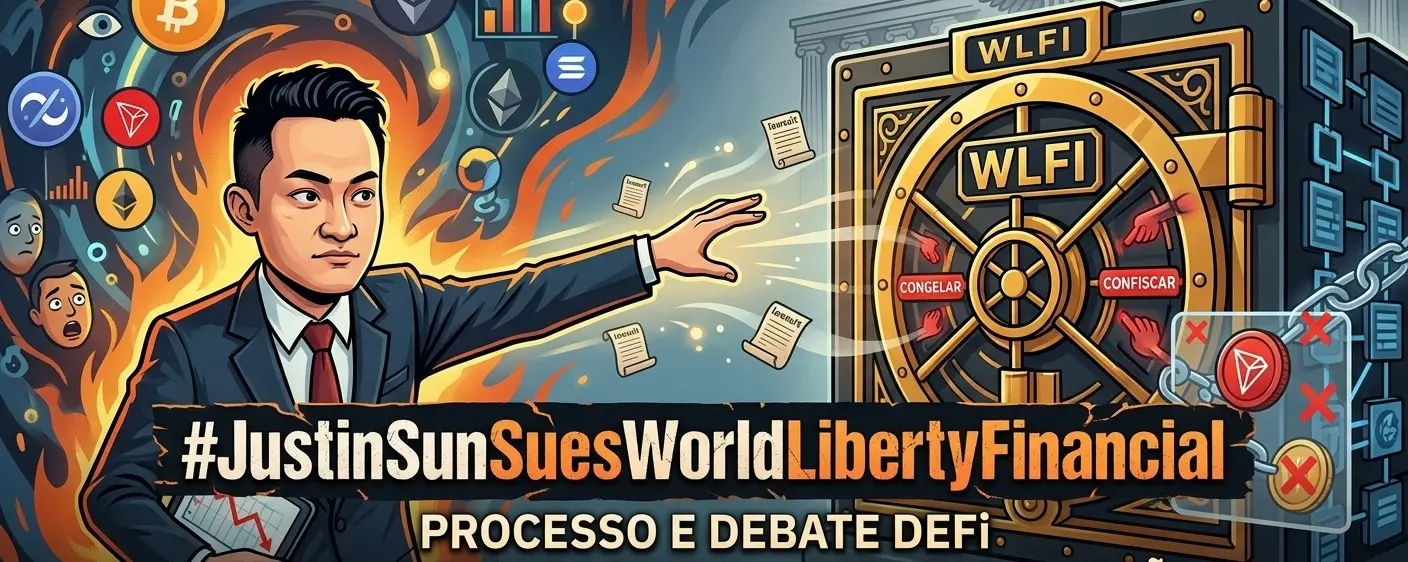
The founder of TRON, Justin Sun, filed a lawsuit in a United States federal court against World Liberty Financial. At the center of the case are serious allegations. Sun claims that his WLFI tokens were frozen, that he was prevented from selling them, that his governance rights were taken away, and that his tokens were even threatened with being burned. According to the claim, all of this happened outside of the investor’s control and without any transparent process.
This is not a minor disagreement involving a small investor. The scale of Sun’s involvement is significant, including tens of millions of dollars in direct investment, billions of WLFI tokens, and at times a potential valuation approaching one billion dollars. The lawsuit argues that due to the freezing of these tokens, Sun missed out on the opportunity to realize hundreds of millions of dollars in gains.
One of the most critical aspects of the case is the claim regarding centralized control. According to Sun, the project is not as decentralized as it presents itself to be. The allegations suggest that hidden control mechanisms were embedded into the token contracts, that certain wallets could be blacklisted, and that token transfers could be halted unilaterally. Such claims directly challenge one of the core principles of decentralized finance, which is user control over assets.
The tension behind the lawsuit goes beyond technical disagreements and includes accusations related to pressure and influence. Sun claims that he was pushed to make additional investments, particularly to support a stablecoin project, and that after refusing, his tokens were frozen. He further alleges that the situation escalated into a form of coercion. On the other side, World Liberty Financial denies all accusations and maintains that its actions were taken to protect platform security.
The broader significance of the case is amplified by the structure behind the project. World Liberty Financial is linked to a politically connected network and has pursued aggressive expansion strategies within decentralized finance and stablecoin markets. As a result, the lawsuit extends into areas beyond crypto, touching on politics, regulation, and potential conflicts of interest.
From a market perspective, this development raises several important concerns. It acts as a stress test for trust in decentralized finance. If such allegations prove valid, investors may begin to question whether they truly have control over their assets or whether hidden centralized mechanisms exist. The ability to freeze tokens at will introduces direct risks to liquidity, while the perception that even large investors may not be protected could slow institutional capital inflows.
At a deeper level, this case has the potential to become a turning point for the industry. It may lead to increased scrutiny of smart contracts, especially regarding hidden administrative powers. It could also push regulators to examine more closely the claims of decentralization made by crypto projects.
Ultimately, the issue at the heart of this story is simple but profound. Are crypto systems genuinely decentralized, or do they only appear that way?
The answer will not only shape the outcome of this lawsuit, but also influence how the entire crypto market evolves in the years ahead.
#GateSquare #CreatorCarnival #ContentMining
repost-content-media
  • Reward
  • 8
  • Repost
  • Share
LittleGodOfWealthPlutus:
马年大吉,恭喜发财
View More
#JustinSunSuesWorldLibertyFinancial
The crypto industry is once again under the spotlight as Justin Sun takes legal action against World Liberty Financial (WLFI). But this isn’t just another lawsuit—it’s a high-stakes battle that questions the very foundation of DeFi: decentralization, transparency, and investor trust.
🔍 What is World Liberty Financial (WLFI)?
World Liberty Financial is a DeFi platform launched in late 2024, associated with Donald Trump and his family, including Eric Trump. The platform promotes governance through WLFI tokens, where holders can vote on proposals—but they don
WLFI-0.47%
USD1-0.01%
TRX-0.32%
post-image
  • Reward
  • Comment
  • Repost
  • Share
#JustinSunSuesWorldLibertyFinancial
Breaking April 22, 2026 | California Federal Court
One of crypto's most explosive legal battles just went official. Justin Sun founder of TRON and World Liberty Financial's largest individual investor has filed a federal lawsuit against the Trump family-backed DeFi project in the US District Court for the Northern District of California. The charges: fraud, breach of contract, criminal extortion, and unjust enrichment.
Lawsuit Main Reason What Triggered This
Sun invested $45 million in WLFI tokens in 2024, attracted by the Trump family's association with th
TRX-0.32%
WLFI-0.47%
USD1-0.01%
HTX0.04%
post-image
Falcon_Official
#JustinSunSuesWorldLibertyFinancial
Breaking April 22, 2026 | California Federal Court
One of crypto's most explosive legal battles just went official. Justin Sun founder of TRON and World Liberty Financial's largest individual investor has filed a federal lawsuit against the Trump family-backed DeFi project in the US District Court for the Northern District of California. The charges: fraud, breach of contract, criminal extortion, and unjust enrichment.
Lawsuit Main Reason What Triggered This
Sun invested $45 million in WLFI tokens in 2024, attracted by the Trump family's association with the project. When WLFI's token sales showed "lackluster demand" generating only $22 million in the first month Sun's investment helped turn the tide, eventually helping the project raise $550 million total. But by July 2025, when Sun refused to keep investing or mint WLFI's USD1 stablecoin on their terms, the relationship turned hostile. A hidden blacklist function was secretly added to the WLFI smart contract in August 2025 nearly 11 months after Sun's initial investment which allowed WLFI to freeze his 2.9 billion tokens without any governance vote, notice, or justification. His holdings once valued at over $1 billion have now collapsed to roughly $75 million due to forced inability to sell or hedge.
Justin Sun's Statement
Sun posted on X: "They wrongfully froze all of my tokens, stripped me of my right to vote on governance proposals, and have threatened to permanently destroy my tokens by burning them all without any proper justification." He also accused co-founder Chase Herro of threatening to burn his tokens unless Sun publicly requested the burn himself, and of falsely claiming Sun's KYC documents were inadequate as leverage to report him to US authorities. Despite the lawsuit, Sun carefully distanced Trump from the conflict: "I do not believe President Trump would condone these actions if he knew about them."
World Liberty Financial Response
Co-founder Zach Witkoff called the lawsuit "a desperate attempt to deflect attention from Sun's own misconduct." Eric Trump mocked: "The only thing more ridiculous than this lawsuit is spending $6 million on a banana duct-taped to a wall." WLFI's official position: Sun transferred unlocked tokens to his exchange HTX shortly after the first unlock while retail holders were still locked which they claim breached contractual terms, triggering the wallet freeze as a security measure.
TRX Price Reaction Market Data
TRX is currently trading at $0.332 holding relatively stable with a 24-hour change of +1.09%, showing surprising resilience despite the legal storm. WLFI on the other hand is down 3.15% to $0.07712, sitting 76% below its all-time high of $0.46 and down 44% year-to-date. The market is clearly separating TRX (fundamentals intact) from WLFI (trust collapse).
Investor Sentiment Fear or Opportunity?
Sentiment is sharply divided. WLFI holders face uncertainty a new governance proposal on April 15 placed all major holder tokens on a two-year cliff with a two-year linear vest, and those who decline the terms face indefinite token locks. Sun cannot even vote on this proposal since his tokens are frozen. For TRX holders, the lawsuit has had minimal negative impact TRX is up 15% over the last 60 days showing ecosystem strength. The lawsuit has, however, rattled confidence in politically-branded crypto projects broadly.
Crypto Regulation Angle
This case carries serious regulatory implications. The lawsuit argues that WLFI's ability to freeze, reassign, and burn tokens without due process could legally qualify the firm as a money transmitter under US FinCEN rules subjecting it to mandatory registration and anti-money laundering requirements. With the SEC already having dropped its prior fraud case against Sun due to his Trump connections, regulators are now watching this case closely as a test of whether politically-linked crypto projects operate above standard investor protection laws.
Possible Court Outcomes
Three scenarios are in play. First Sun wins: WLFI must unfreeze tokens, pay damages, and accept regulatory oversight, which would set a landmark precedent for smart contract governance rights. Second Settlement: Most likely outcome given political sensitivities; Sun gets partial token recovery in exchange for dropping extortion charges. Third WLFI wins: Sun's transfer activity to HTX is proven as a contractual breach, case dismissed, but reputational damage to WLFI remains permanent regardless.
Risk for Holders
WLFI holders face a dangerous situation. The token is down 83% from its all-time high. The new governance proposal forces holders into a 4-year vesting lockup or indefinite freeze. If court proceedings reveal WLFI operated hidden backdoor controls, a full regulatory crackdown and possible exchange delistings could follow. Sun's lawsuit also claims WLFI is "on the verge of collapse" and questions whether it holds sufficient reserves to back its USD1 stablecoin — a direct threat to stablecoin holders.
Media & Industry Trust Impact
Major outlets Bloomberg, CBS News, CNN all leading with this story. The industry trust damage is severe. A Trump-linked DeFi project being accused of using secret smart contract backdoors to extort its largest investor destroys the foundational narrative of decentralization. If centralized control can freeze, burn, or reassign any holder's tokens at will, the "DeFi" label becomes meaningless. This case is already being cited as the strongest argument yet for mandatory smart contract audits and on-chain governance standards in US crypto legislation.
Final Bullish / Bearish Summary
Bearish: WLFI is structurally broken down 83% from ATH, trust shattered, facing federal fraud charges, stablecoin reserves questioned, and its largest backer now a legal adversary. Exit risk is extremely high for WLFI holders.
Bullish for TRX: Sun's personal legal battle does not threaten TRON's ecosystem. TRX holding $0.33 with positive RSI momentum at 61.01 signals that the market trusts the underlying blockchain, not the drama. If Sun wins and his frozen $75M position is unfrozen, TRX narrative strengthens as Sun's credibility is restored.
Bottom Line: This is not just a lawsuit it is a stress test for the entire politically-branded crypto sector. Smart money is watching TRX for opportunity and exiting WLFI entirely.
repost-content-media
  • Reward
  • Comment
  • Repost
  • Share
#JustinSunSuesWorldLibertyFinancial
#GateSquare #CreatorCarnival #ContentMining
Every once in a while, the crypto space encounters a moment that forces everyone to stop, reassess, and ask deeper questions—not about price, not about trends, but about the very foundations the industry claims to stand on. The legal battle that surfaced in April 2026 involving Justin Sun and World Liberty Financial is shaping up to be one of those defining moments.
At first glance, it may look like a high-profile dispute between a well-known crypto entrepreneur and a financial project. But when you look closer,
post-image
  • Reward
  • Comment
  • Repost
  • Share
#JustinSunSuesWorldLibertyFinancial ⚖️ #JustinSunVsWLFI | Potential DeFi Clash Incoming? 🚨
This is a high-alert situation — but let’s stay precise:
👉 As of April 23, 2026, there is NO confirmed official filing yet regarding a lawsuit by Justin Sun against World Liberty Financial.
---
📊 Why This Still Matters
Even as a rumor or early signal, this kind of news can move markets fast:
• ⚡ Big names involved = instant attention
• 💥 DeFi sector sensitive to legal headlines
• 📉 Speculation alone can trigger volatility
👉 In crypto, unconfirmed news = real price impact
---
🔥 Possible Conflict An
WLFI-0.47%
TRX-0.32%
post-image
post-image
  • Reward
  • 2
  • Repost
  • Share
HighAmbition:
Buy To Earn 💰️
View More
#JustinSunSuesWorldLibertyFinancial
This is a major escalation between two heavyweight crypto power centers — and the market is quietly watching it like a liquidity stress test.
The dispute between Justin Sun and World Liberty Financial isn’t just legal noise anymore.
It’s turning into a governance + trust + control narrative for the entire Web3 space.
What’s actually happening (beyond headlines):
Justin Sun has filed a lawsuit accusing World Liberty Financial of:
→ freezing his WLFI token holdings
→ restricting his ability to sell
→ allegedly pressuring him for additional investment
→ and th
WLFI-0.47%
SUN0.15%
post-image
  • Reward
  • 6
  • Repost
  • Share
HighAmbition:
Buy To Earn 💰️
View More
#JustinSunSuesWorldLibertyFinancial 👀
$WLFI
Justin Sun Sues World Liberty Financial
🕵️Token Freezing and Governance Crisis
One of the most talked-about lawsuits in the cryptocurrency world officially began on April 22, 2026. Billionaire Justin Sun, founder of TRON, filed a lawsuit in California federal court against World Liberty Financial (WLF), a company linked to Donald Trump and his family. Sun alleges that WLF illegally froze his WLFI tokens, stripped him of his governance rights, and threatened to "burn" his assets.
Based on the Lawsuit: 540 Million Tokens and a Hidden "Blacklist" F
WLFI-0.47%
post-image
  • Reward
  • 7
  • Repost
  • Share
Juno_:
To The Moon 🌕
View More
#JustinSunSuesWorldLibertyFinancial — The Lawsuit That Could Redefine DeFi Forever
The crypto industry is no stranger to controversy, but every once in a while a case emerges that feels less like a routine dispute and more like a turning point. The legal battle between Justin Sun and World Liberty Financial (WLFI) is shaping up to be exactly that kind of moment. It is not just about money, token prices, or investment disagreements—it is about the core identity of decentralized finance itself.
At its heart, this lawsuit forces the entire crypto ecosystem to confront uncomfortable questions: Wha
SoominStar
#JustinSunSuesWorldLibertyFinancial — The Lawsuit That Could Redefine DeFi Forever
The crypto industry is no stranger to controversy, but every once in a while a case emerges that feels less like a routine dispute and more like a turning point. The legal battle between Justin Sun and World Liberty Financial (WLFI) is shaping up to be exactly that kind of moment. It is not just about money, token prices, or investment disagreements—it is about the core identity of decentralized finance itself.
At its heart, this lawsuit forces the entire crypto ecosystem to confront uncomfortable questions: What does decentralization actually mean in practice? Who really controls so-called governance tokens? And how much trust can investors place in systems that claim to remove intermediaries but may still retain hidden layers of control?
To understand why this case is attracting so much attention, it’s important to first understand what World Liberty Financial is and why it sits at the center of this storm.
🌐 What is World Liberty Financial (WLFI)?
World Liberty Financial is a decentralized finance platform launched in late 2024, built around the idea of token-based governance and community participation. It is politically and publicly associated with high-profile figures, including Donald Trump and members of his family, such as Eric Trump, which has further amplified its visibility in both financial and political circles.
On the surface, WLFI promotes a familiar DeFi narrative: token holders are given governance rights, proposals are voted on collectively, and decision-making is distributed across a community rather than a centralized authority. The WLFI token is positioned as the backbone of this system, allowing holders to participate in shaping the platform’s future.
However, beneath this structure lies a critical distinction that is now being heavily scrutinized in court and in the broader crypto community.
👉 WLFI token holders can vote on proposals
👉 But they do not receive ownership rights
👉 They do not receive dividends or profit shares
👉 And they may not have full control over their tokens in practice
This gap between “governance participation” and actual financial ownership is one of the central tensions in the lawsuit. On paper, WLFI represents decentralization. In reality, critics argue it may function closer to a semi-centralized financial structure where influence exists, but power is unevenly distributed.
Adding further complexity is WLFI’s introduction of a stablecoin called USD1, which has already faced early concerns about depegging and stability. For a DeFi ecosystem built on trust and algorithmic confidence, even minor instability in a stablecoin can trigger broader doubts about internal risk management and liquidity controls.
⚖️ The Lawsuit — What Triggered the Legal Battle?
On April 21, 2026, Justin Sun filed a lawsuit in a U.S. federal court against World Liberty Financial. Sun, one of the most recognizable figures in the crypto industry and founder of TRON, claims that his substantial investment in WLFI has been mishandled, restricted, and devalued in ways that violate the principles of fair participation and investor rights.
This is not a small claim in scale or impact.
👉 Sun reportedly invested around $45 million into WLFI
👉 He holds approximately 4 billion WLFI tokens
👉 At peak valuation, his holdings were estimated between $300 million and $700 million
👉 The current token price has fallen to around $0.076
👉 This represents a decline of roughly 60% from peak levels
These numbers alone make the dispute one of the most significant investor-related legal cases in recent crypto history. But the real weight of the case is not in valuation loss—it is in the allegations surrounding control, governance, and token accessibility.
🚨 Core Allegations — Breaking Down the Claims
Justin Sun’s lawsuit is built on several key allegations, each of which strikes at a different pillar of DeFi ideology. While all claims remain unproven and will be evaluated in court, they collectively paint a picture of potential structural imbalance within WLFI.
❌ 1. Token Freezing and Wallet Restrictions
One of the most serious claims is that Sun’s WLFI tokens were frozen or restricted, preventing him from selling, transferring, or fully accessing his holdings.
In a traditional financial system, asset restrictions are not unusual. But in decentralized finance, where users expect full custody of their tokens, such restrictions raise immediate red flags.
👉 If tokens can be frozen externally
👉 Then how decentralized is the system really?
This question lies at the emotional and philosophical center of the case.
❌ 2. Governance Rights Allegedly Removed
Sun also claims that his voting rights within WLFI’s governance system were limited or removed, preventing him from participating in decisions that affect the platform.
Governance tokens are supposed to represent influence. If that influence can be selectively reduced or revoked, then the definition of “community governance” becomes blurred.
This allegation directly challenges one of DeFi’s strongest selling points: that token holders collectively control the protocol’s future.
❌ 3. Alleged Pressure to Increase Investment
Another serious claim suggests that Sun was pressured into increasing his financial exposure to WLFI under conditions that may not have been fully transparent.
If proven, this would shift the narrative from passive investment risk into potential coercion or manipulation within a supposedly open financial ecosystem.
This is where the case begins to move beyond technical token disputes into broader questions of investor protection and ethical conduct.
❌ 4. Reputation and Market Impact
Sun also alleges that public statements made in relation to him and the project contributed to reputational damage and market volatility, further affecting the value of his holdings.
In crypto markets, sentiment is often as powerful as fundamentals. A reputational shift can trigger rapid price movements, especially in lower-liquidity tokens.
⚠️ It is important to emphasize that all of these remain allegations at this stage. The court will ultimately determine their validity based on evidence presented by both sides.
🛡️ WLFI’s Response — A Strong Counter Narrative
World Liberty Financial has not accepted these claims quietly. CEO Zach Witkoff has publicly rejected the allegations, describing them as baseless and inaccurate. According to WLFI’s position, the actions taken within the platform were necessary to protect ecosystem integrity and prevent misuse or destabilization.
Eric Trump’s public commentary has further intensified the visibility of the dispute, turning what might have been a private legal matter into a highly public narrative battle.
WLFI’s defense essentially rests on three core ideas:
👉 Actions taken were protective, not punitive
👉 Large investors may have system-wide influence risks
👉 Restrictions, if any, were necessary for stability and security
This framing shifts the conversation away from “decentralization betrayal” and toward “risk management in early-stage financial systems.”
📊 Market Reaction — Sentiment Over Fundamentals
While the legal process unfolds, markets have already begun pricing in uncertainty.
WLFI Token
The WLFI token has experienced notable pressure:
Price: ~$0.076
24h change: -4%
Volume: ~$850K
Peak decline: ~60%
Sentiment: Bearish (estimated 70%+)
This reflects growing uncertainty around governance, legal exposure, and long-term viability.
TRON (TRX)
TRON, as Justin Sun’s flagship ecosystem, has also seen mild indirect pressure:
Price: ~$0.328
24h change: -1%
Market cap: ~$31B
Volume: ~$10M
While the impact is far less severe than WLFI, traders are still factoring in headline risk.
⚔️ The Bigger Debate — Beyond One Lawsuit
This case is not just about Justin Sun or WLFI. It has become a proxy battle for deeper ideological conflicts within crypto.
🟢 Bull Case Perspective (Sun-Aligned View)
If Sun’s claims hold weight, the implications could be significant:
Many “DeFi” platforms may not be fully decentralized
Governance tokens may not guarantee real control
Hidden centralized mechanisms may still exist
Investor protections in crypto remain structurally weak
This would reinforce the argument that the industry still has transparency gaps despite its branding.
🔴 Bear Case Perspective (WLFI-Aligned View)
On the other hand, WLFI’s defense highlights a different interpretation:
Some controls may be necessary for ecosystem protection
Large investors can introduce systemic manipulation risks
Temporary restrictions may prevent long-term damage
Not all decentralization models are absolute or rigid
If this view prevails, it could legitimize hybrid models where decentralization coexists with selective oversight.
🌍 Industry-Wide Implications
Regardless of the outcome, the ripple effects could extend far beyond WLFI.
⚠️ 1. Redefining “Decentralization”
The most immediate impact is conceptual. The industry may need to revisit what decentralization truly means in operational terms—not just marketing language.
⚠️ 2. Investor Protection Standards
If even high-profile investors can face disputes over token control, retail investors may begin demanding stronger safeguards, disclosures, and legal clarity.
⚠️ 3. Stablecoin Confidence
The USD1 depegging concerns add another layer of risk, raising questions about internal liquidity mechanisms and reserve transparency.
⚠️ 4. Politics Meets Crypto
The involvement of politically exposed figures introduces regulatory sensitivity that could influence future oversight frameworks.
Crypto is no longer isolated from global politics—it is becoming part of it.
🧠 Key Lessons for Investors
This case offers several practical takeaways:
✔ “Decentralized” does not always mean fully permissionless
✔ Token utility and token ownership are not the same
✔ Governance power can be conditional or limited
✔ Legal disputes can drive extreme volatility
✔ Due diligence must include control structure analysis
In short, narratives are powerful—but structure is everything.
🔮 What Happens Next?
The legal process will likely unfold over months, possibly longer. During this time:
New evidence may surface
Both sides will strengthen arguments
Market volatility will continue
Sentiment will shift rapidly with headlines
Short-term direction remains uncertain, but long-term implications are structural.
🚀 Final Perspective A Defining Moment for DeFi
The Justin Sun vs World Liberty Financial lawsuit is not just another crypto headline. It is a stress test for the entire DeFi ideology.
If the claims about hidden control mechanisms are proven, it could force a major redesign of how decentralized systems are built, governed, and marketed. If they are disproven, it may strengthen arguments for more controlled, hybrid models of decentralized finance.
Either way, the industry cannot ignore what this case represents.
Because beneath all the token charts, legal filings, and public statements lies a much bigger question:
👉 Can decentralized finance truly be decentralized when real money, real power, and real risk are involved?
And the answer to that question will likely shape the next era of crypto evolution.
repost-content-media
  • Reward
  • 4
  • Repost
  • Share
BeautifulDay:
To The Moon 🌕
View More
#JustinSunSuesWorldLibertyFinancial
Crypto markets occasionally face turning points that go far beyond price movements. The lawsuit that emerged in April 2026 between Justin Sun and World Liberty Financial represents exactly such a moment. This development is not just a legal dispute between two parties; it also brings back into focus a fundamental question for the crypto industry: how real is the concept of decentralization?
The founder of TRON, Justin Sun, filed a lawsuit in a United States federal court against World Liberty Financial. At the center of the case are serious allegations. S
WLFI-0.47%
TRX-0.32%
post-image
post-image
  • Reward
  • Comment
  • Repost
  • Share
Load More