

#MayTokenUnlockWave
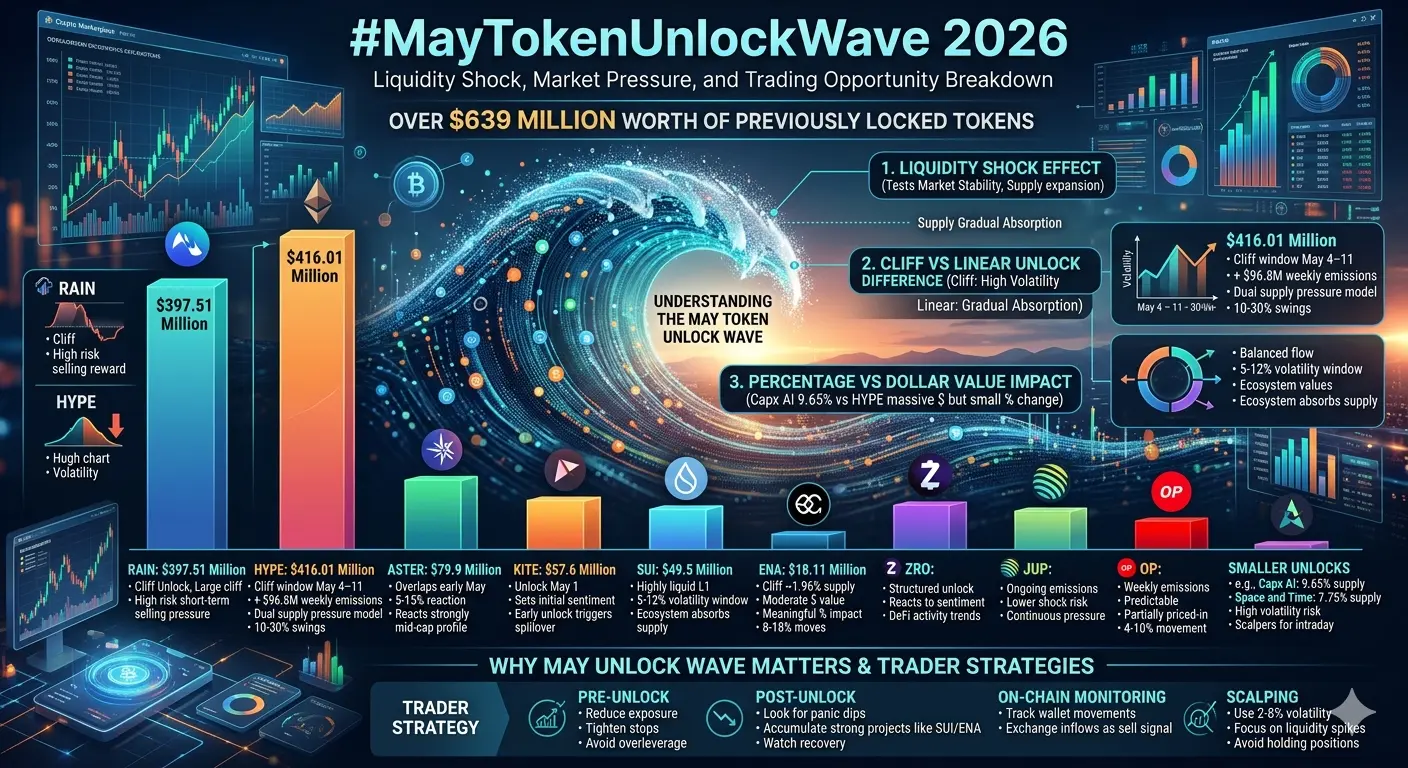
The May 2026 Token Unlock Wave represents one of the most concentrated liquidity events in the crypto market this year, with over $639 million worth of previously locked tokens scheduled to enter circulation within a short time window. These unlocks originate from vesting schedules, team allocations, early investor cliffs, ecosystem incentives, and structured emissions. When multiple large unlocks cluster together, the result is not just supply expansion but a full liquidity stress test across multiple tokens simultaneously.
This event is being closely watched because it combines large absolute unlock values, high percentage supply releases in selected projects, and overlapping unlock timelines, creating conditions for increased volatility, trading opportunities, and short-term market inefficiency.
Understanding the May Token Unlock Wave
A token unlock wave occurs when multiple projects release locked tokens into circulation at the same time period. In May 2026, the combined unlock value exceeds $639 million, making it one of the largest synchronized unlock periods in recent months.
This matters because crypto markets are highly sensitive to supply changes. Unlike traditional equities, where dilution is gradual and regulated, crypto unlocks can instantly increase circulating supply by 5% to 20% in a single event window, depending on the project.
Major Token Unlocks in May 2026 (Key Projects Breakdown)
RAIN
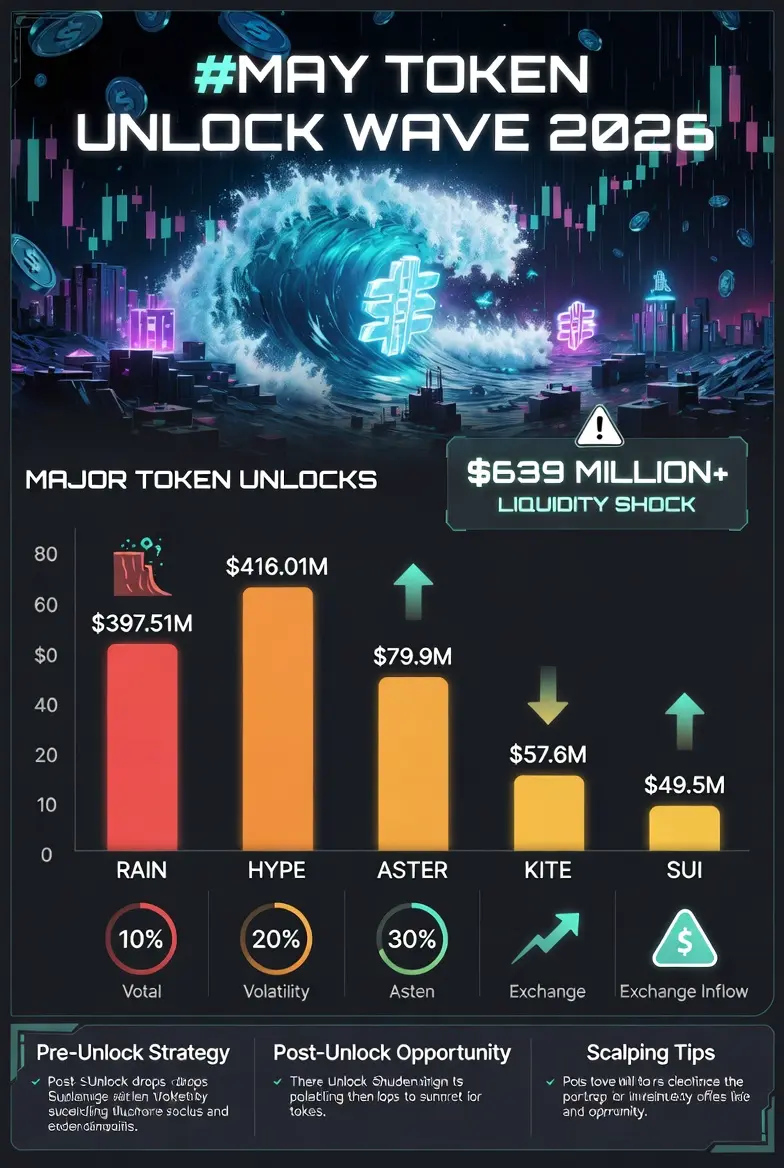
• Unlock Value: $397.51 million
• Market Impact Weight: ~60%+ of total May unlock wave
• Type: Large cliff unlock
RAIN is the most dominant event in this cycle. A cliff unlock of this size means a large portion of previously locked tokens becomes liquid at once. Historically, such events can trigger 8% to 25% price volatility, depending on whether early investors decide to sell immediately or hold.
Trader Impact: • High risk of short-term selling pressure
• Potential liquidity imbalance due to sudden supply spike
• Opportunity for post-unlock reversal trades if selling is absorbed
HYPE (Hyperliquid)
• Unlock Value: $416.01 million cliff unlock window (May 4–11)
• Additional weekly emissions: ~$96.8 million ongoing flow
HYPE is structurally different because it combines a large cliff unlock with continuous emissions. This creates a dual supply pressure model.
Trader Impact: • Short-term volatility range: 10%–30% swings possible
• Continuous emissions reduce price stability
• High-frequency traders benefit from intraday movement
ASTER
• Unlock Value: $79.9 million
ASTER’s unlock overlaps with early May liquidity conditions. Even though smaller than RAIN or HYPE, it still adds pressure during an already volatile period.
Trader Impact: • Likely 5%–15% short-term price reaction
• Often reacts strongly due to mid-cap liquidity profile
KITE
• Unlock Value: $57.6 million
• Unlock Date: May 1
KITE enters circulation early in the wave, meaning it can set initial sentiment for the rest of the month.
Trader Impact: • Early unlock can trigger market sentiment spillover
• If weak reaction, it may signal broader bearish tone
SUI
• Unlock Value: $49.5 million
SUI is a highly liquid Layer-1 asset, meaning it can absorb supply better than smaller tokens, but large unlocks still matter due to institutional participation.
Trader Impact: • Expected range: 5%–12% volatility window
• Strong ecosystems can reduce downside impact over time
ENA (Ethena)
• Unlock Value: $18.11 million cliff unlock (~1.96% supply)
ENA shows moderate dollar value but meaningful percentage impact relative to circulating supply.
Trader Impact: • Sensitive to sentiment due to smaller float
• Can move 8%–18% in short windows
ZRO (LayerZero)
• Unlock Type: Structured unlock cycles
ZRO remains closely watched due to its ecosystem relevance in cross-chain infrastructure.
Trader Impact: • Often reacts more to sentiment than pure supply
• Volatility depends on DeFi activity trends
JUP (Jupiter)
• Unlock Model: Ongoing emissions
JUP represents a steady emission model rather than a single cliff event.
Trader Impact: • Lower shock risk but continuous supply pressure
• Best suited for range trading strategies
OP (Optimism)
• Unlock Type: Weekly structured emissions
OP follows predictable unlock patterns, which makes it partially priced-in by the market.
Trader Impact: • Typically 4%–10% movement around unlock cycles
• Market adapts faster due to predictability
Smaller Unlocks (SIGN, OMNI, REX, Capx AI, Space and Time)
• Capx AI: 9.65% supply release (highest % impact)
• Space and Time: 7.75% supply release
Even though dollar value is smaller, percentage unlock is high, making these tokens vulnerable to sharper moves.
Trader Impact: • High percentage unlock = higher volatility risk
• Often used by scalpers for fast intraday trades
Why May Unlock Wave Matters for Markets
1. Liquidity Shock Effect
When over $639 million worth of tokens enters circulation, market liquidity is tested. If demand does not match supply expansion, downward pressure increases.
Typical market reaction: • Weak markets → 5% to 20% correction across affected tokens
• Strong markets → absorption with minimal impact
2. Cliff vs Linear Unlock Difference
Cliff Unlocks (HIGH IMPACT): • RAIN, HYPE
• Sudden large supply release
• Can trigger 10%–30% volatility spikes
Linear Unlocks (LOWER IMPACT): • OP, JUP
• Gradual supply increase
• Market absorbs more efficiently
3. Percentage vs Dollar Value Impact
• Capx AI → 9.65% supply increase (high risk structurally)
• HYPE → massive dollar value but small % supply change
This shows that percentage unlock often matters more than dollar value for price impact.
Trader Strategy During May Unlock Wave
Pre-Unlock Strategy
• Reduce exposure in tokens with large cliff unlocks
• Tighten stop-loss levels
• Avoid overleveraged positions before events
Expected advantage: • Avoid 10%–25% downside spikes in weak sentiment scenarios
Post-Unlock Strategy
• Look for panic dips in strong projects like SUI or ENA
• Accumulate if selling pressure is not fundamental-driven
• Watch recovery within 24–72 hours after unlock shock
On-Chain Monitoring Strategy
Smart traders track: • Whether unlocked tokens move to exchanges
• Whether wallets retain unlocked supply
• Exchange inflows as a sell signal
Scalping Strategy
During unlock window: • Use 2%–8% intraday volatility ranges
• Focus on liquidity spikes
• Avoid holding positions during news-triggered swings
Market Behavior Patterns Observed
Historically: • Tokens with >2% circulating supply unlocks often see 5%–15% dips
• Strong ecosystem tokens recover faster within 3–7 days
• Weak sentiment markets amplify downside to 20%–30%
Overall Market Impact
The May Token Unlock Wave does not automatically mean a crash. Instead, it creates:
• Short-term volatility expansion
• Temporary supply-demand imbalance
• Trading opportunity zones
• Liquidity redistribution across assets
In strong market conditions, unlocks are absorbed efficiently. In weak conditions, they act as accelerators of downside moves.
Final Outlook
The May 2026 unlock cycle is less about individual token failure and more about system-wide liquidity stress testing. With over $639 million in scheduled unlocks, the market enters a phase where short-term price action will be heavily influenced by supply shocks rather than pure demand trends.
For traders, this environment is not purely bearish or bullish—it is volatility-rich, meaning opportunity exists in both directions for those who manage risk properly.
The key separating factor will be simple: Whether market demand absorbs $639M+ in new supply efficiently or not.
The May 2026 Token Unlock Wave represents one of the most concentrated liquidity events in the crypto market this year, with over $639 million worth of previously locked tokens scheduled to enter circulation within a short time window. These unlocks originate from vesting schedules, team allocations, early investor cliffs, ecosystem incentives, and structured emissions. When multiple large unlocks cluster together, the result is not just supply expansion but a full liquidity stress test across multiple tokens simultaneously.
This event is being closely watched because it combines large absolute unlock values, high percentage supply releases in selected projects, and overlapping unlock timelines, creating conditions for increased volatility, trading opportunities, and short-term market inefficiency.
Understanding the May Token Unlock Wave
A token unlock wave occurs when multiple projects release locked tokens into circulation at the same time period. In May 2026, the combined unlock value exceeds $639 million, making it one of the largest synchronized unlock periods in recent months.
This matters because crypto markets are highly sensitive to supply changes. Unlike traditional equities, where dilution is gradual and regulated, crypto unlocks can instantly increase circulating supply by 5% to 20% in a single event window, depending on the project.
Major Token Unlocks in May 2026 (Key Projects Breakdown)
RAIN
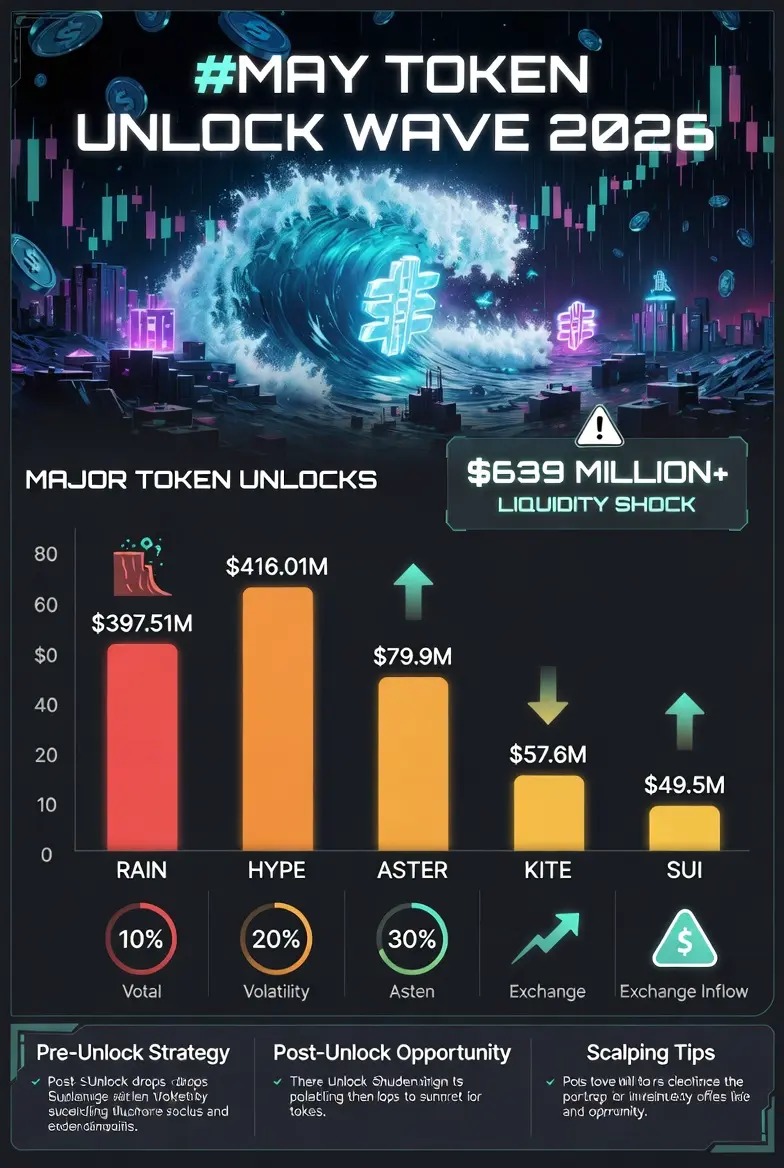
• Unlock Value: $397.51 million
• Market Impact Weight: ~60%+ of total May unlock wave
• Type: Large cliff unlock
RAIN is the most dominant event in this cycle. A cliff unlock of this size means a large portion of previously locked tokens becomes liquid at once. Historically, such events can trigger 8% to 25% price volatility, depending on whether early investors decide to sell immediately or hold.
Trader Impact: • High risk of short-term selling pressure
• Potential liquidity imbalance due to sudden supply spike
• Opportunity for post-unlock reversal trades if selling is absorbed
HYPE (Hyperliquid)
• Unlock Value: $416.01 million cliff unlock window (May 4–11)
• Additional weekly emissions: ~$96.8 million ongoing flow
HYPE is structurally different because it combines a large cliff unlock with continuous emissions. This creates a dual supply pressure model.
Trader Impact: • Short-term volatility range: 10%–30% swings possible
• Continuous emissions reduce price stability
• High-frequency traders benefit from intraday movement
ASTER
• Unlock Value: $79.9 million
ASTER’s unlock overlaps with early May liquidity conditions. Even though smaller than RAIN or HYPE, it still adds pressure during an already volatile period.
Trader Impact: • Likely 5%–15% short-term price reaction
• Often reacts strongly due to mid-cap liquidity profile
KITE
• Unlock Value: $57.6 million
• Unlock Date: May 1
KITE enters circulation early in the wave, meaning it can set initial sentiment for the rest of the month.
Trader Impact: • Early unlock can trigger market sentiment spillover
• If weak reaction, it may signal broader bearish tone
SUI
• Unlock Value: $49.5 million
SUI is a highly liquid Layer-1 asset, meaning it can absorb supply better than smaller tokens, but large unlocks still matter due to institutional participation.
Trader Impact: • Expected range: 5%–12% volatility window
• Strong ecosystems can reduce downside impact over time
ENA (Ethena)
• Unlock Value: $18.11 million cliff unlock (~1.96% supply)
ENA shows moderate dollar value but meaningful percentage impact relative to circulating supply.
Trader Impact: • Sensitive to sentiment due to smaller float
• Can move 8%–18% in short windows
ZRO (LayerZero)
• Unlock Type: Structured unlock cycles
ZRO remains closely watched due to its ecosystem relevance in cross-chain infrastructure.
Trader Impact: • Often reacts more to sentiment than pure supply
• Volatility depends on DeFi activity trends
JUP (Jupiter)
• Unlock Model: Ongoing emissions
JUP represents a steady emission model rather than a single cliff event.
Trader Impact: • Lower shock risk but continuous supply pressure
• Best suited for range trading strategies
OP (Optimism)
• Unlock Type: Weekly structured emissions
OP follows predictable unlock patterns, which makes it partially priced-in by the market.
Trader Impact: • Typically 4%–10% movement around unlock cycles
• Market adapts faster due to predictability
Smaller Unlocks (SIGN, OMNI, REX, Capx AI, Space and Time)
• Capx AI: 9.65% supply release (highest % impact)
• Space and Time: 7.75% supply release
Even though dollar value is smaller, percentage unlock is high, making these tokens vulnerable to sharper moves.
Trader Impact: • High percentage unlock = higher volatility risk
• Often used by scalpers for fast intraday trades
Why May Unlock Wave Matters for Markets
1. Liquidity Shock Effect
When over $639 million worth of tokens enters circulation, market liquidity is tested. If demand does not match supply expansion, downward pressure increases.
Typical market reaction: • Weak markets → 5% to 20% correction across affected tokens
• Strong markets → absorption with minimal impact
2. Cliff vs Linear Unlock Difference
Cliff Unlocks (HIGH IMPACT): • RAIN, HYPE
• Sudden large supply release
• Can trigger 10%–30% volatility spikes
Linear Unlocks (LOWER IMPACT): • OP, JUP
• Gradual supply increase
• Market absorbs more efficiently
3. Percentage vs Dollar Value Impact
• Capx AI → 9.65% supply increase (high risk structurally)
• HYPE → massive dollar value but small % supply change
This shows that percentage unlock often matters more than dollar value for price impact.
Trader Strategy During May Unlock Wave
Pre-Unlock Strategy
• Reduce exposure in tokens with large cliff unlocks
• Tighten stop-loss levels
• Avoid overleveraged positions before events
Expected advantage: • Avoid 10%–25% downside spikes in weak sentiment scenarios
Post-Unlock Strategy
• Look for panic dips in strong projects like SUI or ENA
• Accumulate if selling pressure is not fundamental-driven
• Watch recovery within 24–72 hours after unlock shock
On-Chain Monitoring Strategy
Smart traders track: • Whether unlocked tokens move to exchanges
• Whether wallets retain unlocked supply
• Exchange inflows as a sell signal
Scalping Strategy
During unlock window: • Use 2%–8% intraday volatility ranges
• Focus on liquidity spikes
• Avoid holding positions during news-triggered swings
Market Behavior Patterns Observed
Historically: • Tokens with >2% circulating supply unlocks often see 5%–15% dips
• Strong ecosystem tokens recover faster within 3–7 days
• Weak sentiment markets amplify downside to 20%–30%
Overall Market Impact
The May Token Unlock Wave does not automatically mean a crash. Instead, it creates:
• Short-term volatility expansion
• Temporary supply-demand imbalance
• Trading opportunity zones
• Liquidity redistribution across assets
In strong market conditions, unlocks are absorbed efficiently. In weak conditions, they act as accelerators of downside moves.
Final Outlook
The May 2026 unlock cycle is less about individual token failure and more about system-wide liquidity stress testing. With over $639 million in scheduled unlocks, the market enters a phase where short-term price action will be heavily influenced by supply shocks rather than pure demand trends.
For traders, this environment is not purely bearish or bullish—it is volatility-rich, meaning opportunity exists in both directions for those who manage risk properly.
The key separating factor will be simple: Whether market demand absorbs $639M+ in new supply efficiently or not.