Paxos burned PYUSD, creating the biggest blunder in crypto history, minting and destroying 300 trillion PayPal USD stablecoins in just 30 minutes on October 15, an astronomical figure equivalent to twice the global GDP.
This “internal transfer technical error” led to Aave's emergency freeze of PYUSD transactions. Although Paxos emphasized that there were no security vulnerabilities and that customer funds are safe, this unprecedented Paxos destruction of PYUSD incident still triggered deep market doubts about the robustness of the stablecoin system.
Paxos Destroys PYUSD Shocking the Market, A 30-Minute Horror Story
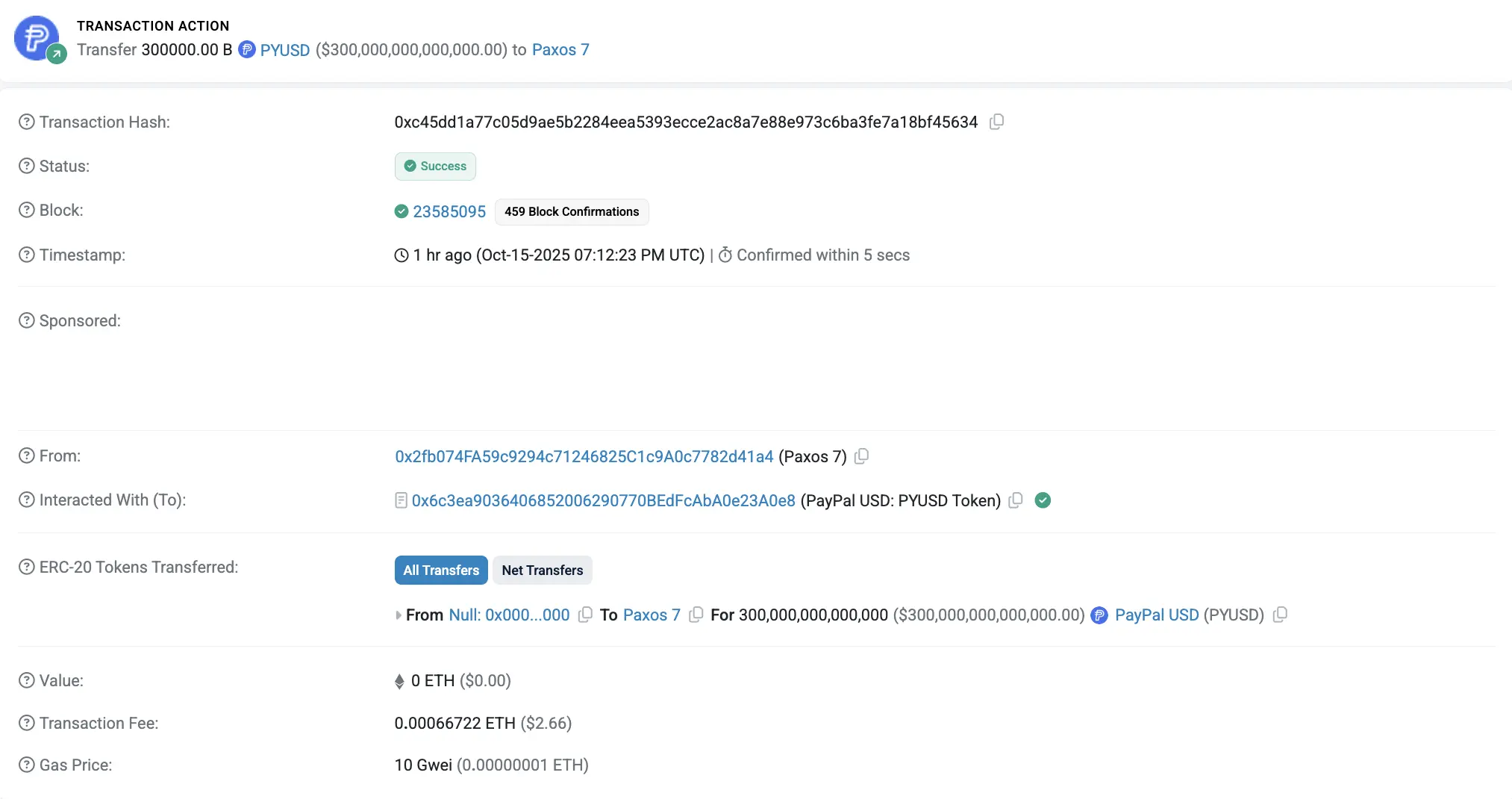
(Source: Etherscan)
On October 15, the cryptocurrency market experienced an unprecedented moment of panic. Ethereum blockchain data showed that the stablecoin issuer Paxos suddenly minted 300 trillion PayPal USD (PYUSD) stablecoins at 7:12 PM UTC, a figure so large that it left analysts monitoring on-chain activities in shock.
Even more confusing is that this astronomical number of tokens did not enter the market circulation. Just 22 minutes later, Paxos sent all 300 trillion PYUSD to an inaccessible burn address, completing the largest single token burn in cryptocurrency history. The entire process from minting to burning took less than half an hour, but it was enough to cause a huge uproar in the crypto community.
Since PYUSD is pegged to the USD at a 1:1 ratio, the amount of PYUSD that Paxos destroyed in this batch is equivalent to approximately 300 trillion USD in fiat currency value. What does this concept mean? According to data from the International Monetary Fund, 300 trillion USD is more than twice the total Gross Domestic Product of all countries on Earth. In other words, the stablecoins minted by Paxos in just a few minutes have a theoretical value that exceeds all the wealth created by the global economy in a year.
The unusual nature of this incident immediately triggered the risk management mechanisms of decentralized financial protocols. Omer Goldberg, the founder of Chaos Labs, posted on the X platform stating that Aave will temporarily freeze trading activities of PYUSD in response to this “unexpected surge in trading intensity.” This preventive measure shows that even after Paxos has completed the minting of PYUSD, market concerns about potential risks have not dissipated.
The Etherscan blockchain explorer clearly records the timeline of the entire event. From the confirmation of the minting transaction to the large amount of tokens transferred to the burn address, every step is presented transparently on the chain. This transparency is not only an advantage of blockchain technology but also makes this blunder event impossible to hide, quickly fermenting into a hot topic on social media.
The reactions of cryptocurrency users range from confusion to skepticism. Some question whether this represents a fundamental flaw in the stablecoin system, while others are curious how such a large-scale error could pass through internal auditing processes. Even conspiracy theorists speculate that this could be a cover for some kind of test or more complex operation. Regardless of the truth, this incident of Paxos destroying PYUSD has become one of the most shocking technical accidents in the cryptocurrency market in 2025.
Technical error or operational mistake? Paxos emergency response clarification
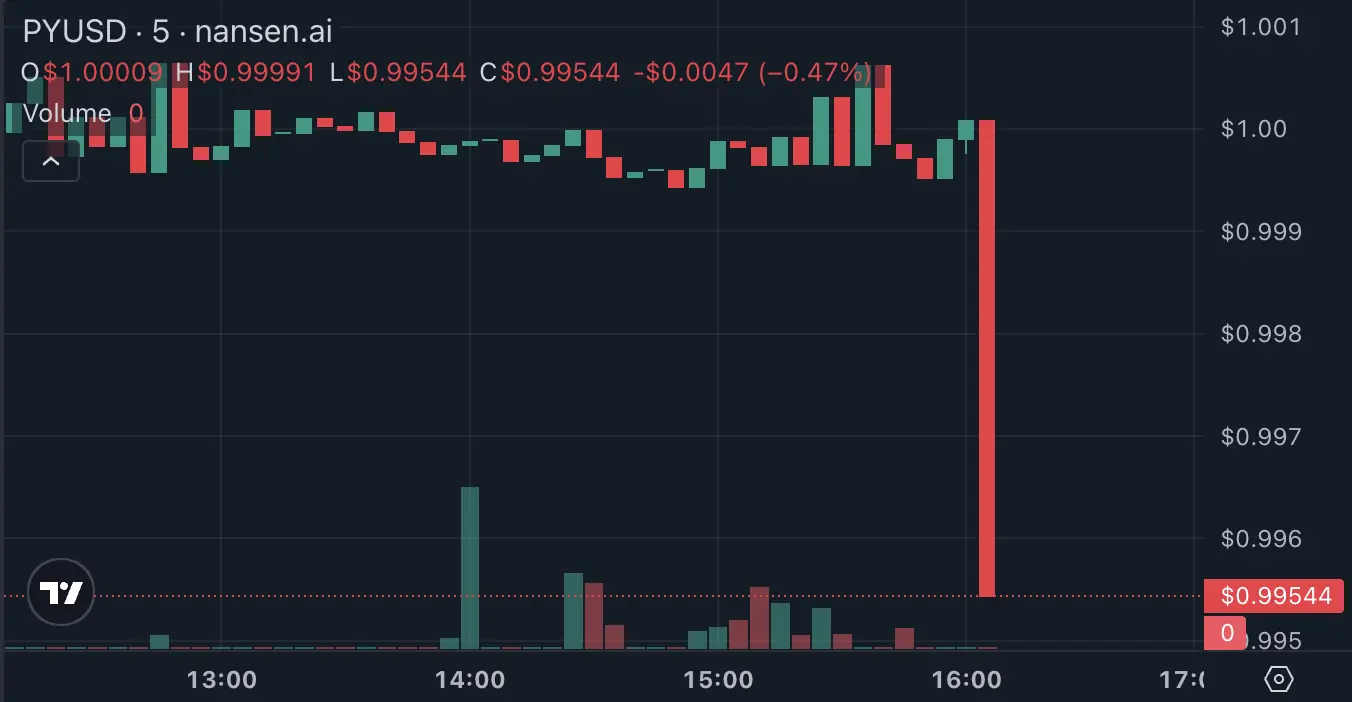
(Source: Trading View)
In response to market skepticism and panic, Paxos quickly issued an official statement within hours of the incident. The company explained in a post on the X platform that the large-scale minting was “excess PYUSD minted due to an error in the internal transfer process,” which was attributed to an internal technical error rather than an external attack.
Paxos's statement attempts to calm market sentiment from three key points. First, the company clearly states that “this is an internal technical error,” characterizing the issue as a failure in internal processes rather than a systemic flaw. Second, Paxos emphasizes that “there are no security vulnerabilities,” intending to clarify that there was no hacking or attack on smart contracts. Third, and most importantly, the company assures that “customer funds are secure,” and claims that “we have resolved the root cause.”
This rapid crisis public relations response has stabilized market confidence to some extent. According to data from Nansen, although the price of PYUSD temporarily fell by about 0.5% after the news broke, the stablecoin basically maintained its peg to the USD. This slight fluctuation indicates that, while the market was surprised by the event, it overall accepted Paxos's explanation, believing that this was indeed a technical incident rather than a more serious systemic issue.
However, Paxos' brief statement also leaves many unanswered questions. Firstly, what kind of “internal transfer process” would require the minting of 300 trillion tokens? Normal internal transfers should move tokens within the existing supply, rather than creating new supply. Such a scale of minting clearly exceeds any reasonable internal operational need, implying a possible numerical error or logical flaw in the code.
Secondly, why did Paxos's internal control mechanisms fail to intercept this obviously anomalous operation before the minting execution? For a fintech company managing billions of dollars in stablecoin assets, there should be multiple layers of review and limit controls to prevent such errors. The enormous figure of 300 trillion should have triggered any normal anomaly transaction detection system.
Third, Paxos claims to have “resolved the root cause,” but has not elaborated on the specific technical measures taken to prevent similar incidents from occurring again. This vague statement, while understandable as a means to protect trade secrets, makes it difficult for outsiders to assess whether the issue has truly been resolved or if it is merely a temporary fix.
Industry experts point out that although this incident did not cause any actual economic losses, it exposed potential technical risks in the stablecoin issuance mechanism. If similar errors occur at different stages of the minting process, or if attackers exploit similar vulnerabilities, the consequences could be far more serious than the recent incident involving Paxos destroying PYUSD. This has also sparked discussions on whether stablecoin issuers need stricter technical audits and risk control standards.
The Deep Impact of the Largest Destruction Event in Encryption History
When examining the recent Paxos PYUSD burn event within the context of cryptocurrency history, its scale is unprecedented. Previous major token burn events cannot compare in quantity. For example, a cryptocurrency exchange sent over 65 million platform tokens to an inaccessible address in August 2024, which was already a large-scale operation aimed at maintaining a supply of 21 million platform tokens.
Another frequently mentioned case is the Bonk memecoin project, which destroyed approximately 1.7 trillion BONK tokens in December 2024. Although the number seems vast, the actual value of these tokens at the time was only about 50 million USD, far less than Paxos's theoretical scale of 300 trillion USD. Of course, since Paxos executed the destruction of PYUSD immediately after minting, these tokens never entered circulation, and thus their actual impact on the market was extremely limited.
Currently, the market capitalization of PYUSD has exceeded 2.3 billion USD, ranking sixth in the stablecoin market, just behind Tether's USDT, Circle's USDC, Ethena's USDe, MakerDAO's DAI, and World Liberty Financial USD. This market position indicates that PYUSD has become an important stablecoin option, closely related to the endorsement of PayPal, the global payment giant.
Although this incident did not shake PYUSD's market position, it did affect its reputation to some extent. The decision by the Aave protocol to temporarily freeze PYUSD trading reflects the cautious attitude of the decentralized finance ecosystem towards such technical incidents. While this preventive measure may cause short-term inconvenience, it is necessary for protecting user funds and maintaining system stability.
From a regulatory perspective, the recent incident of Paxos destroying PYUSD may attract more attention from regulatory agencies regarding stablecoin issuance mechanisms. If a regulated stablecoin issuer can experience such a large-scale technical error, regulators may demand stricter technical standards, more frequent audits, and more robust internal control mechanisms. This could mean an increase in compliance costs for the entire stablecoin industry, but it would also enhance the overall safety and reliability of the system.
For cryptocurrency investors, this event serves as an important reminder: even stablecoins pegged to fiat currencies are not completely free from technical risks. Although PYUSD quickly maintained its peg, in extreme situations, technical incidents or operational errors could still trigger market panic and liquidity issues. Diversifying holdings across different stablecoins, rather than overly concentrating on a single issuer, may be a more prudent risk management strategy.


