Cryptocurrency markets experienced a sharp correction on November 21, with the overall market cap evaporating a total of $1.35 trillion since October. In just the past 24 hours, total market liquidations reached as high as $1 billion. Bitcoin plummeted 8% to $85,000, Ethereum dropped 9% below $2,800, and major tokens like Solana and XRP all saw declines exceeding 7%.
This crash coincided with a $4.2 billion options expiry event, including 390,000 Bitcoin options (notional value $3.4 billion) and 185,000 Ethereum options (notional value $525 million) expiring on the same day, potentially further amplifying market volatility. Strong US employment data weakened expectations for Fed rate cuts, prompting traders to rapidly close leveraged positions, triggering $450 million in liquidations within two hours.
$1 Billion Liquidated in a Single Day in Crypto Markets
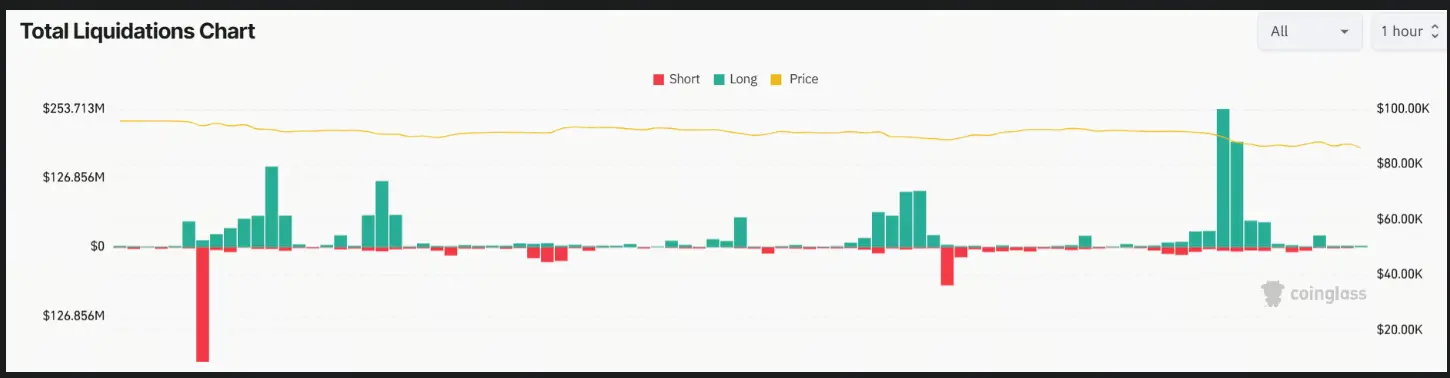
(Source: Coinglass)
According to Coinglass data, the past 24 hours saw a massive series of liquidations in the crypto market totaling $1 billion, involving over 252,000 traders. Bitcoin was the most impacted, accounting for $500 million in liquidations alone, with long positions accounting for $460 million, causing the price to quickly decline to a 24-hour low of $85,300. On a major centralized exchange (CEX), liquidation orders for BTCUSDT perpetual contracts worth $30.91 million occurred, representing the largest single liquidation event of this downturn.
The market shows a clear imbalance between bullish and bearish forces, with total long liquidations reaching $850 million compared to $150 million in shorts. This stark disparity indicates prior market sentiment was overly optimistic, and leveraged long positions triggered a chain reaction during the price reversal. Notably, within just two hours after the release of strong US employment data, $450 million in liquidations occurred, highlighting the increased transmission of macroeconomic data into crypto markets. Traditional financial factors are now becoming key variables in crypto asset pricing.
Besides Bitcoin and Ethereum, other major tokens also faced heavy selling pressure. Solana fell 8% to a low of $130.52 intraday, XRP dropped 7% below $1.96, and assets like ZEC, HYPE, DOGE, TON, ASTER, and BNB also ranked high in liquidations. This broad decline reflects a systemic change in market risk appetite rather than issues specific to individual assets. From a temporal perspective, this correction marks the most severe adjustment phase since Bitcoin hit its all-time high of $125,100 on October 5.
Major Cryptocurrency Liquidation Data Overview
Bitcoin (BTC)
24-hour liquidation: $500 million
Price decline: 8%
Lowest price: $85,300
Long liquidation proportion: 92%
Ethereum (ETH)
Price decline: 9%
Current price: below $2,800
Liquidation size: approximately $210 million
Other major tokens
Solana (SOL): down 8%, liquidation over $80 million
XRP: down 7%, liquidation about $55 million
Total market longs: $850 million
Total market shorts: $150 million
Options Expiry May Trigger Further Selling Pressure
Today’s crypto options expiry totals $4.2 billion, which could add additional downside pressure amid the weak market. Data from Deribit shows that 39,000 Bitcoin options (notional value $3.4 billion) are expiring today, with a put-to-call ratio of 0.52. The maximum pain point is set at $98,000, well above the current market price. However, in the past 24 hours, put options trading volume significantly exceeded call options, with a put-to-call ratio of 1.36, indicating traders are actively hedging to limit potential losses.
Ethereum options exhibit a similar pattern, with 185,000 options (notional value $525 million) expiring soon. The put-to-call ratio is 0.72. Over the last 24 hours, put options trading doubled, raising the ratio to 1.01, confirming a shift in market sentiment. The largest pain point is at $3,200, noticeably above the current $2,800 trading price, which could incentivize option sellers to exert downward pressure before expiry to maximize gains.
Deribit analysts note that current positions do not show signs of significant risk aversion; traders still maintain some exposure amid volatility, indicating market confidence has not fully collapsed. However, this relatively optimistic assessment diverges from actual price movements. The gamma effects in the options market may intensify short-term volatility. Market makers hedging their options positions through dynamic hedging can produce additional selling pressure during price declines, creating a negative feedback loop.
Macroeconomic Factors and Structural Market Changes
The strong US employment report served as a catalyst for the recent sell-off, quickly adjusting expectations for a December rate cut by the Federal Reserve. The sensitive response of traditional financial markets to monetary policy signals now transmits almost instantaneously to crypto, highlighting the deepening correlation between the two asset classes. Changing rate expectations affect global liquidity outlooks, prompting investors to reassess allocations to high-risk assets, with cryptocurrencies as a high-beta asset class leading the way.
According to a recent report by 10x Research, market participants are overly focused on price charts while neglecting structural factors such as ETF holdings changes, weak performance of crypto IPOs, and shifts in Wall Street incentives. The firm believes that the chain reaction triggered by ETF holders being forced to unwind positions is not over yet, and it’s too early to bottom fish. This view is supported by actual capital flow data, as US spot Bitcoin ETF funds have experienced net outflows for several consecutive days, contrasting with the steady inflows seen earlier this year.
The internal structure of the crypto market has also evolved significantly. The share of decentralized derivatives trading volume has increased, and leverage usage has become more widespread. While this improves market efficiency, it also raises systemic risk. When prices reverse, the built-in liquidation mechanisms of decentralized protocols automatically execute, avoiding counterparty risk but removing traditional negotiation and risk management buffers, leading to more volatile and rapid price swings.
Historical Comparisons and Market Bottom Signals
Comparing current conditions with historical cycles reveals some similarities but also notable differences. Unlike the liquidity crisis triggered by the 2022 FTX collapse, this decline has not been accompanied by large institutional failures or systemic risk events, but is mainly driven by leverage liquidations and technical factors. Bitwise analysts point out that market infrastructure has improved significantly in this cycle, with tokenization progress and stablecoin expansion enhancing ecosystem resilience, fundamentally different from a bear market driven solely by confidence collapse.
On-chain data shows Bitcoin’s MVRV ratio (market cap / realized cap) has entered negative territory, indicating that average holders are at a loss. Historically, when MVRV drops to between -8% and -18%, it often marks the market bottom, as long-term investors tend to accumulate rather than sell. However, this indicator’s effectiveness may be challenged in the current cycle due to the large amount of Bitcoin held via ETFs, whose investor behavior may differ from retail holders.
Derivatives market data offers some optimistic signals. Despite the huge scale of liquidations, futures funding rates have normalized and are not exhibiting persistent negative extremes, suggesting leverage excess has been mitigated. Additionally, options skewness indicators show that panic sentiment has not reached extreme levels historically, indicating restrained reactions that could leave room for a subsequent rebound. Yet, these positive signs require confirmation from price action to be sustainable.
The crypto market faced a perfect storm on expiry day, with $1 billion in leveraged position liquidations resonating with $4.2 billion in options expiry, accelerating the correction. This adjustment, triggered by macroeconomic factors and amplified by market structure, reveals the increasingly tight linkage between crypto and traditional financial systems. Despite short-term challenges, ongoing improvements in market fundamentals and restrained panic sentiment leave room for recovery, reminding investors to focus not only on price swings but also on the structural evolution of the ecosystem.
FAQ
What caused this sharp decline in the crypto markets?
Strong US employment data reduced expectations for Fed rate cuts, triggering liquidation of highly leveraged long positions. The $4.2 billion options expiry date added technical pressure, together leading to a $1 billion liquidation in 24 hours.
How does options expiry influence crypto prices?
When large amounts of out-of-the-money options, especially puts, are expiring, market makers hedge risk by selling, which can push prices in certain directions. Today’s $3.4 billion Bitcoin options expiry at a maximum pain point of $98,000—above the current price—may exert downward pressure.
Is the market at or near bottom?
Institutions like 10x Research believe ETF holdings are still adjusting, and it’s too early to bottom-fish. Despite the MVRV ratio indicating undervaluation, the complete liquidation of leverage and macroeconomic signals need to align before a confirmed bottom.
Which cryptocurrencies were most affected?
Bitcoin and Ethereum saw the largest liquidations—$500 million and $210 million respectively—and major tokens like Solana and XRP declined over 7%, indicating a broad market correction rather than issues with individual assets.
How should investors respond now?
Reduce leverage, monitor the key support levels at $85,000 for Bitcoin and $2,800 for Ethereum, wait for options expiry effects to subside, and for volatility to decrease. Long-term investors might consider phased building positions but should strictly control position sizes.


