Elon Musk stated that Bitcoin is “fundamental” because it is based on physical energy: “Energy is the real currency.” He asserted that governments cannot “counterfeit” Bitcoin as they do with fiat money. Elon Musk’s cryptocurrency holdings include Bitcoin, Ethereum, and Dogecoin, while Tesla holds 9,720 BTC valued at over $1 billion.
Musk’s Philosophy: Why Energy Is the Real Currency
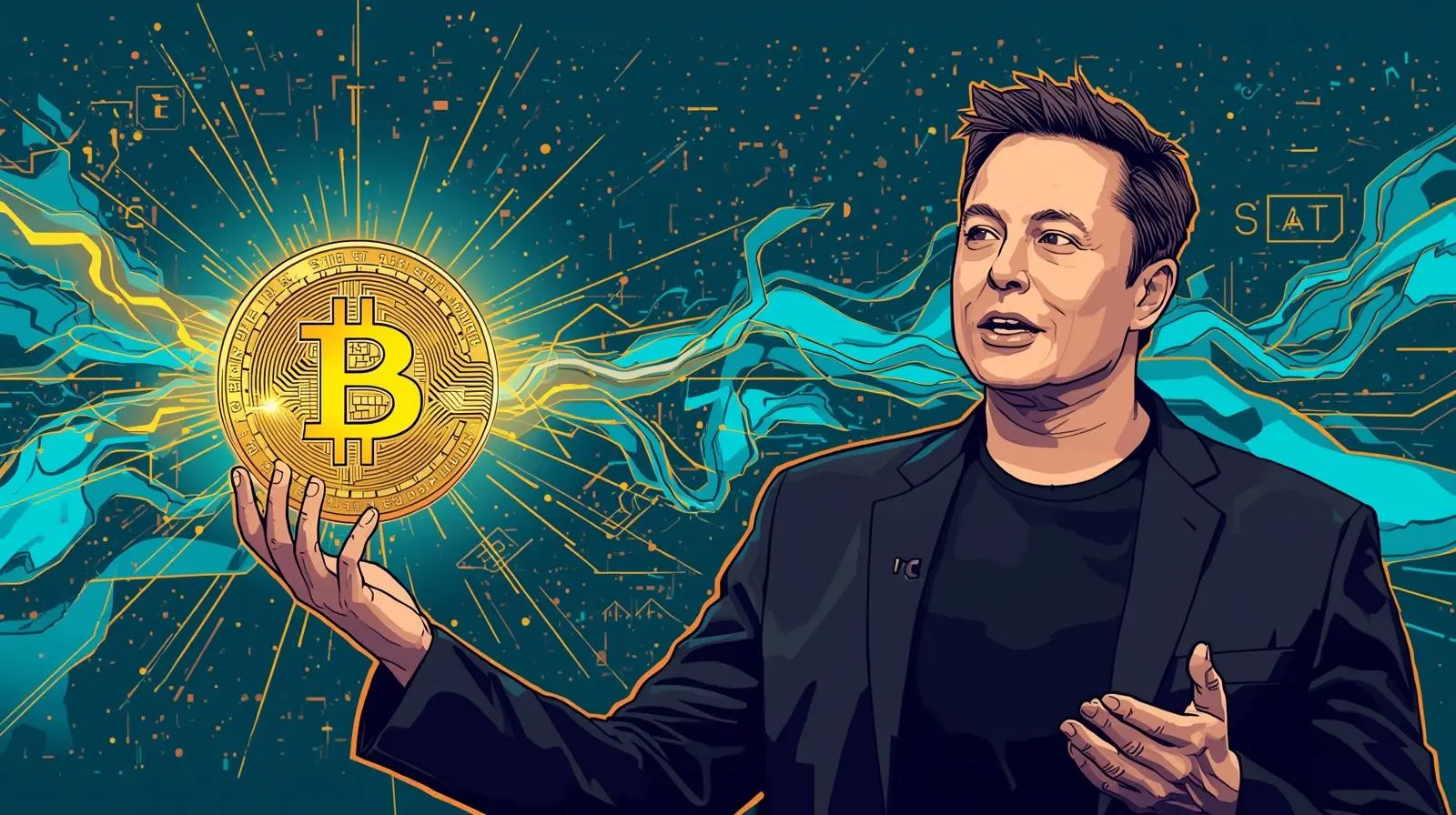
Musk explained to entrepreneur Nikhil Kamath that Bitcoin’s intrinsic value comes from the physical energy required to mine it, not from government backing. “Energy is the real currency. That’s why I said Bitcoin is based on energy,” stated the SpaceX CEO. This perspective positions Elon Musk’s cryptocurrency as fundamentally different from fiat money.
He argued that energy cannot be created by legislation: “You can’t just pass a law and suddenly have lots of energy. It’s very hard to generate energy, or especially to harness it usefully to do useful work.” This reasoning connects Bitcoin’s value to the second law of thermodynamics—energy has a real cost that no government can legislate out of existence.
Bitcoin mining requires a large amount of electricity to power computers that solve cryptographic puzzles, a process that secures the network and introduces new coins into circulation. Each mined block represents approximately 1,000 megawatt-hours of energy consumed, anchoring Bitcoin’s value in real physical resources instead of government promises.
These comments echo statements from October 2024, when Musk noted that governments cannot “counterfeit” Bitcoin as they can with fiat currencies. This criticism of fiat money reflects a libertarian concern about inflation and monetary devaluation through centrally controlled supply expansion. Bitcoin, with its fixed supply of 21 million, represents programmed scarcity that no authority can modify.
Elon Musk’s History with Cryptocurrencies: From 2019 to 2025
The relationship between Elon Musk and cryptocurrencies is a rich, well-known, and public trajectory. The world’s most high-profile billionaire and entrepreneur is responsible for thousands of people taking the leap and buying cryptocurrencies. Musk moves the market with his messages: every public appearance or coin mention has generated instant volatility.
The tech tycoon began publicly showing interest in cryptocurrencies at the beginning of 2019, when he made his first tweets about Dogecoin, describing it as an appealing currency to him. His definitive immersion in the crypto market came at the end of 2020, when he notably increased his comments about Bitcoin and Dogecoin, taking advantage of the crypto market boom.
The turning point came in January 2021, when Tesla announced the purchase of $1.5 billion in Bitcoin, becoming one of the publicly traded companies with the largest reserves of the cryptocurrency worldwide. This corporate decision validated Bitcoin as a legitimate reserve asset for company balance sheets, inspiring other companies like MicroStrategy, Square, and MassMutual to follow suit.
In 2021, during a public conference, Musk confirmed that his only significant personal investments outside of Tesla and SpaceX were in Bitcoin, Ethereum, and Dogecoin, cementing his position as one of the most influential figures in the crypto ecosystem, able to move markets with a simple social media comment.
Elon Musk’s Confirmed Cryptocurrency Holdings
Bitcoin (BTC): Personal holdings undisclosed; Tesla holds 9,720 BTC according to recent financial reports
Ethereum (ETH): Personal amount not specified, confirmed in public statements
Dogecoin (DOGE): Musk has described DOGE as “the people’s cryptocurrency” and confirms personal holdings
What’s not known for sure: There is no reliable public confirmation that Musk holds cryptocurrencies beyond BTC, ETH, and DOGE. The cryptocurrencies held by his companies do not necessarily reflect personal holdings. There is no public and verifiable list of personal wallets—he has not shared his keys or verified addresses.
DOGE: The Double Meaning That Boosted Dogecoin
After his electoral victory in November 2024, U.S. President Donald Trump announced that Elon Musk and entrepreneur Vivek Ramaswamy would lead the new Department of Government Efficiency, whose English acronym was precisely “DOGE”—an evident nod to the Dogecoin cryptocurrency that Musk has publicly promoted since 2013.
Dogecoin doubled in value after the announcement of the DOGE department. During the campaign, whenever Musk mentioned the acronym “DOGE” at Trump rallies, Dogecoin’s price saw speculative jumps of 10-15%, even though the tycoon was referring to the Department of Government Efficiency and not the cryptocurrency.
In the recent interview with Kamath, Musk spoke about his Department of Government Efficiency, calling it an “interesting side mission” that revealed the “inner workings” of government operations. “A lot of what DOGE did was just common sense, things that would be normal for any organization that cared about financial responsibility,” he said.
The department denied reports of its closure last week, stating that it would resume “regularly scheduled” updates. Musk confirmed the initiative is still ongoing: “It’s still going, by the way. DOGE is still happening.”
The DOGE website lists approximately $214 billion in savings, with its latest update published on October 4. However, some reports have questioned these figures, suggesting they may inflate real savings by counting maximum possible contract values instead of confirmed spending reductions.
Musk’s Impact on the Crypto Market: Opportunity and Volatility
Elon Musk is watched by millions, no matter what message he sends. Although his influence on crypto volatility has lessened over time, he still has power over market temperature and trends or the so-called “FOMO” (fear of missing out).
However, it is not a good idea to confuse influence with investment recommendation. Musk speaking positively (or negatively) about a coin does not make that cryptocurrency a good investment: many reactions are speculative and temporary. Studies show that his interventions increase volatility and short-term trading but rarely alter fundamental long-term trends.
Elon Musk’s messages about cryptocurrencies have sparked debates about whether they influence crypto markets too much—a gray area regarding possible market manipulation—and attract regulatory and media scrutiny. The U.S. SEC has investigated some of Musk’s public statements regarding their effects on investment markets, particularly after his tweets about Dogecoin in 2021 that caused price surges of over 100% in hours.
What We Know About Elon Musk’s Cryptocurrency
· Prefers decentralized cryptocurrencies over centralized alternatives
· Has criticized aspects of the traditional financial system and fiat monetary expansion
· Is skeptical about some aspects of cryptocurrencies but sees them as a viable alternative
· Dogecoin is his favorite cryptocurrency, adopting it as “the people’s cryptocurrency”
The Future: Will Musk Integrate Crypto into the X Ecosystem?
The future of Elon Musk in the crypto market looks set to continue being marked by his ability to influence cycles of euphoria and technological narratives. Although his comments no longer generate the explosive peaks of 2021, Musk remains a figure capable of reigniting retail interest, especially around projects with a community component like Dogecoin, cryptocurrencies with artificial intelligence, or initiatives related to tokenization of energy, payments, and social networks within his business ecosystem—including the X platform.
If he ultimately integrates crypto micropayments into his companies, he could open a new phase of mass adoption. The X platform (formerly Twitter) has obtained money transmission licenses in multiple U.S. states, suggesting plans for an integrated payment system. Integrating cryptocurrencies into this system would turn hundreds of millions of X users into instant crypto users.
However, his relationship with the market will continue to swing between strategic vision and media spectacle, making his influence a mix of opportunity and permanent volatility for investors. Elon Musk’s cryptocurrency—whatever its definition—will continue to be a topic of speculation and debate in 2025 and beyond.


