The much-anticipated year-end surge in digital assets collapsed into a severe crypto crash, marking the worst quarterly decline since the 2022 bear market depths.
Expectations built around robust digital asset treasuries, new altcoin ETFs, and bitcoin’s historical seasonal strength all unraveled, leaving the market vulnerable to cascading liquidations and fading liquidity. A devastating $19 billion wipeout in October eroded market depth, while subsequent price recoveries appeared driven primarily by short squeezes rather than organic buying interest.
As enthusiasm for ETFs wanes and several treasuries trade below net asset value—risking potential forced sales—the crypto crash has stripped away major bullish narratives heading into 2026. With rate cuts failing to ignite risk appetite and no immediate catalysts in sight, the ongoing crypto crash highlights a fragile ecosystem still prone to sharp reversals despite growing institutional participation. Capitulation from over-leveraged holders could eventually pave the way for a bottom, though near-term risks remain elevated.
(Sources: Blockworks)
Key Highlights
- The crypto crash delivered bitcoin’s steepest Q4 drop in years, defying historical seasonality and expected tailwinds from ETFs and treasuries.
- Digital asset treasuries shifted from aggressive buyers to potential forced sellers as premiums evaporated and shares traded below NAV.
- Altcoin ETFs attracted billions in inflows but failed to prevent underlying token prices from plunging amid broader risk aversion.
- October’s massive liquidation event created a persistent liquidity void, with rebounds fueled mainly by short covering.
- The crypto crash leaves the market entering 2026 without clear positive drivers, raising odds of further downside pressure.
Crypto Crash: From Bullish Expectations to Harsh Reality
Optimism heading into late 2025 centered on strong ETF demand, proliferating digital asset treasuries modeled after high-profile strategies, and bitcoin’s proven track record of fourth-quarter gains. Looser monetary policy and a potentially supportive regulatory environment further fueled projections of new all-time highs.
Instead, the crypto crash materialized swiftly, with bitcoin shedding 23% since October’s start—underperforming surging equities and precious metals dramatically.
Digital Asset Treasuries Fuel the Crypto Crash
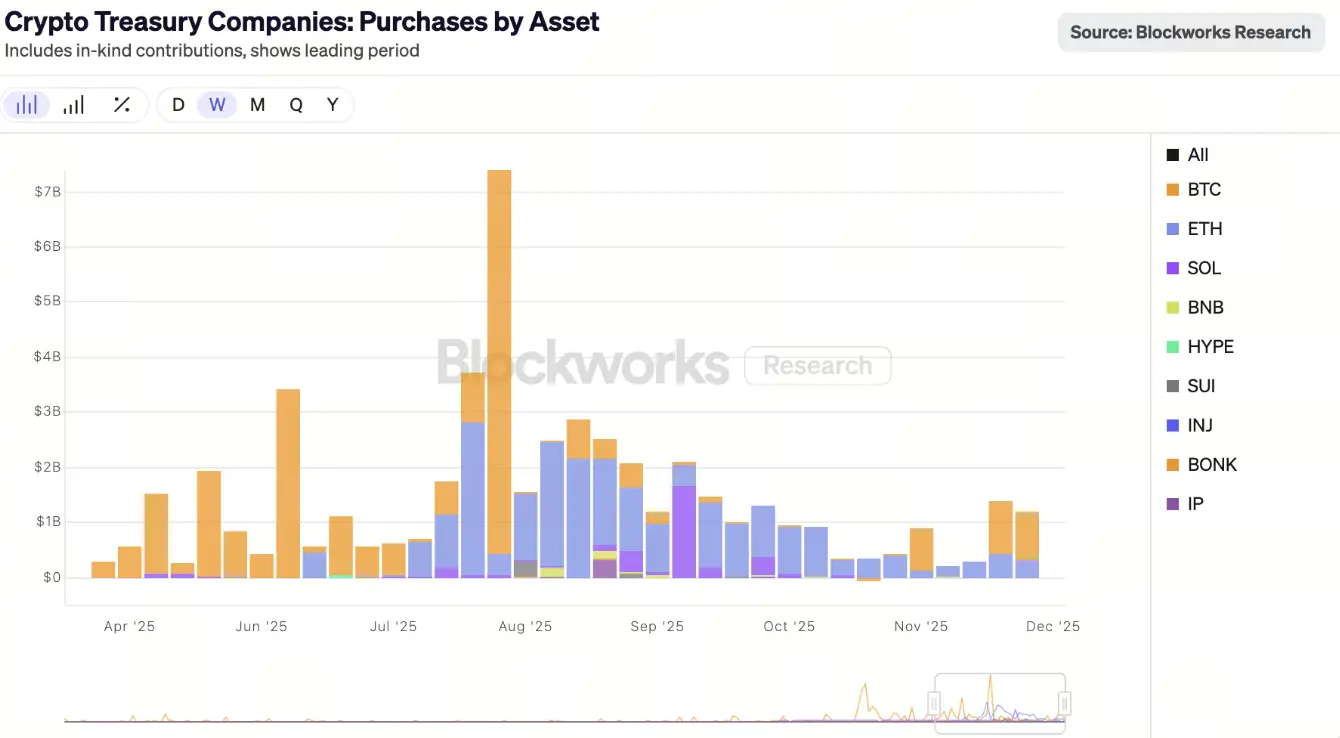
Initially hailed as a powerful accumulation mechanism, digital asset treasuries rapidly lost momentum during the crypto crash. Early enthusiasm gave way to sharp sell-offs as share prices collapsed, pushing many below net asset value and halting capital raises.
Purchasing activity dried up entirely for most, with funds redirected toward share buybacks. Extreme cases saw bitcoin holdings valued at multiples of enterprise value, heightening concerns of involuntary liquidations that could exacerbate the crypto crash.
Altcoin ETFs Fail to Stem the Crypto Crash
Spot altcoin ETFs launched amid high hopes but arrived during worsening sentiment, unable to counteract the crypto crash. Solana vehicles accumulated $900 million and XRP products exceeded $1 billion in inflows, yet underlying tokens suffered steep declines—SOL down 35% and XRP nearly 20% post-launch.
Smaller altcoin ETFs attracted minimal interest as risk tolerance evaporated, underscoring how inflows alone couldn’t arrest the broader crypto crash.
Seasonality Breaks Down in Historic Crypto Crash
Bitcoin’s reliable year-end strength—averaging 77% Q4 returns since 2013 with positive performance in most years—crumbled during this crypto crash. The current trajectory positions 2025 for one of the weakest final quarters on record, aligning with prior deep bear phases rather than typical bullish patterns.
Liquidity Damage Prolongs the Crypto Crash
October’s explosive $19 billion liquidation event not only triggered immediate losses but inflicted lasting harm during the crypto crash. Market depth remains impaired months later, amplifying volatility and deterring leveraged participation.
Post-low recoveries have coincided with declining open interest, confirming short covering as the primary driver rather than conviction buying—a dynamic that leaves the crypto crash vulnerable to renewed selling.
Outlook Following the 2025 Crypto Crash
The crypto crash has exposed the limits of 2025’s narrative drivers, from fading ETF momentum to treasury vulnerabilities and ineffective rate cuts. Bitcoin’s relative underperformance against traditional risk assets signals exhausted bullish themes.
While forced unwinds could intensify near-term pain, historical parallels suggest that peak capitulation often marks attractive re-entry points. For now, the crypto crash dominates sentiment, with meaningful catalysts scarce on the 2026 horizon.
Disclaimer: The information on this page may come from third parties and does not represent the views or opinions of Gate. The content displayed on this page is for reference only and does not constitute any financial, investment, or legal advice. Gate does not guarantee the accuracy or completeness of the information and shall not be liable for any losses arising from the use of this information. Virtual asset investments carry high risks and are subject to significant price volatility. You may lose all of your invested principal. Please fully understand the relevant risks and make prudent decisions based on your own financial situation and risk tolerance. For details, please refer to
Disclaimer.
Related Articles
Gold falls to $4,758, the BTC Volatility Index drops 1.77%, and WTI crude oil rises 0.44%
April 10, gold and silver prices fell slightly, trading at $4,758.37 per ounce and $75.165 per ounce, respectively. The Bitcoin Volatility Index (BVIX) dropped to 44.36, and in the foreign exchange market, the U.S. dollar rose against the offshore yuan and the Japanese yen. Major European stock indexes generally declined, while WTI and Brent crude oil rose slightly. The Gate platform supports trading a variety of financial market products.
GateNews7m ago
Changpeng Zhao: Quantum computing could undermine existing encryption mechanisms; Bitcoin may need to fork to respond
Changpeng Zhao said in an interview that advances in quantum computing technology could threaten the security of existing cryptocurrencies, and that Bitcoin may need to adopt post-quantum encryption technology through a fork upgrade. He emphasized that the emergence of new encryption algorithms will help address the challenges posed by quantum computing.
GateNews10m ago
Cango Completes $442M Bitcoin Liquidation and Secures $75M in New Capital for AI Pivot
Cango Inc. sold 6,451 bitcoin across February and March 2026, applying the proceeds entirely to retire crypto-collateralized loans as the company transitions its mining infrastructure toward artificial intelligence (AI) compute services.
Key Takeaways:
Cango Inc. sold 6,451 BTC across February an
Coinpedia1h ago
BTC 跌破 72000 USDT
Gate News bot 消息,Gate 行情显示,BTC 跌破 72000 USDT,现价 71996.4 USDT。
CryptoRadar2h ago
BTC 15-minute drop of 0.42%: Large-amount net outflows and geopolitical risk-off sentiment weigh on the short-term market
From 22:30 to 22:45 (UTC) on 2026-04-09, the BTC price briefly dipped within a 0.46% amplitude range. The return was recorded at -0.42%, and the price fluctuated between 72,298.3 and 72,631.6 USDT.
During this period, market attention warmed up. Trading volume for short-term active orders increased alongside heightened volatility, and overall sentiment turned cautious.
The main driving forces behind this unusual move were net outflows of large exchange funds and a liquidity bottleneck. On-chain data shows that over the past 24 hours, the BTC exchange large-net-outflow amount reached -559.08 BTC, directly reflecting institutions and Large Investors
GateNews2h ago


