2026 will become the pivotal year for large-scale institutional adoption of blockchain, with stablecoins serving as the foundational and largest-scale application of blockchain technology. Trend Research believes that WLFI (World Liberty Financial) and its launched USD1 stablecoin will become one of the fastest-growing and most widely applied blockchain projects, possessing comprehensive advantages in compliance, branding, users, and liquidity in the future on-chain finance era, forming the infrastructure for the hundreds of trillions of financial on-chain market.
1. Stablecoin Explosion Is Ready to Burst
“Throughout the history of fintech, rarely has there been a project of this scale starting globally from the outset. The business model of stablecoins is fostering a new wave of founders, builders, and products who are no longer constrained by geopolitical barriers. From the moment of product launch, their goal is the global market.”
1. Growth Trend of Stablecoins
In 2025, stablecoins experienced rapid growth, increasing from $130.553 billion at the start of the year to $308.585 billion, with an annualized growth of 136%. Even after the 1011 incident, stablecoin market cap quickly rebounded to new highs. US Treasury Secretary Bessant predicted that after the US stablecoin legislation passes, the market cap of stablecoins will rapidly grow to over $2 trillion in the coming years.

We believe that, driven by favorable US regulations, pilot projects and adoption by tech and AI companies, Wall Street’s on-chain finance, and a triple-driven force, stablecoins will experience “explosive growth” in 2026.
2. US Regulatory Policies
The 2025 passage of the “Genius Act” filled the regulatory gap for stablecoins. It is the first comprehensive federal regulatory framework for stablecoins, clarifying issuer qualifications, reserve requirements, and operational standards. It mandates stablecoins to be pegged 1:1 to the US dollar, promoting the penetration of the dollar into the global crypto economy and cross-border payments through stablecoins, consolidating the dollar’s dominant position in international finance. It also enforces reserve rules (requiring reserves to be short-term US Treasuries or cash), creating structural demand in the US debt market and alleviating US fiscal pressure.

With the passage of the “Genius Act” in 2026, more participants will enter the stablecoin development, accelerating institutional adoption and blockchain integration.
3. Tech and AI Companies’ Deployment
Traditional Web2 tech companies and AI firms are piloting stablecoin projects to prepare for large-scale adoption when the time is right.
Among traditional Web2 tech companies, PayPal has expanded its PYUSD stablecoin to enterprise applications, including partnering with YouTube to allow creators to receive payments via stablecoins; Stripe acquired Bridge for over $1 billion and partnered with Visa to launch stablecoin-linked card products, enabling users to spend stablecoin balances directly at Visa-accepting merchants. In 2025, Visa expanded multi-stablecoin support (such as USDC) and reported that stablecoin usage shifted from holding to spending, indicating stablecoins will become mainstream payment tools.
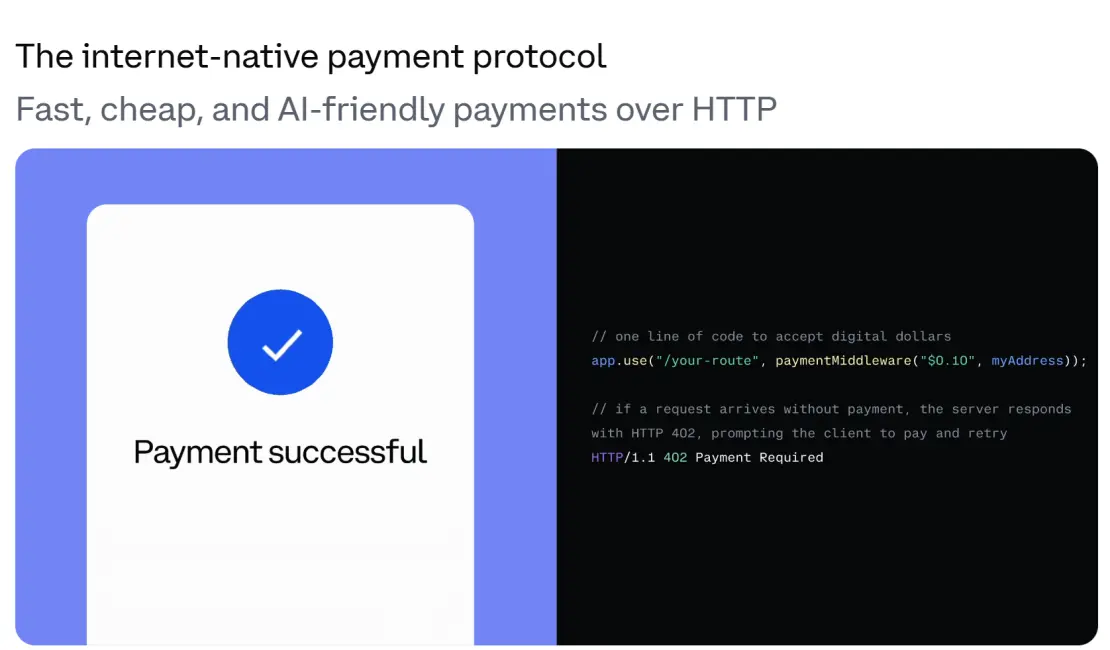
In the AI sector, 2025 is the acceleration year for AI development, and further AI advancement will inevitably generate demand for machine-to-machine transactions and micro-payments. Blockchain may become the ultimate infrastructure for AI and machine interactions. The emergence of the x402 protocol exemplifies the integration of AI and crypto, with backers including Coinbase, Google, Cloudflare, Circle, Visa, and AWS—each with large user bases and consumption scenarios. A new narrative around AI and payments is visibly heating up.
Outside the US, companies are also seizing stablecoin application scenarios. Ctrip’s overseas version, Trip.com, has launched stablecoin payment features for global users, currently supporting USDT and USDC. Major tech and payment companies like Ant Group, JD.com, and Grab have also entered the stablecoin space.
4. Wall Street’s On-Chain Finance
Stablecoins are the most critical underlying infrastructure for traditional finance’s integration into the blockchain, enabling programmable, decentralized money, and serving as the foundation for all on-chain financial asset circulation and settlement.
The key motivation for Wall Street to promote stablecoin development is to facilitate “everything on-chain” after building the infrastructure.
SEC Chair Paul Atkins once declared, “The next step will be digital assets, market digitization, and tokenization… All US markets will be on-chain within two years.” BlackRock CEO Larry Fink stated, “Tokenization of all financial assets is the future trend, and we have already entered this stage… ETFs are the first step in the technological revolution of financial markets. The second step will be the tokenization of all financial assets.”
BlackRock has launched and operates the BUIDL fund, tokenizing US Treasuries on the blockchain to achieve 24/7 instant settlement and institutional-level liquidity; JPMorgan uses the Kinexys platform for on-chain trading and settlement, handling over $1.5 trillion in transactions; Goldman Sachs operates a digital asset platform issuing and trading tokenized bonds; Depository Trust & Clearing Corp. (DTCC) received SEC approval to provide tokenization services, handling on-chain versions of securities transactions exceeding $3.5 trillion. These activities leverage blockchain technology to realize asset tokenization, on-chain trading, and settlement, representing the trend of traditional finance transforming onto the blockchain. Based on institutional pilots and production deployments, they aim to enhance liquidity, efficiency, and global access.
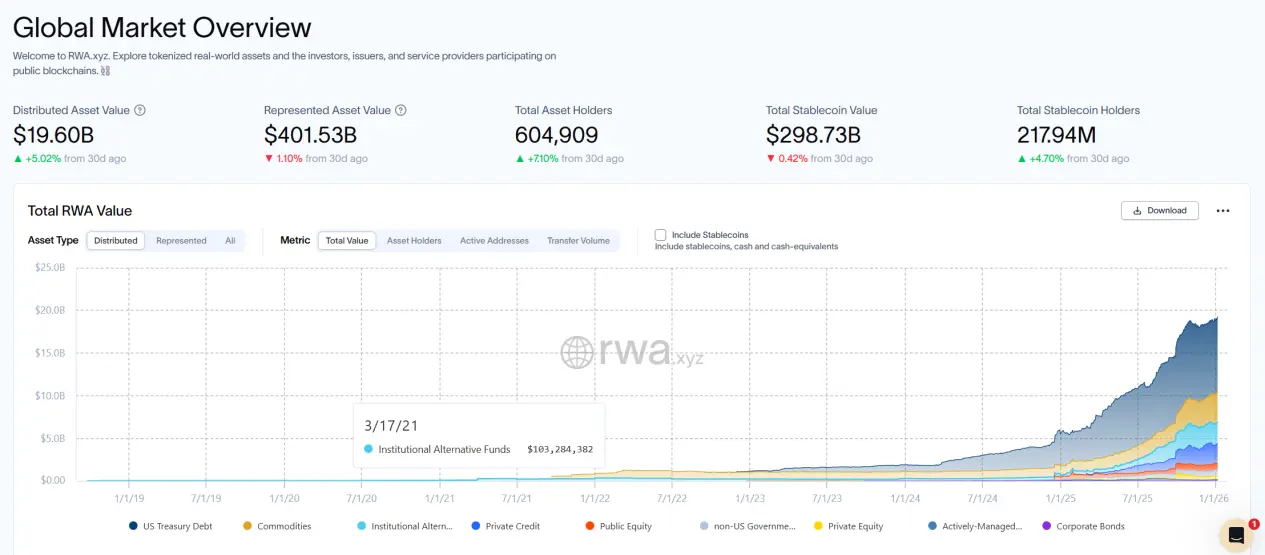
Currently, the total market cap of traditional finance exceeds $400 trillion, the crypto market cap is $3.3 trillion, stablecoins total $0.3 trillion, and RWA (Real-World Assets) total $0.02 trillion. Industry forecasts from Standard Chartered, Redstone, RWA.xyz, and others suggest that by 2030–2034, 10%-30% of global assets—equivalent to $40–$120 trillion—may be tokenized, with RWA’s total market cap potentially expanding to 1,000 times its current size.
2. WLFI Opens a New Era of Panoramic Finance
In the future, every company worldwide must have a blockchain and AI strategy, or they will be unable to compete efficiently with new technologies and achieve scalable growth.
Stablecoins will become the intersection point of finance, internet, AI companies, cross-border trade, and local payments. Under the premise of a stablecoin explosion, Trend Research believes WLFI and USD1 will be the most benefited crypto companies in this wave, surpassing past paradigms and becoming the fastest-growing blockchain projects.

1. USD1 Will Become the Fastest-Growing Stablecoin
After WLFI’s TGE, USD1 experienced a new wave of rapid growth, increasing from $2.462 billion in three months to $3.438 billion, a 40% increase, making it the fastest-growing mainstream stablecoin in recent three months. Its market rank is seventh among stablecoins, soon to surpass PYUSD (PayPal USD)), with an average daily trading volume of about $1–3 billion, mainly distributed on BNB Chain (55.61%) and Ethereum (37.38%).
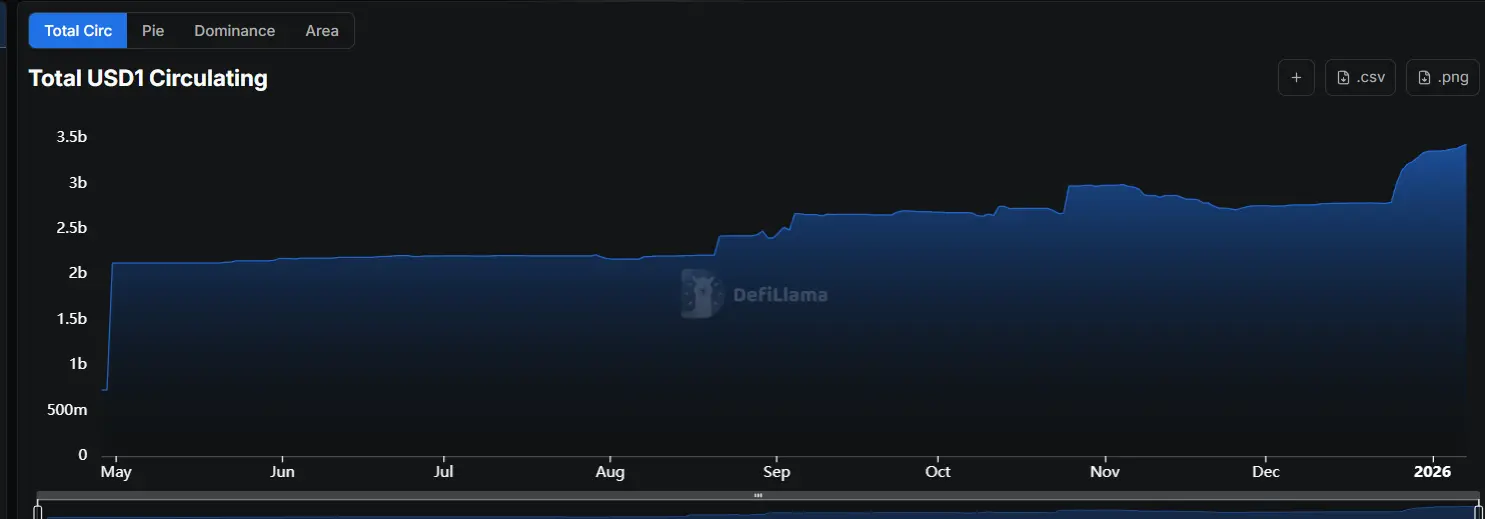
Trend Research forecasts that USD1 will rapidly surpass $10 billion in 2026, becoming the fastest-growing stablecoin, and will long-term reach a trillion-dollar scale.
2. USD1 Will Become the Most Orthodox Stablecoin
USD1 complies with the requirements of the Genius Act, with reserves and collateral assets fully supported by real dollar-equivalent assets, including US dollar cash or deposits, short-term US Treasuries, and other cash equivalents (such as money market funds), ensuring each USD1 has an equivalent dollar asset backing, theoretically enabling 1:1 redemption and settlement.
Regarding reserve proof and auditing mechanisms, the USD1 team publishes regular reserve reports and verifications, transparently disclosing reserve quantities and asset distribution to the public. US dollar reserves are periodically audited by independent third-party firms.
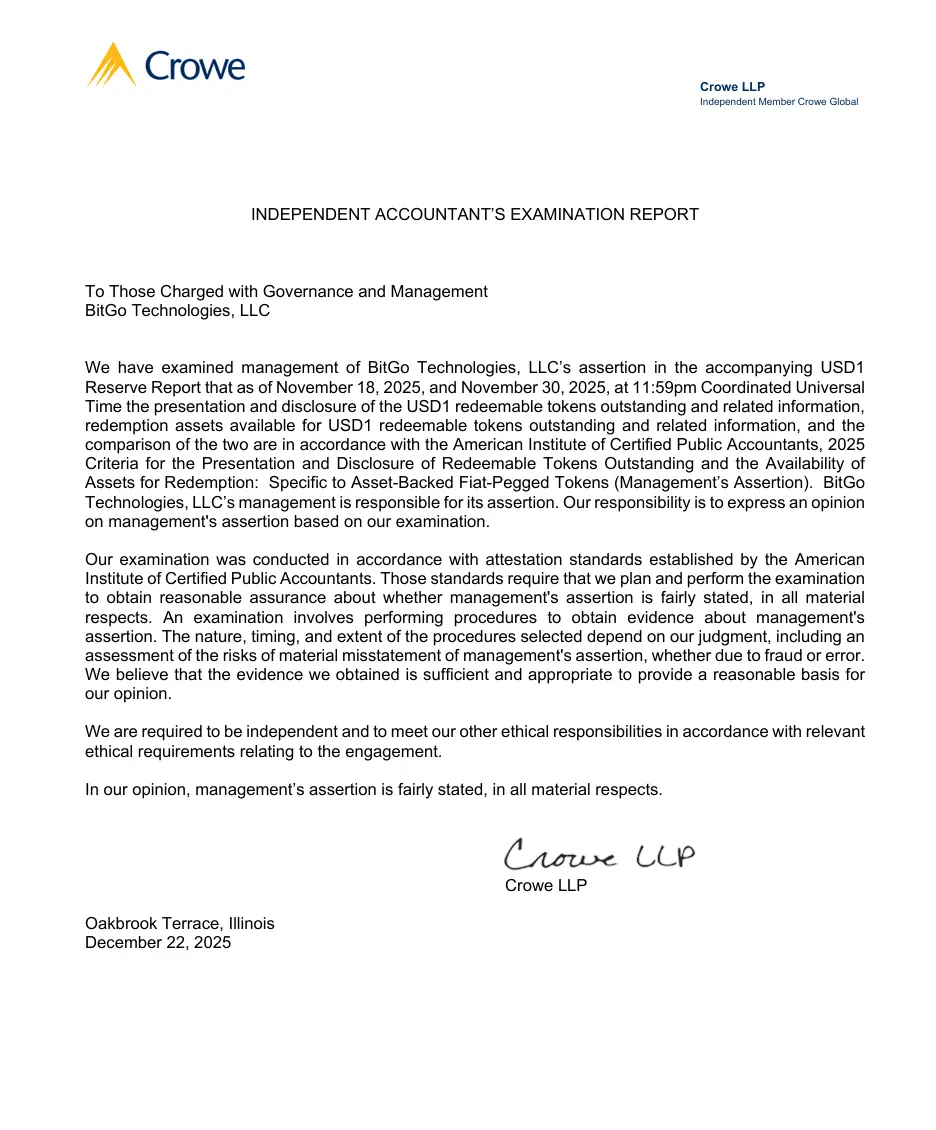
In custody, USD1’s reserve custodian is BitGo Trust, managing over $100 billion in reserves, handling transactions exceeding $3 trillion, and serving over 1,500 institutional clients across more than 50 countries, including processing 20% of on-chain Bitcoin transactions. Clients of BitGo Trust include Circle, Paxos, WBTC, Bitstamp, Fidelity Digital Assets, Vanguard, and others.
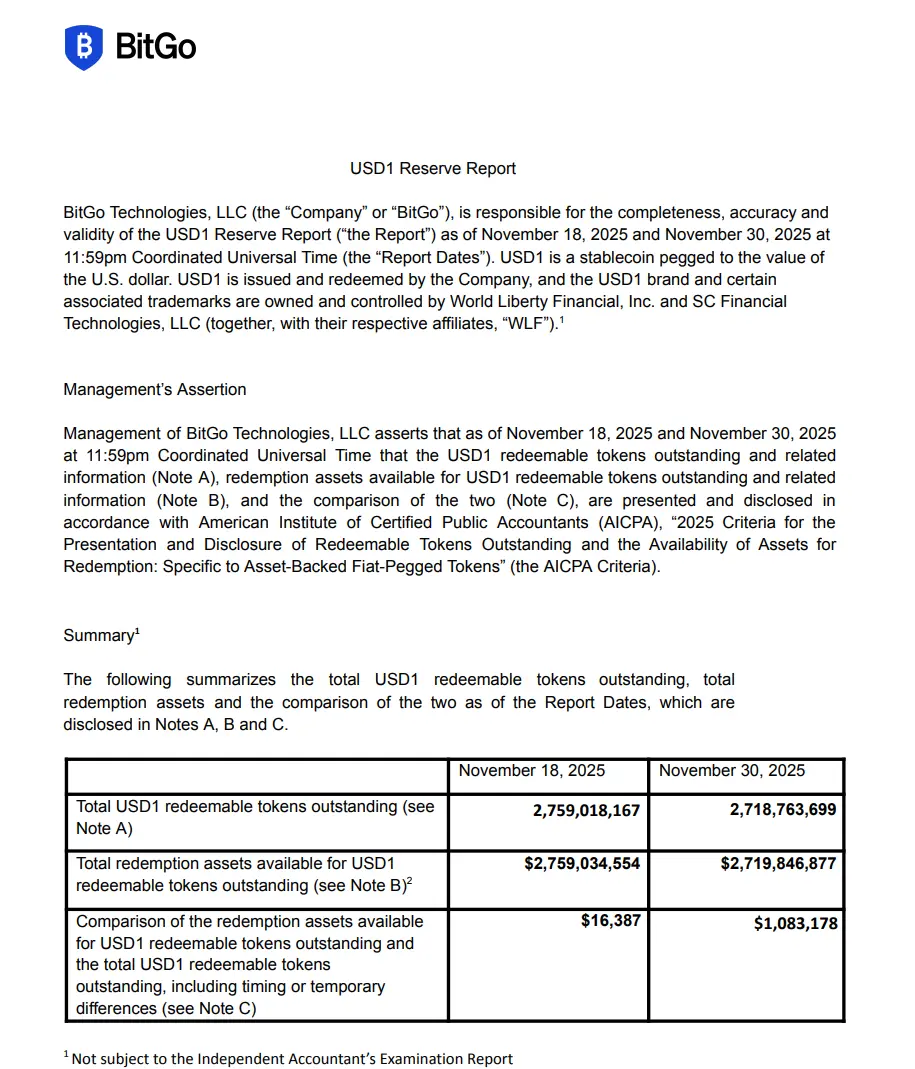
Compared to other projects, WLFI and USD1 are endorsed by the most powerful presidential family. Trend Research believes USD1 will further advance compliance and become one of the most orthodox stablecoins.
3. The Adoption Wave of USD1 Is Opening
Since WLFI’s TGE, the adoption wave of USD1 has gradually begun. Currently, Binance has listed nearly 20 USD1 trading pairs. Trading platforms like StableStock are expanding USD1 trading to include US stocks. As USD1’s scale and compliance further strengthen, it is foreseeable that in 2026, USD1 will expand from crypto to traditional finance, internet trading, offline payments, and other scenarios.


