The global market has rebounded strongly after the previous deep sell-off, pushing stocks, cryptocurrencies, and commodities into severely oversold territory. Bitcoin has recovered to around $71,000, while the US stock market, gold, and silver also saw significant gains, thanks to technical buying and easing concerns over short-term macroeconomic factors.
Notably, this recovery was not driven by changes in fundamental factors but mainly resulted from a period of strong deleveraging.
Technical Milestones Triggering the Recovery Momentum
The broad-based rebound began when key technical levels held across multiple asset classes. The S&P 500 index reached the 100-day moving average — an important support level closely monitored by systematic traders and investors.
This triggered mechanical buying from investment funds aiming to rebalance risk portfolios after several consecutive sell-off sessions.
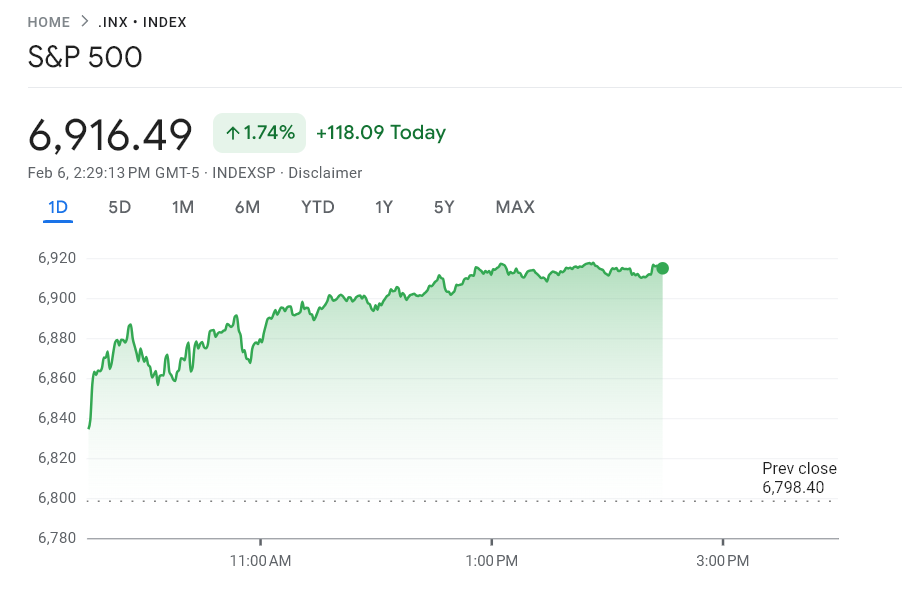 S&P 500 Chart | Source: Google FinanceBitcoin also followed a similar trend. After briefly dropping to $60,000, this digital currency rebounded strongly as forced liquidations gradually decreased and funding rates stabilized.
The lack of new liquidation pressure created an environment for spot traders to participate, supporting the short-term recovery.
Re-establishing Positions to Reduce Selling Pressure
The previous sell-off wiped out most leverage in the financial markets.
Especially in the cryptocurrency sector, derivatives positions had become heavily skewed toward longs, causing prices to fall further when support levels were broken. However, by February 6, most of this excess leverage had been eliminated.
As a result, marginal selling pressure decreased significantly. With fewer margin calls and forced liquidations, prices were able to recover without any new bullish catalysts.
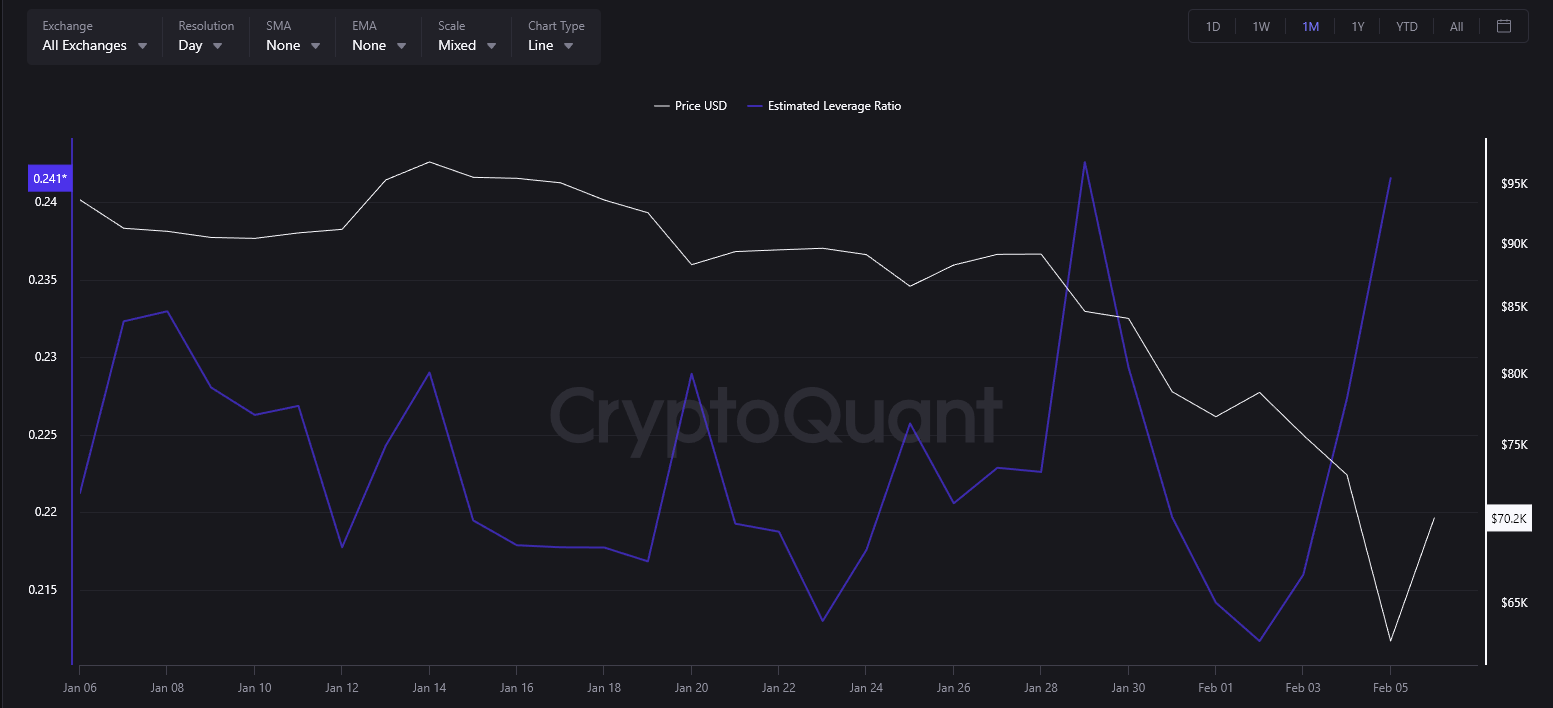 Estimated Bitcoin leverage across all exchanges | Source: CryptoQuantMarket charts show leverage steadily increasing throughout January before sharply declining when prices broke support levels in early February. After this correction phase, forced selling pressure eased, allowing prices to rebound even without clear growth drivers.
Macro Signals Easing Short-Term Tensions
Signals from the US macroeconomy also contributed to market stability. The consumer confidence report released on February 6 exceeded expectations, reaching the highest level in six months.
While not indicating strong growth, this data helped alleviate immediate concerns about a sudden recession risk.
The bond market responded positively, pricing in a higher likelihood that the Federal Reserve may cut interest rates in the near term. This caused short-term bond yields to decline before stabilizing, easing financial conditions and supporting risk assets.
Gold and silver also rebounded strongly, confirming that the previous session’s decline was mainly due to liquidity pressures rather than a rejection of their safe-haven roles. The weakening US dollar and the activity of buying cheap assets also contributed to the rally of precious metals.
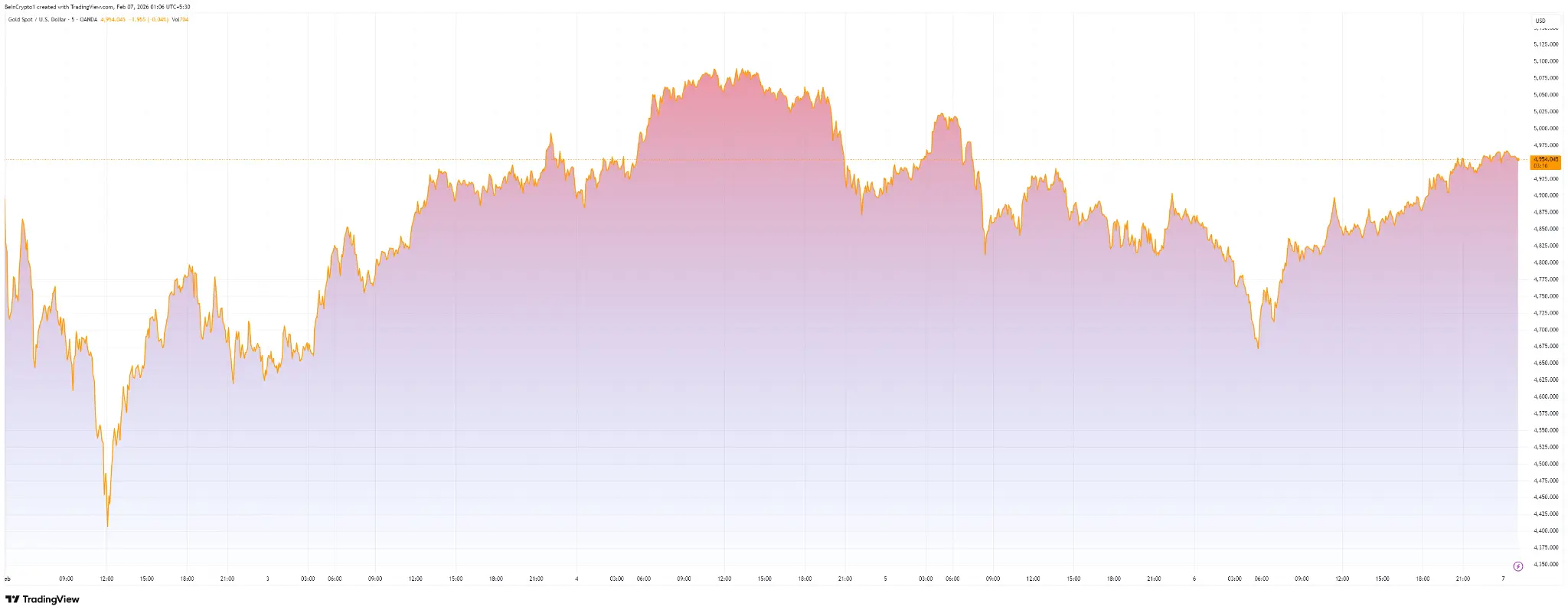 Gold price chart over the past week | Source: TradingView## Technical rebound, not a trend reversal
The rebound on February 6 reflected a technical rally driven by oversold conditions, position rebalancing, and short-term macroeconomic easing. However, there is not enough evidence to confirm this as a sustainable trend reversal.
The financial markets remain heavily influenced by liquidity conditions, interest rate expectations, and global capital flows. Volatility is likely to continue as investors reassess risks amid an increasingly tightening financial environment.
Mr. Teacher
Disclaimer: The information on this page may come from third parties and does not represent the views or opinions of Gate. The content displayed on this page is for reference only and does not constitute any financial, investment, or legal advice. Gate does not guarantee the accuracy or completeness of the information and shall not be liable for any losses arising from the use of this information. Virtual asset investments carry high risks and are subject to significant price volatility. You may lose all of your invested principal. Please fully understand the relevant risks and make prudent decisions based on your own financial situation and risk tolerance. For details, please refer to
Disclaimer.
Related Articles
Bitcoin Faces Obstacle at $75,000: Federal Reserve Meeting and Middle East Situation May Become Key Turning Points
Bitcoin's upward momentum weakened after touching $75,000, with market concerns about a near-term peak. Despite continued institutional accumulation pushing total open interest to $58 billion, prices face pressure from macro uncertainty. Bitcoin ETF inflows exceeding $1.5 billion support the price. Market focus remains on the Federal Reserve meeting and geopolitical situation, which may impact near-term trends.
GateNews7m ago
Why Does Ethereum Price "Rise with Bitcoin but Ignore Fundamentals"? Bitwise Reveals: 65% of Price Movement Determined by Bitcoin
Bitwise's research indicates that Ethereum's price movements are primarily driven by Bitcoin and macroeconomic liquidity, with relatively weak influence from on-chain fundamentals. The model shows that Bitcoin volatility can explain 65% of Ethereum's volatility, while accommodative monetary conditions and ETF fund flows also contribute to Ethereum's price. The current market views Ethereum as a "network commodity," and its price movements in the short term may still be dominated by Bitcoin and the liquidity environment.
GateNews11m ago
Citi significantly lowers Bitcoin and Ethereum target prices, with policy delays constraining upside potential
Citigroup has lowered its 12-month target prices for Bitcoin and Ethereum to $112,000 and $3,175 respectively, mainly due to the slower-than-expected progress of U.S. policy initiatives. Although the target prices have been reduced, both assets still have room for upward movement. The market's diminished expectations for demand growth make the sustainability of capital inflows a critical factor. If regulatory conditions improve, the target prices may be raised; otherwise, the downward adjustment will be justified.
GateNews26m ago
Mainstream CEX and DEX funding rates show the market remains bearish
On March 18, Gate News reported that as Bitcoin dipped slightly, the funding rates across major CEX and DEX platforms show the market is broadly bearish, indicating that market sentiment remains skewed to the downside.
GateNews26m ago
U.S. stocks strengthen but crypto concept stocks diverge, with Bitcoin's high-level fluctuations suppressing the performance of COIN and MSTR
The US stock market rose slightly driven by macroeconomic data and corporate earnings, with investors showing increased risk appetite for equities. Cryptocurrency-related stocks showed mixed performance, with COIN and MSTR trading characteristics closely tied to Bitcoin price fluctuations. Despite overall strength in US equities and rapid capital inflows, crypto stocks will continue to exhibit high volatility if Bitcoin fails to establish a trending rally.
GateNews30m ago


