The world’s largest corporate Bitcoin holder, MicroStrategy (Strategy), CEO announced plans to issue more perpetual preferred shares to provide investors with a tool that offers “existing digital capital positions while avoiding volatility.” But how long can this financial magic last?
(Background recap: Bitcoin rebounds to $65,000, sleeping whales buy the dip, Japan’s MicroStrategy Metaplanet: embracing BTC with unchanged goals)
(Additional context: MicroStrategy’s BTC floating unrealized losses surpass $10 billion! The worst financial report in Strategy’s history with stock plunging 17% overnight)
Table of Contents
- The bet of 714,644 Bitcoins
- The limits of financial engineering
- Innovation or risk shifting?
MicroStrategy CEO Phong Le recently told Bloomberg that the company will issue more perpetual preferred shares to ease investor concerns over sharp stock price fluctuations.
We know Strategy is the publicly traded company holding the most Bitcoin globally, with its stock price highly correlated to Bitcoin. Its issued perpetual preferred share product is called “Stretch” (ticker STRC). Its mechanism: the dividend rate resets monthly, currently at 11.25%, designed to keep the stock price stable near a face value of $100.
This is a hybrid security: it has stock-like features (perpetual, no maturity date) and bond-like features (fixed dividends, price anchoring). For investors wanting Bitcoin exposure but unable to tolerate MSTR’s stock dropping from $200 to $100, STRC offers a “buffer zone.”
Data shows that since its launch last July, STRC has contributed over 27,000 BTC worth of funding to Strategy’s Bitcoin purchases. This makes it Michael Saylor’s primary fundraising tool.
The bet of 714,644 Bitcoins
According to the latest data, Strategy holds 714,644 Bitcoins, valued at approximately $48.4 billion, with an average cost basis of about $76,506 per BTC. Amid a significant Bitcoin correction, the current unrealized loss is nearly $6.2 billion.
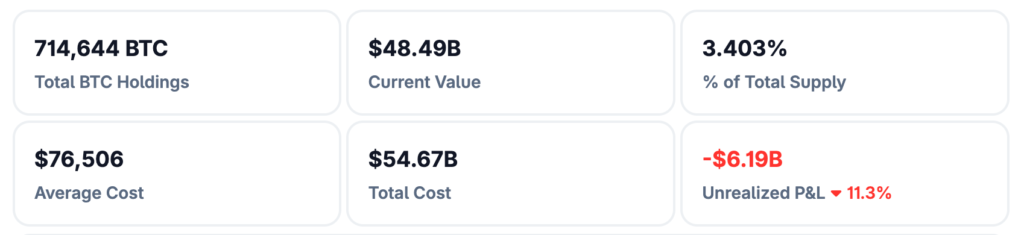
To reassure the market, Executive Chairman Saylor repeatedly emphasized that concerns about “Bitcoin declines forcing the company to sell holdings” are “groundless.” He pointed out that the company’s debt is unsecured and long-term, with most obligations not due until 2027-2028, so there’s no risk of margin calls.
This logic is technically sound, but he did not delve into a potential issue: if Bitcoin remains below cost basis long-term, how will the company continue issuing new shares or preferred stock to buy more Bitcoin?
The limits of financial engineering
Strategy’s business model is essentially an arbitrage: using the valuation premium in the stock market to buy spot Bitcoin. As long as investors are willing to pay above net asset value for “Bitcoin positions,” this machine can keep running.
Perpetual preferred shares are a new component of this machine. They attract a different set of investors—those seeking fixed income rather than unlimited upside potential. This broadens Strategy’s funding sources and reduces dilution pressure on common shares.
But this model carries clear risks. When Bitcoin’s price drops sharply (for example, below $70,000 currently), STRC’s attractiveness depends on whether investors believe that an 11.25% dividend yield sufficiently compensates for the risk. If confidence wanes, Strategy loses an important fundraising channel.
Innovation or risk shifting?
From one perspective, Strategy is doing what traditional financial institutions have done for decades: creating products with different risk levels to meet diverse investor preferences. There’s nothing new there.
But from another angle, it’s using financial engineering to mask a fundamental issue: Bitcoin’s volatility doesn’t disappear just because you package it as preferred shares. The risk is merely shifted—from those who can tolerate volatility to those who think they’re buying a “stable” product.
Saylor’s vision is to make Strategy an “on-ramp” to Bitcoin, but in times of panic, everyone will want to exit simultaneously. MicroStrategy has already demonstrated the long-term gains of holding through the last cycle; with the current bear market’s end still unclear, investors need to exercise stricter risk controls.

Disclaimer: The information on this page may come from third parties and does not represent the views or opinions of Gate. The content displayed on this page is for reference only and does not constitute any financial, investment, or legal advice. Gate does not guarantee the accuracy or completeness of the information and shall not be liable for any losses arising from the use of this information. Virtual asset investments carry high risks and are subject to significant price volatility. You may lose all of your invested principal. Please fully understand the relevant risks and make prudent decisions based on your own financial situation and risk tolerance. For details, please refer to
Disclaimer.
Related Articles
'Black Swan' Author Nassim Taleb Believes Elon Musk's X Money is 'Much Smarter' Than Bitcoin - U.Today
Elon Musk's X Money will enter early access in April, with Nassim Taleb praising it as a superior alternative to Bitcoin. He argues it promotes competition in currency issuance, functional daily use, and is backed by a robust infrastructure, unlike volatile cryptocurrencies.
UToday15m ago
ETH 15-minute decline of 0.80%: On-chain large fund flows and DEX selling pressure resonate to trigger a downtrend
2026-03-11 15:00 to 2026-03-11 15:15 (UTC), ETH price briefly and rapidly declined within the range of 2042.35 to 2065.57 USDT, with a K-line return of -0.80% and an amplitude of 1.13%. Market volatility intensified during this period, with significantly increased attention, and short-term market pressure triggered market alertness.
The main driving force behind this anomaly is large-scale on-chain fund flows and sell pressure concentrated on decentralized exchanges (DEX). Monitoring data shows multiple large ETH transfers to trading platforms, suspected to involve institutions or whales.
GateNews35m ago
XRP Price Hints at Bullish Reversal as Negative Funding Rates Build Pressure on Short Sellers
XRP shows potential for a bullish reversal as market indicators align, with negative funding rates possibly triggering a short squeeze. Technical patterns and whale accumulation further support an upward move, indicating a significant price change may be imminent.
CryptometerIo1h ago
Shiba Inu (SHIB) regains momentum as buying pressure reaches the highest level of the month
The price of Shiba Inu (SHIB) is fluctuating around the 0.0000056 USD mark at the time of writing on Wednesday, after rising nearly 7% over the past two days. This recovery trend appears as on-chain indicators and derivatives market data begin to send positive signals. Trading volume is increasing.
TapChiBitcoin1h ago
Goldman Sachs: Hedge fund positioning may create conditions for a rebound in US stocks, with short positions rising to the highest since September 2022
Goldman Sachs report indicates that the structure of hedge fund positions in the US stock market is creating conditions for a market rebound. Speculators maintain long positions while shorting ETFs and futures. Short positions have reached their highest level since September 2022, reflecting market responses to uncertainty. If positive news emerges, it could trigger a rapid market rally.
GateNews1h ago
ETH 15-minute increase of 0.83%: Whales' capital inflow and DeFi lending demand resonate to drive the price
Between 13:30 and 13:45 (UTC) on March 11, 2026, ETH experienced a short-term fluctuation. The candlestick data shows a return of +0.83%, with a price range of 2046.07 to 2082.31 USDT, and an amplitude of 1.77%. Market activity increased during this period, with trading volume significantly higher than the previous cycle, and volatility exceeding the intraday average, attracting widespread market attention.
The main drivers of this fluctuation were the rapid inflow of large on-chain funds and active institutional accounts. Between 13:32 and 13:43,
GateNews2h ago


