The measure, described last week, would be submitted by Brazil’s Revenue Service for public consultation and would impose a 3.5% tax on both stablecoin purchases and remittances, treating them as foreign currency exchanges subject to the existing Tax on Financial Transactions (IOF).
Brazil Prepares For Issuing Decree Taxing Stablecoin Purchases and Remittances
The Brazilian crypto industry is on the verge of changing due to a new tax measure expected to be presented in the next few days.
According to Valor Econômico, the Brazilian government is preparing to close what many considered a gray area by classifying stablecoins as digital assets subject to taxation (IOF). The proposal will come from the Federal Revenue Service (Receita Federal), which will specify that both stablecoin purchases and remittances will be taxed with 3.5% on their operations.
Nonetheless, individuals will be exempt from paying this percentage if they don’t transact over 10,000 Brazilian reais (nearly $1,910) monthly. Companies leveraging stablecoins will not enjoy this benefit.
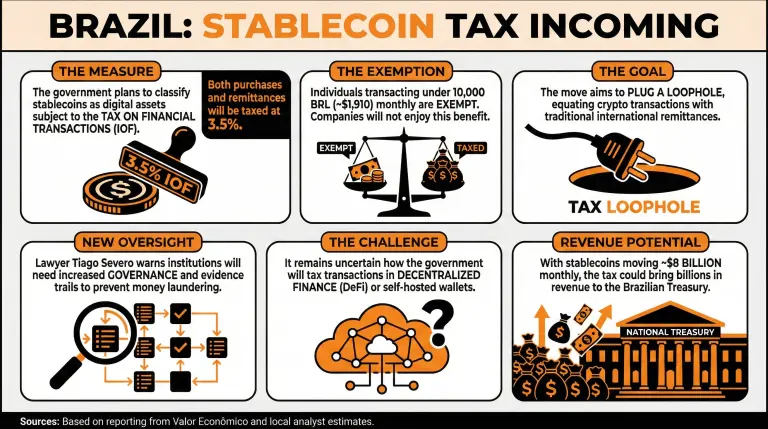
This move would equate cryptocurrency transactions and traditional remittances, plugging a loophole that allowed both individuals and companies to sidestep taxation in these operations.
Local analysts explain that the proposal will also include a new level of oversight on institutions handling stablecoins. Tiago Severo, a crypto-specialized lawyer, highlighted that anyone who operates crypto for payments or international remittances “will need to raise governance, evidence trails, and controls to prevent money laundering to a level closer to the regulated exchange rate.”
Nonetheless, the measure is expected to face significant opposition from the crypto industry, as it will surely affect their operations as customers abandon these local businesses for decentralized finance alternatives.
It is uncertain how or even if the government plans to apply this tax to transactions outside the centralized exchange sector, as Brazilians will also be able to manage stablecoins through decentralized finance options and move them using self-hosted wallets.
According to estimates, if applied, the tax would bring billions in revenue to the Brazilian Treasury, as stablecoins move up to $8 billion each month in the country.
FAQ
- What significant tax measure is Brazil expected to introduce for the crypto industry?
The Brazilian government plans to classify stablecoins as digital assets, subjecting them to a 3.5% Tax on Financial Transactions (IOF).
- How will this tax affect individual and corporate stablecoin transactions?
Individuals will be exempt from the tax if their transactions do not exceed 10,000 Brazilian reais monthly, while companies will not receive this exemption.
- What additional regulations are expected alongside this tax proposal?
The proposal will introduce increased oversight on institutions handling stablecoins, requiring enhanced governance and control measures to combat money laundering.
- What impact is this measure predicted to have on the Brazilian crypto industry?
Local analysts anticipate significant opposition from the crypto sector, as this tax may drive customers to decentralized finance alternatives and impact local business operations.
Disclaimer: The information on this page may come from third parties and does not represent the views or opinions of Gate. The content displayed on this page is for reference only and does not constitute any financial, investment, or legal advice. Gate does not guarantee the accuracy or completeness of the information and shall not be liable for any losses arising from the use of this information. Virtual asset investments carry high risks and are subject to significant price volatility. You may lose all of your invested principal. Please fully understand the relevant risks and make prudent decisions based on your own financial situation and risk tolerance. For details, please refer to
Disclaimer.
Related Articles
Vancouver's "Bitcoin City" plan faces setbacks: officials suggest abandoning municipal BTC holdings plan
Vancouver city government faces resistance to plans to incorporate Bitcoin into its financial system. An official report recommends that the city council abandon the proposal, mainly due to legal restrictions and financial risks. Although supporters believe Bitcoin has potential as a store of value, the city council has not yet decided whether to proceed with this plan.
GateNews13m ago
Ethereum approaches $2,500 resistance amid weakening derivatives data and declining DApp activity
Ethereum has recently shown weak rebounds, falling back 6% after touching $2200. Geopolitical tensions and weak stock markets have intensified market risk aversion, leading to insufficient bullish demand and a decline in on-chain activity. Despite the current challenges, Ethereum still holds an advantage in the blockchain space, with institutional funds favoring its ecosystem. If market sentiment recovers to $2400, it will be beneficial for a rebound in the future.
GateNews26m ago
XRP stabilizes at $1.40, oil prices retreat, and the CLARITY bill boosts the market
On Friday, XRP price remained stable at $1.40, driven by falling oil prices and Ripple CEO's support for the CLARITY Act. The decline in oil prices eases inflationary pressures and helps risk assets perform. The bill could boost exchange confidence, encourage institutional participation, and promote product development. XRP funding rates turned negative, indicating a concentration of short positions, and a comprehensive assessment is needed to determine the short-term trend.
MarketWhisper33m ago
Insider: The Trump administration is currently not considering involving the Treasury Department in oil futures trading.
BlockBeats News, March 6 — Sources familiar with the matter revealed that the Trump administration is currently not considering involving the Treasury Department in oil futures trading. Government officials had discussed involving the Treasury Department in energy futures buying and selling, but they believe the Treasury's ability to have a substantial impact on the market is limited. (Jin10)
GateNews37m ago
Iranian Revolutionary Guard monopolizes mining, airstrikes trigger a 700% surge in private coin withdrawals
Iran's Bitcoin mining activities are controlled by the Islamic Revolutionary Guard Corps, with most cheap electricity providers being affiliated with the government. In the context of low-cost mining, many Chinese miners have entered the market but face high risks, often ending in losses. After airstrikes, the Central Bank of Iran banned individual cryptocurrency transactions, but the public still relies on crypto assets due to the devaluation of the local currency, leading to a surge in withdrawal volumes that cannot be executed due to network outages.
MarketWhisper42m ago
Hyperliquid vs Polymarket, how do on-chain exchanges price crises?
Summary: The Middle East reignites in conflict, and traditional markets fall into a "pricing vacuum" due to weekend closures. Prediction markets and perpetual exchanges, at this moment, become the only continuously operating price systems worldwide.
Author: Changan I Biteye Content Team
Over the weekend, the US and Israel jointly conducted airstrikes on Iran, targeting the core areas of Tehran and missile facilities. This marks the most intense escalation in Middle East tensions in decades. Iran immediately issued a warning: if the conflict continues, the Strait of Hormuz will no longer be safe.
Everyone's first reaction is the same: open trading apps and try to do something, but not only are US stocks closed for the weekend, oil and gold futures are also shut all day on Saturday. Panic needs to be released, funds need a place to go, so everyone's attention turns to these two platforms: Polymarket and Hyperliquid.
Hyperliquid offers 24/7 commodity futures trading.
Biteye1h ago


