A recent report from Standard Chartered reveals that stablecoin issuers’ demand for U.S. short-term government bonds is accelerating rapidly. It is estimated that by the end of 2028, this new demand will reach $1 trillion. When including the Federal Reserve’s bond purchase programs, the total demand for short-term government bonds could exceed $2.2 trillion. This structural shift may compel the U.S. Treasury to reconfigure its debt portfolio or even suspend 30-year bond auctions for up to three years.
Stablecoins Are Becoming the Invisible Major Buyer of U.S. Treasury Bonds
(Source: Standard Chartered)
Standard Chartered analyst Jeff Kendrick notes in the report that stablecoin issuers typically need to hold large amounts of highly liquid, top-rated assets to maintain their peg stability, with U.S. Treasury bills (T-bills) being the preferred choice. These emerging buyers are quietly transforming the demand structure in the U.S. short-term debt market.
The bank’s forecast figures are striking. By the end of 2028, the additional demand for T-bills driven by stablecoins is expected to range between $800 billion and $1 trillion. When factoring in the Fed’s ongoing bond purchases and the refinancing of maturing mortgage-backed securities, the total demand in the short-term government bond market could reach $2.2 trillion, fundamentally reshaping U.S. debt financing strategies.
Who Is Driving This Demand?
Emerging Market Stablecoins: Expected to account for two-thirds of the total new demand, representing net new capital inflows globally rather than internal fund shifts.
Developed Market Stablecoins: Demand mainly comes from replacing existing holdings, contributing relatively little to market growth.
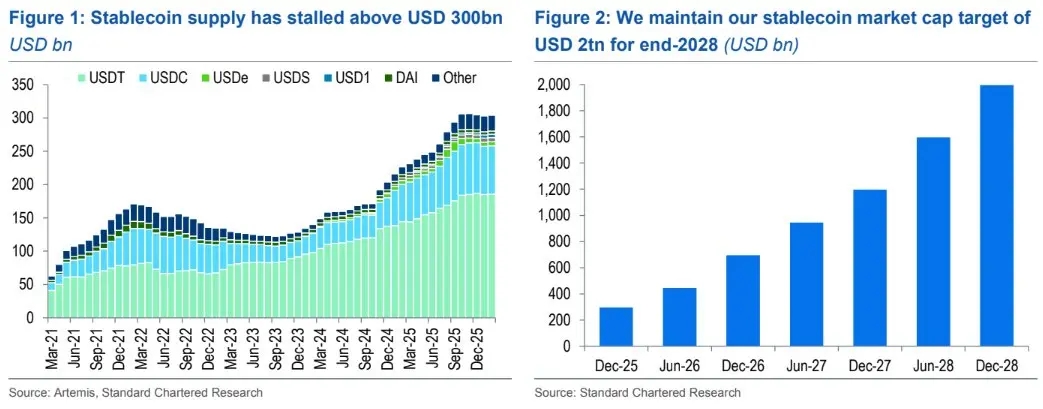
Total Stablecoin Market Cap: Currently around $304 billion, with Standard Chartered predicting it will surpass $2 trillion by 2028.
This structure highlights a key reality: the growth in stablecoin demand is not an internal cycle within the crypto market but is systematically channeling new capital from emerging markets worldwide into the U.S. short-term debt market.
U.S. Treasury Faces a Historic Dilemma: Shortening Debt Maturity
(Source: Standard Chartered)
This enormous demand for short-term securities presents the U.S. Treasury with an unprecedented policy opportunity, as well as a challenging structural choice.
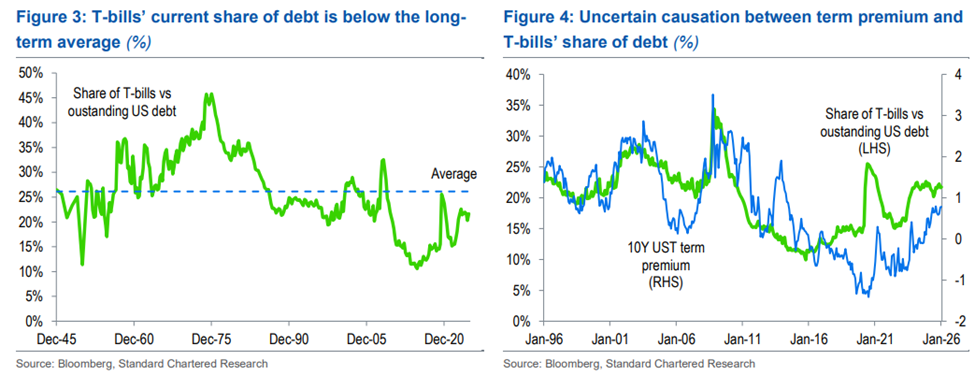
Standard Chartered warns that the Treasury might respond to the excess demand for stablecoins by significantly increasing the proportion of T-bills in its overall debt portfolio, while reducing the issuance of 30-year bonds or even suspending long-term auctions for up to three years. Historically, the Treasury suspended 30-year bond auctions from 2002 to 2006 — but the fiscal deficit environment then was far less severe than today, which is a critical difference highlighted by the bank.
If Treasury Secretary Yellen chooses to increase T-bills’ share by 2.5% over three years, roughly releasing an additional $900 billion in short-term supply, it could offset the excess demand from stablecoins and keep the 10-year Treasury yield within manageable levels.
However, Standard Chartered also cautions that this approach is not without costs. Rising term premiums, ongoing fiscal deficits, and rollover risks could produce more complex effects on the overall yield curve in the medium to long term. The short-term bull flattening effect does not equate to long-term rate stability.
Regulatory Lag Is the Biggest Uncertainty
Although Standard Chartered remains optimistic about the long-term demand for stablecoins, short-term growth has indeed stalled. Currently, the total stablecoin market cap is about $304 billion, still far from the $2 trillion target. The main reasons are recent weakness in the crypto market and the slower-than-expected implementation of regulatory frameworks following the passage of the U.S. “Genius Act.”
The bank characterizes these obstacles as cyclical rather than structural bottlenecks. As regulatory clarity gradually improves, institutional adoption of stablecoins will accelerate, and the profound impact on the U.S. short-term government bond market will follow.
Disclaimer: The information on this page may come from third parties and does not represent the views or opinions of Gate. The content displayed on this page is for reference only and does not constitute any financial, investment, or legal advice. Gate does not guarantee the accuracy or completeness of the information and shall not be liable for any losses arising from the use of this information. Virtual asset investments carry high risks and are subject to significant price volatility. You may lose all of your invested principal. Please fully understand the relevant risks and make prudent decisions based on your own financial situation and risk tolerance. For details, please refer to
Disclaimer.
Related Articles
ETH short-term decline of 1.12%: macro liquidity disturbances and whale position reduction resonance intensify volatility
On March 5, 2026, from 16:00 to 16:15 (UTC), the price of Ethereum (ETH) recorded a -1.12% return within 15 minutes, with a price range of 2056.69 to 2087.34 USDT, and an amplitude of 1.47%. Market attention during this period significantly increased, volatility intensified, mainstream coins experienced a synchronized pullback, and short-term traders engaged in frequent speculative battles.
The main driver of this fluctuation is macro-level liquidity disturbances. As the Federal Reserve's interest rate decision approaches and the U.S. non-farm payroll data is set to be released on March 6, the market shows divergence in the pace of rate cuts, prompting some short-term funds to choose
GateNews5h ago
70% of assets heavily invested in Bitcoin! Mexican billionaire urges "buy quickly during the dip," and the wealthy dad is also increasing his holdings
Mexican billionaire Ricardo Salinas Pliego is heavily investing in Bitcoin, believing it can hedge against inflation and symbolize personal freedom. Robert Kiyosaki warns that a stock market crash is imminent and continues to increase his holdings in Bitcoin and precious metals, remaining confident. They both believe that Bitcoin has long-term value potential, and the current price dip is a good buying opportunity.
区块客6h ago
U.S. Treasury yields rise across the board, with market expectations for fewer interest rate cuts
Influenced by Middle East conflicts and inflation concerns, U.S. Treasury yields continue to rise. Initial jobless claims remain at 213,000, and the January import price index growth was below expectations. The market expects non-farm employment to decline, while the futures market anticipates the Federal Reserve will cut interest rates only once by 2026. The 10-year U.S. Treasury yield rose to 4.134%.
GateNews7h ago
Institutions: Unless tomorrow's non-farm payrolls show significant weakness, the US dollar will remain strong.
A strategist at TD Securities stated that if the U.S. non-farm payroll report does not show significant weakness, it will not affect the dollar. They believe the market will focus on the Middle East conflict and its impact on the Federal Reserve's rate-cutting ability, rather than employment data. If oil prices remain high, the dollar should stay strong.
GateNews7h ago
Oil prices surge, interest rate cut expectations cool down! Circle benefits as the target price breaks $100
U.S. stablecoin giant Circle recently surged nearly 8% in stock price, hitting a four-month high, due to soaring oil prices and a cooling of interest rate cut expectations. Mizuho Securities raised its target price to $100, while maintaining a "Neutral" rating, but became more optimistic about profit prospects. Analysts believe that if the Federal Reserve continues to keep interest rates high, Circle's revenue will benefit accordingly, but market competition and regulatory pressures should still be watched carefully.
区块客12h ago
Trump pressures the Big Seven tech giants to sign "bear the cost of electricity price hikes"! AI data centers consume 12% of electricity in the U.S., and voter anger is fueling the push.
In his State of the Union address, Trump announced the "Rate Protection Commitment," requiring the seven major tech giants to bear the electricity costs of data centers themselves, aiming to alleviate voter dissatisfaction caused by rising electricity prices. However, the commitment lacks legal binding force, and its enforcement mechanism is unclear, raising questions about its effectiveness. The electricity demand from data centers could lead to a 12% increase in nationwide electricity consumption, becoming a political focal point.
動區BlockTempo17h ago


