Miner'sHelmetUnderTheMoonlight

vip
Age 0.1 Year
Peak Tier 0
Very interested in the history of PoW and mining costs, occasionally using the hashrate curve as a macro indicator. Speaks slowly, but doesn't engage in empty talk.
In the past two days, the group has been sharing screenshots about stablecoin regulation, reserve audits, and "de-pegging" concerns. Seeing these repeatedly has actually made me a bit numb... I usually don't follow the crowd emotionally; I have a habit: I first check the project's GitHub and the most recent audit report, even if just to get a general idea.
To put it simply, if a newcomer wants to judge "credibility," I think focusing on three things is enough: whether GitHub has long-term maintenance (not just a sudden flurry of commits), whether the audit report clearly states the scope and w
View Original
  • Reward
  • Comment
  • Repost
  • Share
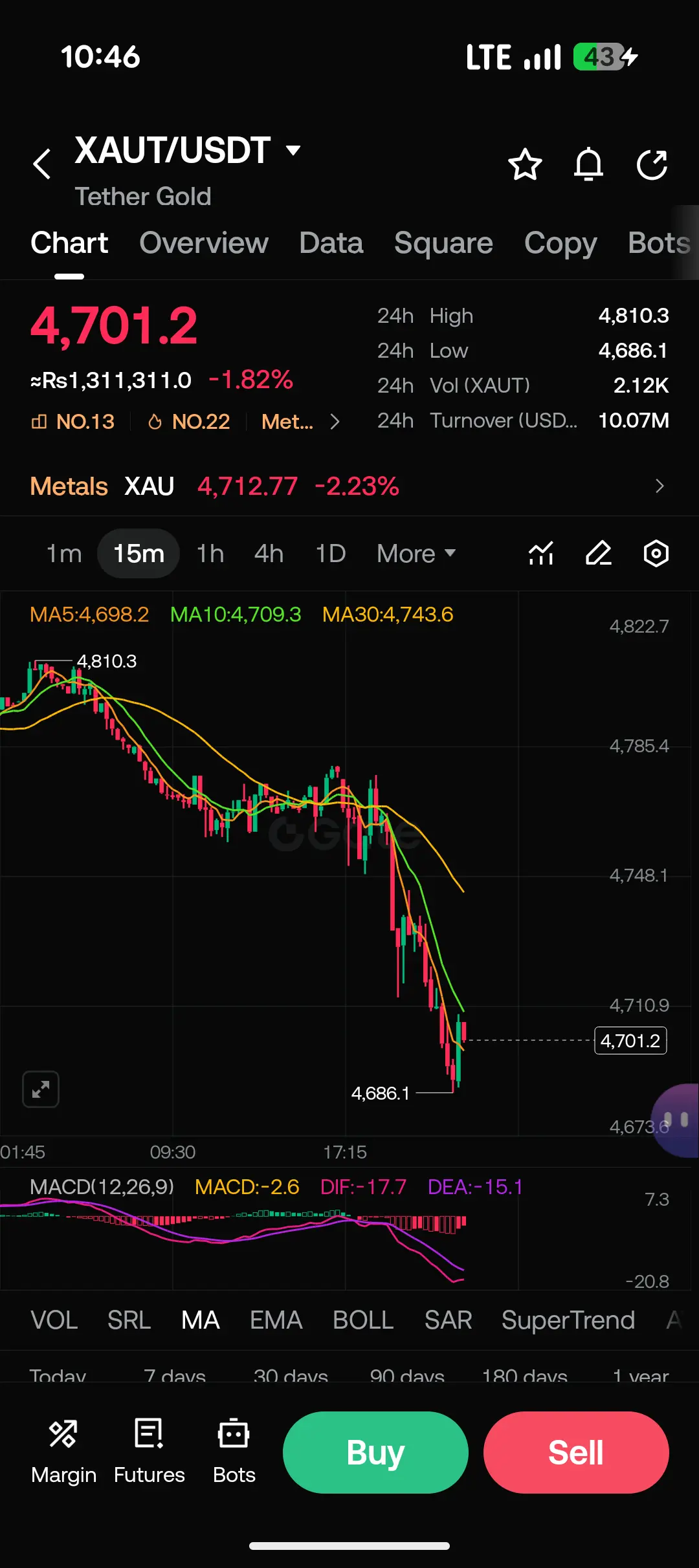
Weak rebound = the bears are still controlling the market, don't be fooled by the small bullish candlestick.
View Original
NexaCrypto
$XAUUSD (15m) – Quick Signal
Bias: Bearish (Sell)
Entry: 4700 – 4720 (pullback area)
Stop Loss: 4760
Take Profit: 4650 / 4600
Reason:
Clear downtrend (lower highs & lower lows)
Price below all MAs (MA5, MA10, MA30 = bearish alignment)
Weak bounce after dump → sellers still in control
MACD negative → momentum bearish
👉 Better to sell on pullback, not chase entry at bottom.
#GatePreIPOsLaunchesWithSpaceX #Gate13thAnniversaryLive #USIranTalksProgress
repost-content-media
  • Reward
  • Comment
  • Repost
  • Share
Recently, I've seen a bunch of screenshots of "tags + clustering + fund flows," claiming which addresses are institutions and which are smart money. Frankly, I only trust half of the address profiling: on-chain transfers can be seen, but people's motives are invisible; it's not surprising that the same entity splits into a hundred addresses; and exchanges, market makers, and custody wallets being mixed together is even more common.
Now I prefer to focus on a few key points: large UTXO/cold wallet inflows and outflows, concentrated transfers after mining pool settlements, and the rhythm of cr
View Original
  • Reward
  • Comment
  • Repost
  • Share
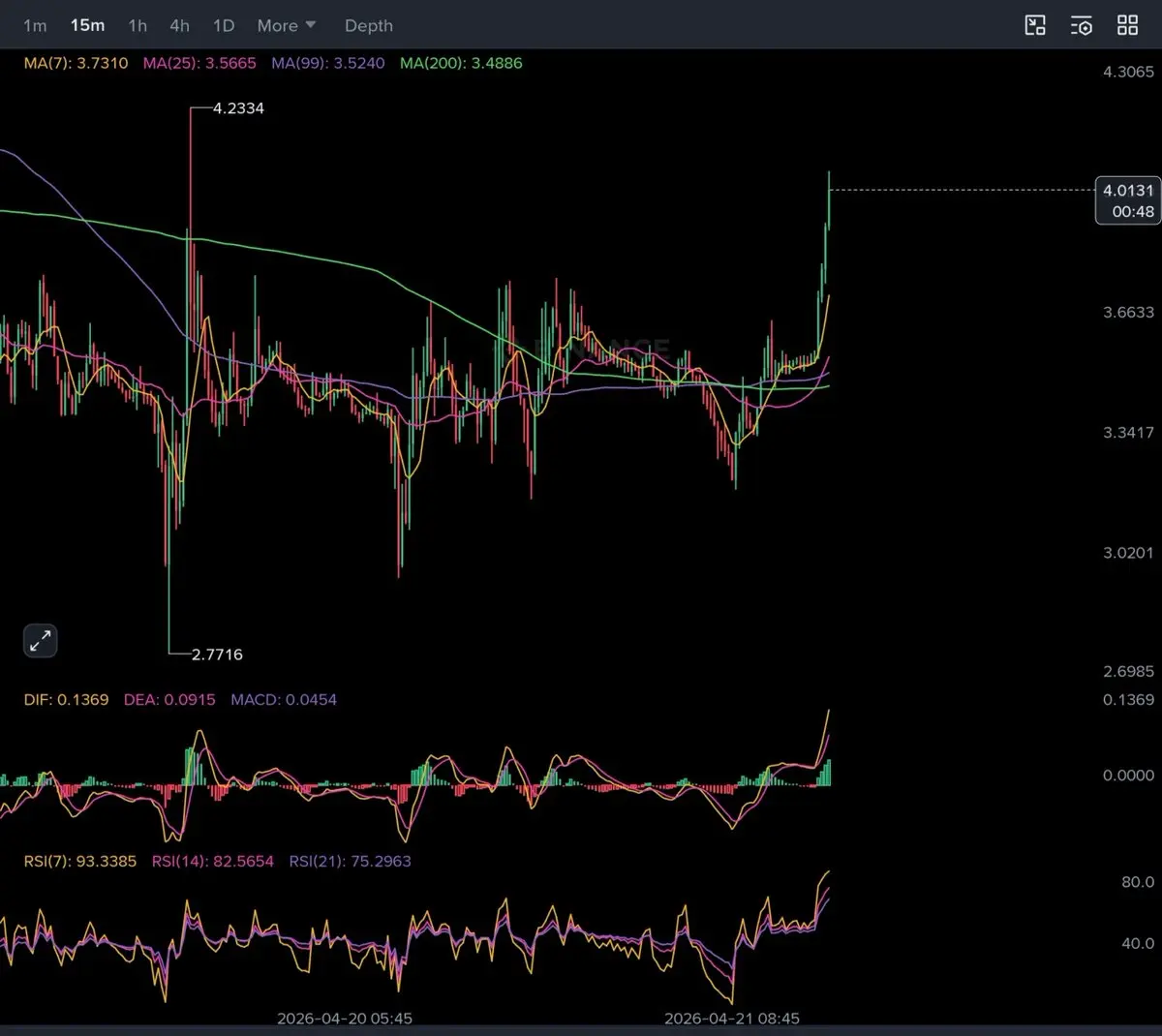
If it truly reverts to MA25/MA99, the 3.5-3.3 range could be reached very soon.
View Original
CryptoSat
💰 $M – Overextended Pump, Reversal Setup 📉
🔽 SHORT
✳️ ENTRY : 4.05 - 4.15 - 4.25
🎯 TARGETS: 3.97, 3.905, 3.380, 3.6600, 3.50 , 3.340 , 3
🀄️ LEVERAGE: 20x
🔴 STOPLOSS: 4.40
Explosive move with parabolic push + vertical candles → classic exhaustion signal
Price already stretched far above MA25 & MA99 → mean reversion likely
RSI overheated (above 90 zone) → strong indication of short-term top formation
MACD showing peak momentum, but histogram may start fading → momentum slowing
If price fails to sustain above 4.1, expect a sharp pullback toward 3.0–2.5 zone ⚡
repost-content-media
  • Reward
  • Comment
  • Repost
  • Share
From "Buying Coins" to "Treasury Strategy," the narrative is upgrading, and the institutionalization process is visibly progressing.
View Original
CryptoFrontier
Bitcoin Treasury Companies Head to Vegas After Surviving Drawdowns
Digital asset treasury (DAT) companies are emerging as the focal point at Bitcoin Conference 2026 in Las Vegas, according to BTC Inc. head of growth partnerships Sean Hagan. After months of market drawdowns, nearly all firms that loaded their balance sheets with Bitcoin remain operational and are
  • Reward
  • Comment
  • Repost
  • Share
These days I’ve seen a bunch of interpretations that link ETF capital flows and U.S. stock market risk appetite to the rise and fall of the crypto market, as if it’s all fate… I’d rather remind myself: many outcomes are just the result of probability stacking.
The curve of the AMM looks quite elegant, but market making is really not a get-rich-while-you-lie job. You put your coins in, and once the price drifts, your position is “automatically swapped,” earning less when prices go up and taking more on the weaker side when prices fall. Basically, impermanent loss is slowly eating away at you. C
View Original
  • Reward
  • Comment
  • Repost
  • Share
First, observe for a while, and wait until on-chain data and position distribution are available before deciding whether to follow the trade.
View Original
Original content no longer visible
  • Reward
  • Comment
  • Repost
  • Share
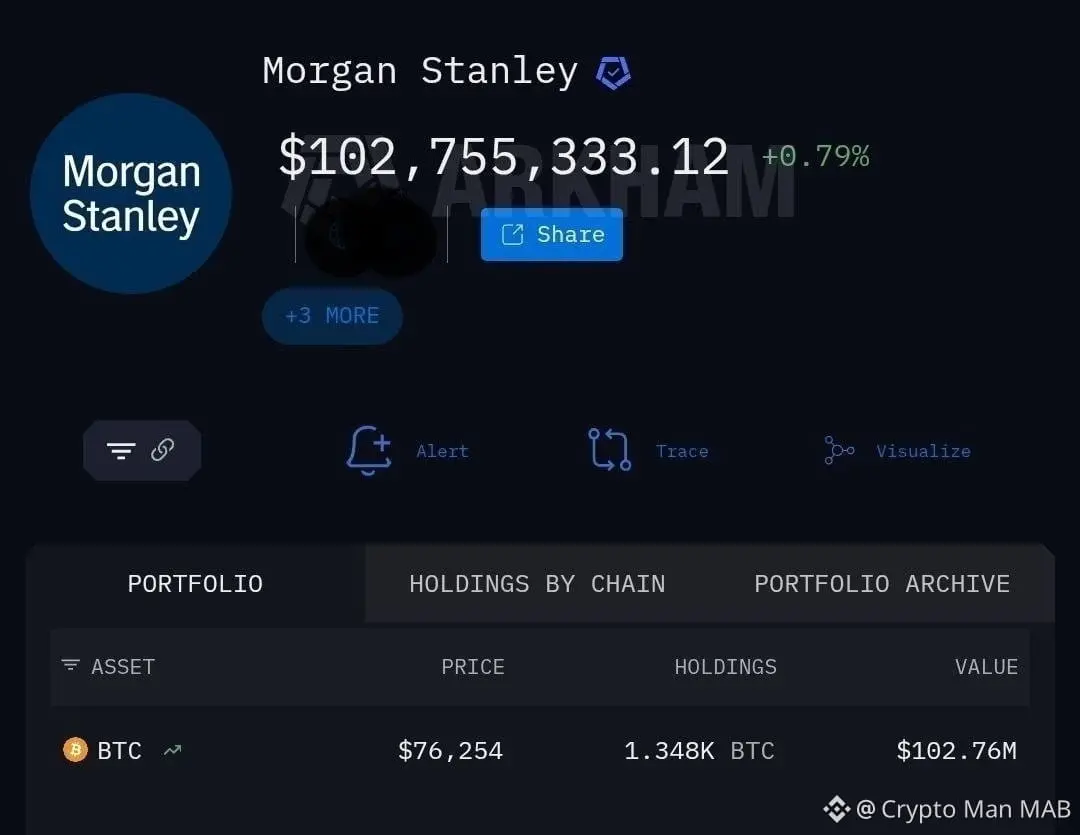
This is not retail investors playing; it's traditional finance adjusting allocations.
View Original
CryptoManMab
Morgan Stanley now holds 1,348 $BTC worth over $102M
repost-content-media
  • Reward
  • Comment
  • Repost
  • Share
The S&P 500 keeps reaching new highs, while value stocks are being suppressed; 2026 looks a lot like a "growth year."
View Original
CryptoFrontier
Berkshire Hathaway Trails S&P 500 as Greg Abel Takes Leadership
Berkshire Hathaway's stock has significantly underperformed the broader market in 2026, with both share classes posting month-to-date losses just under 1% while the S&P 500 closed above 7,100 for the first time, according to Cryptopolitan. The underperformance marks a sharp reversal from the
  • Reward
  • Comment
  • Repost
  • Share
Recently, I've seen people interpret large on-chain transfers and hot/cold wallet movements on exchanges as "smart money." My first reaction wasn't to follow suit but rather to feel a bit nervous: the more people watch the market, the more phishing sites love to jump in and ride the hype.
Later, I thought it was pretty funny—I'm someone who watches hash rate curves, yet I get my mindset more like a retail investor because of "wallet pop-ups."
Don't cross the red line of mnemonic phrases; if you really need to remember them, don't store them in cloud drives or chat logs.
Don't click on "f
View Original
  • Reward
  • Comment
  • Repost
  • Share
I also noticed that blur/bio starting to emerge, like the market is looking for new beta, which is quite interesting.
BLUR-15.51%
BIO3.67%
View Original
God-givenTeam
Is it just my illusion that it feels a bit like a knockoff season? Recently, a batch of counterfeit coins suddenly emerged, not the kind of trash coins you've never heard of, but former star projects like Ordi, Bio, Sats, Blur, and so on. You should know that even in a bear market, there are dead-cat bounce行情, and the so-called four-year cycle doesn't mean a continuous four-year decline. Usually, before a wave of行情, there's a wave of knockoff躁动. Large funds won't rush to heavily buy mainstream coins right away, but will test the waters on some projects with large elasticity and small market caps. Now, small-cap knockoffs are collectively emerging, trading volume suddenly increases, and at least the market sentiment has been ignited. It all seems very fitting now. I feel like April might have a chance.
As the old saying goes, don't short in April, don't go long in May. What does everyone think?
  • Reward
  • Comment
  • Repost
  • Share
These days, there's again debate over whether re-staking and shared security are "nested" or not. I think it's normal to argue about it. Seeing compounded returns looks very attractive, but people tend to subconsciously interpret "an extra layer of return" as "an extra layer of certainty," and the illusion just keeps stacking up. The mining setup at least has costs written into electricity bills—it's ugly but straightforward; re-staking here is more like credit and relevance layered together, and when things go wrong, it's often a chain reaction.
Recently, I treat it as a practice in trading p
View Original
  • Reward
  • Comment
  • Repost
  • Share
The phrase "Thunder is not harsh" is quite accurate; many coins are noisy, but those with real potential are actually quiet.
View Original
CarpenterLabs
Currently on BSC, it's not projects that are lacking, but "steadfastness."
After looking around, Thor's trajectory is quite interesting. With a market cap of 2 million, other projects might have already started shouting and writing small essays, but this community instead has a kind of inexplicable calmness.
Maybe those who truly want to "Make BSC Great Again" are not in a rush for a quick surge right now. Listen to this thunder, it's not harsh, and even feels a bit steady.
Thor has now set sail. If you're tired of the quick in-and-out gambling, perhaps you can listen to this thunder. ⛈
CA: 0x7488ae896e232de4f69da856ec8d7ec4aa8bffff
#DYOR
repost-content-media
  • Reward
  • Comment
  • Repost
  • Share
Japan is moving cryptocurrency regulation directly from "payment tools" to "securities-level" oversight. After addressing insider trading and information disclosure, it’s a positive for institutional entry, but compliance costs will also soar.
View Original
CryptoNewcomersAreHere22222
(FSA) Previously regulated cryptocurrencies under the "Funds Clearing Law," using payment methods as the basis for supervision. As the investment uses of cryptocurrencies continue to expand, the proportion of users holding assets for profit has significantly increased, and the current regulatory framework has become insufficient to effectively protect investors' rights. Based on this background, the Financial Services Agency has decided to transfer the regulatory framework to the "Financial Instruments and Exchange Act," placing cryptocurrencies alongside stocks, bonds, and other traditional financial products in legal classification, and related industry players will face compliance standards similar to those of traditional financial institutions. This transition also brings Japan's cryptocurrency regulatory structure closer to the mainstream financial regulations of major G7 economies. Core provisions of the amendment: strengthened obligations and upgraded penalties.
Main changes in the amendment:
Insider trading ban: Explicitly prohibits trading cryptocurrencies using material non-public information, filling gaps in current law.
Annual disclosure obligations: Cryptocurrency issuers must regularly disclose financial and business information to regulators and investors.
Change of operator name: Registered operators are officially renamed from "cryptocurrency exchange operators" to "cryptocurrency trading operators."
Increased criminal penalties: The maximum prison term for unlicensed operators is increased from 3 years to 10 years, and the fine cap is raised from 3 million yen to 10 million yen.
  • Reward
  • Comment
  • Repost
  • Share
  • Pin