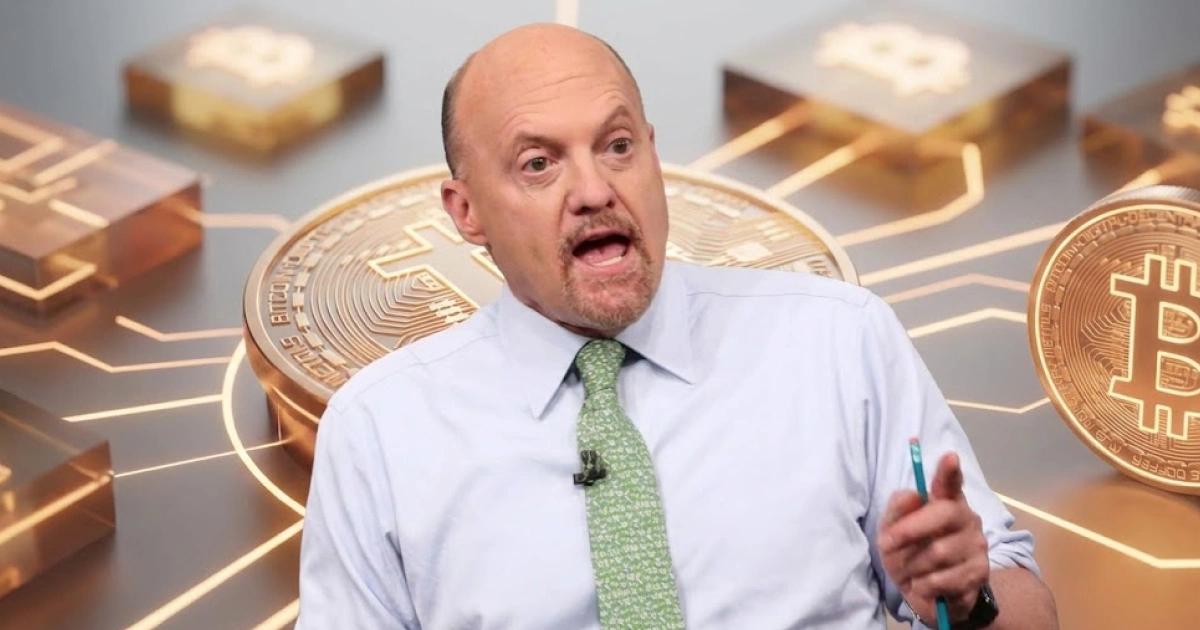
Celebrity commentator Jim Cramer claims the U.S. government will step in to support Bitcoin when it hits $60,000, but Treasury Secretary Bessent has clarified that the government has no authority to bail out the market and is currently limited to retaining law enforcement seized assets. Establishing an official reserve still requires legislation from Congress, and there is no active mechanism for buying coins at this time.
Counter-indicator: Cramer claims the U.S. will intervene when Bitcoin drops to $60,000
Recently, Bitcoin ($BTC) has been weak, and the market is full of uncertainty. The well-known financial commentator Jim Cramer, often called a “counter-indicator,” claimed that he heard that if Bitcoin falls to $60,000, President Trump will activate a “Bitcoin Reserve” plan to fill the inventory.
Although this statement is unverified and remains a market rumor, Cramer’s high profile among retail investors in the U.S. stock market, combined with Bitcoin’s recent trading range between $62,840 and $70,000, has sparked speculation. The market is eager to clarify whether the White House has set a target price and is ready to intervene at any moment.
U.S. Bitcoin Strategic Reserve: Only an Executive Order So Far
However, according to CoinDesk, President Trump previously signed an executive order requiring the creation of a Bitcoin strategic reserve, but the mechanism is still far from operational.
Although the U.S. Treasury and crypto advisory teams have spent months auditing government-held crypto assets, White House crypto advisor Patrick Witt told the media last week that specific figures are not yet public. This does not mean the government has the capacity for large-scale Bitcoin purchases.
The main obstacle to the U.S. actively buying Bitcoin lies in the legislative process. To formally establish a legal national reserve, relevant laws must be passed by Congress.
Currently, within the federal government system, there is no large-scale crypto procurement mechanism, nor is there a “buy button” as Cramer described that can be pressed at any time. Congress’s current legislative focus is on market regulation and tax rules for digital assets; establishing a reserve may not be a top priority.
U.S. Treasury Secretary Clarifies No Authority to Bail Out Market or Use Public Funds to Buy Coins
In fact, regarding whether the U.S. government will intervene to support the market, Treasury Secretary Scott Bessent clearly responded last week during a hearing that he, as Treasury Secretary, has no authority to do so, nor to order U.S. banks to purchase cryptocurrencies.
Bessent reiterated that the U.S. government’s reserve plan maintains a budget-neutral approach and will not use taxpayers’ money to buy cryptocurrencies.
According to Arkham data, the U.S. government currently holds Bitcoin worth about $23 billion, mainly from law enforcement seizures. The current policy focuses on stopping the sale of these seized assets to build reserves, which is fundamentally different from actively intervening in the open market or using public funds to purchase.
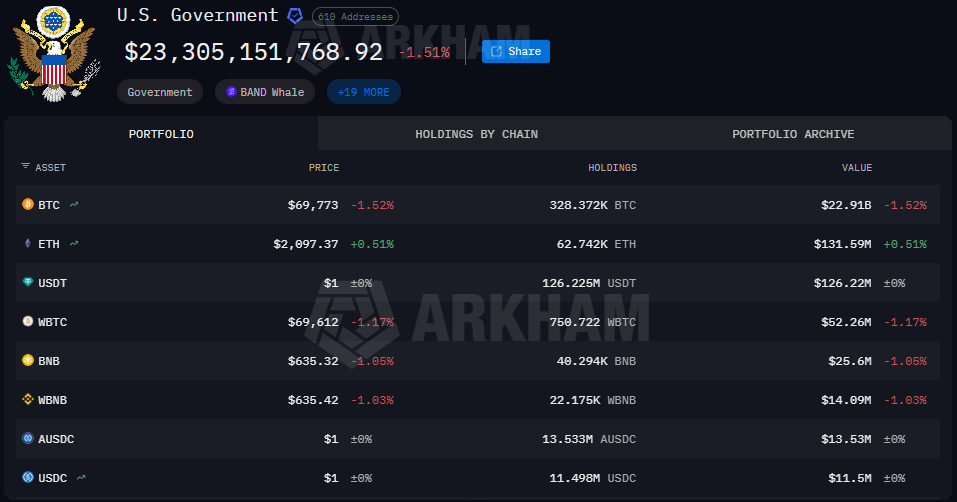
Image source: Arkham
Disclaimer: The information on this page may come from third parties and does not represent the views or opinions of Gate. The content displayed on this page is for reference only and does not constitute any financial, investment, or legal advice. Gate does not guarantee the accuracy or completeness of the information and shall not be liable for any losses arising from the use of this information. Virtual asset investments carry high risks and are subject to significant price volatility. You may lose all of your invested principal. Please fully understand the relevant risks and make prudent decisions based on your own financial situation and risk tolerance. For details, please refer to
Disclaimer.


