# TraditionalFinanceAcceleratesTokenization

15.24K
#PreciousMetalsAndOilPricesSurge
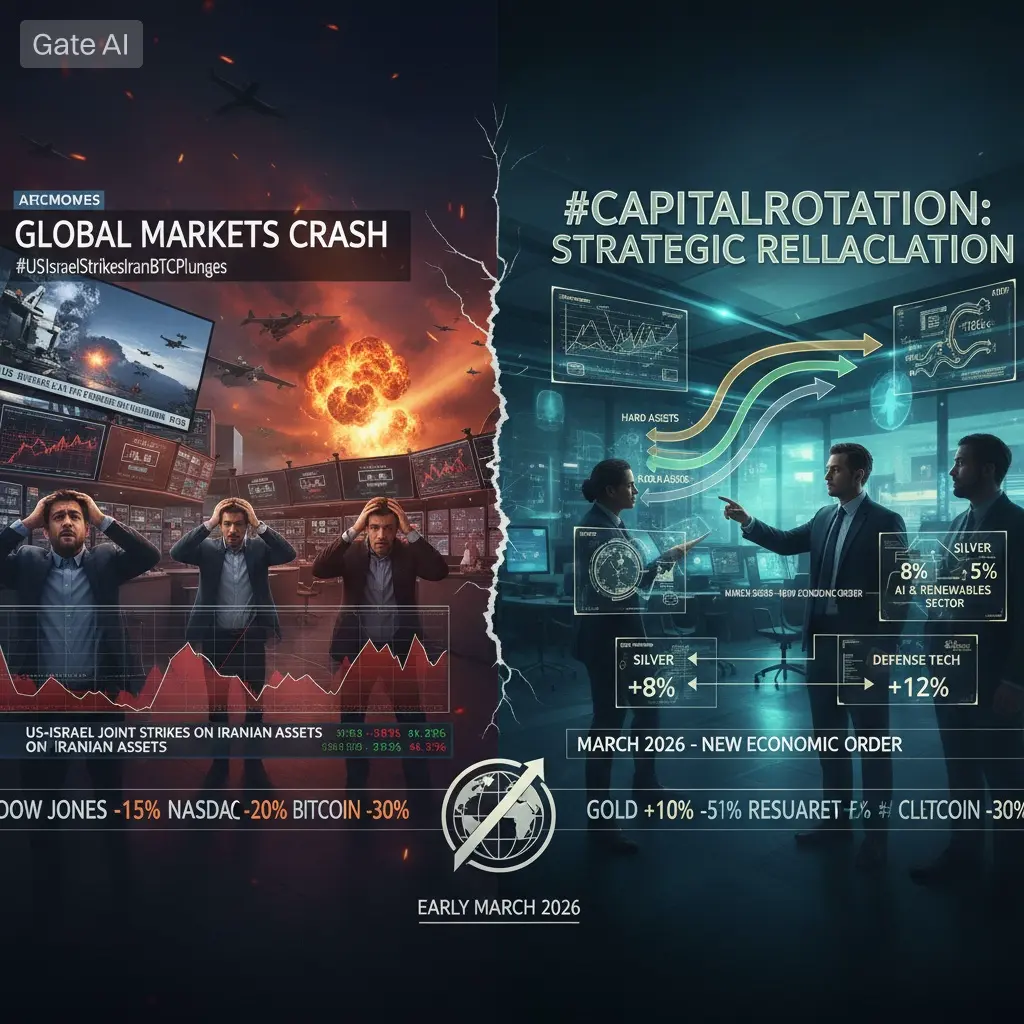
As of early March 2026, global markets are navigating one of the most volatile geopolitical shockwaves in recent years following coordinated U.S.–Israel military actions targeting Iranian assets. The immediate market response triggered sharp risk-off behavior across equities and crypto, driving the narrative of #USIsraelStrikesIranBTCPlunges. However, what we are witnessing now is not just panic — it is a structured and strategic #CapitalRotation across asset classes.
Below is a deeper breakdown of what is unfolding across crypto, commodities, macroeconomics,
BTC0,44%
ETH-0,38%
PAXG-0,29%
post-image
  • Reward
  • 13
  • Repost
  • Share
Yusfirahvip:
thanks for shairing the outstanding info with us
View More
#TraditionalFinanceAcceleratesTokenization
#TraditionalFinanceAcceleratesTokenization – February 26, 2026 Update 🚀
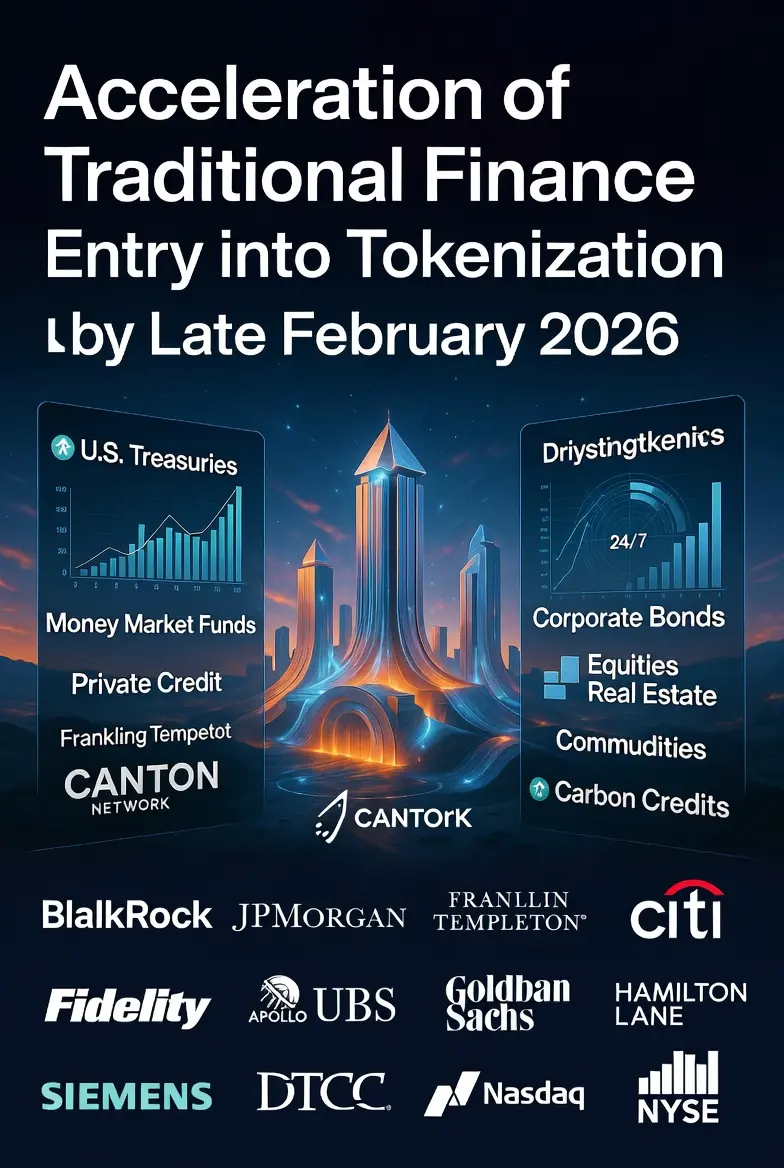
The tokenization wave in traditional finance (TradFi) is no longer a concept—it’s live, growing, and reshaping global markets. As of late February 2026, institutional adoption is accelerating at unprecedented speed. Major banks, asset managers, and exchanges are moving beyond pilot programs, launching real-world products, and scaling infrastructure to handle trillions in tokenized assets over the coming years.
What Tokenization Means Today
Tokenization converts ownership rights
ETH-0,38%
SOL1,22%
AVAX-0,08%
MNT0,08%
HighAmbitionvip
#TraditionalFinanceAcceleratesTokenization
#TraditionalFinanceAcceleratesTokenization – February 26, 2026 Update 🚀
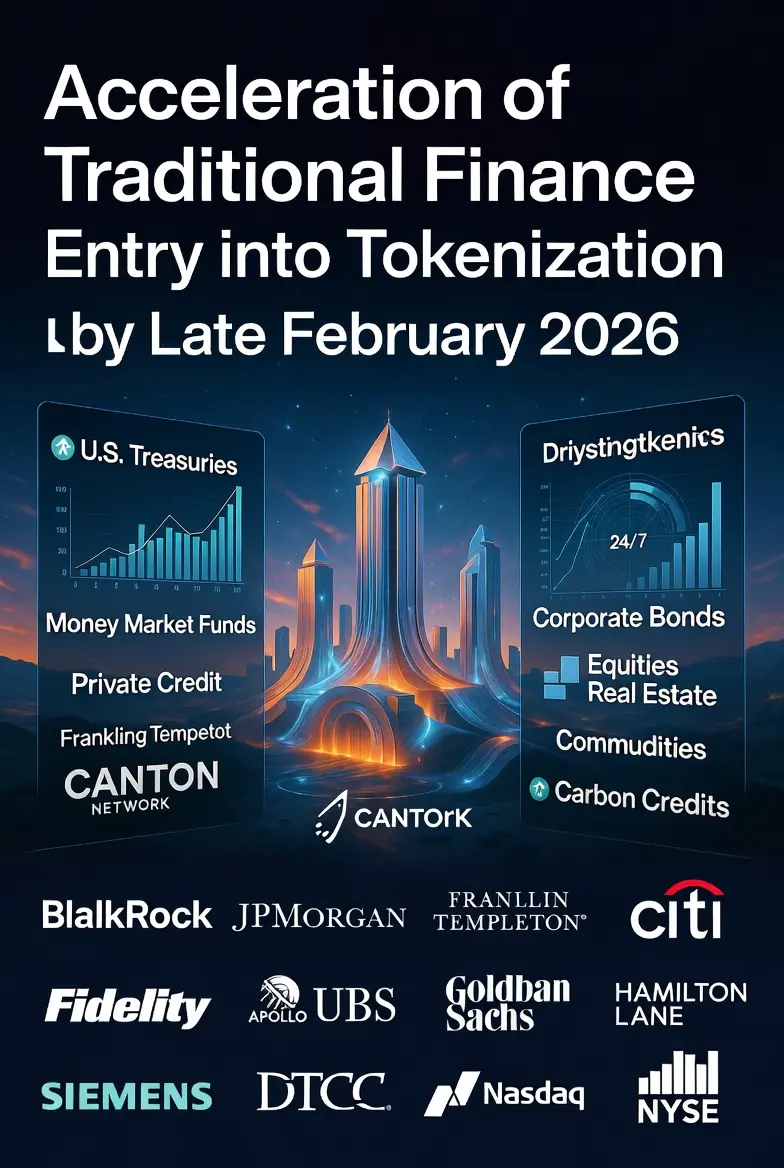
The tokenization wave in traditional finance (TradFi) is no longer a concept—it’s live, growing, and reshaping global markets. As of late February 2026, institutional adoption is accelerating at unprecedented speed. Major banks, asset managers, and exchanges are moving beyond pilot programs, launching real-world products, and scaling infrastructure to handle trillions in tokenized assets over the coming years.
What Tokenization Means Today
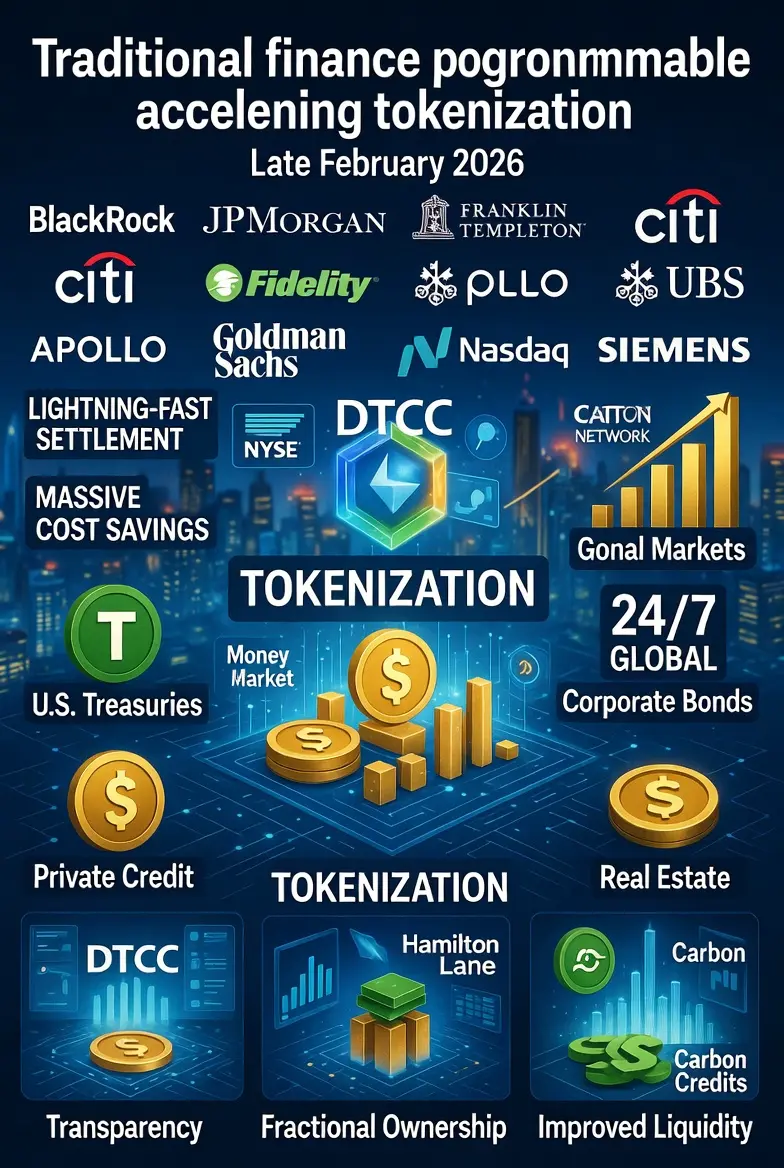
Tokenization converts ownership rights of physical and financial assets into secure, blockchain-based digital tokens. This covers bonds, equities, real estate, commodities, funds, private credit, and more, enabling 24/7 trading, instant settlement, fractional ownership, and full auditability. The distributed on-chain value of real-world assets (RWAs) now stands at $25.23B, with represented assets approaching $370B, reflecting institutional scale.
Why Acceleration Is Happening in 2026
Regulatory Clarity – U.S. frameworks like the GENIUS Act and Clarity Act are defining tokenized asset rules, reducing uncertainty and unlocking institutional flows.
Mature Tech & Infrastructure – Ethereum, Solana, Polygon, Avalanche, and Canton networks deliver high-speed, compliant, secure execution.
Institutional Demand for Efficiency – TradFi suffers from slow settlement (T+2), high intermediaries, and limited trading hours. Tokenization offers near-instant settlement, transparency, and improved yields.
Explosive Growth – After 266% growth in 2025, projections suggest $100B+ on-chain by end-2026 and long-term estimates reaching $2–30T+ by 2030–2034.
Leading TradFi Examples
BlackRock BUIDL – $2.2–$2.4B AUM, listed on public chains for DeFi liquidity; tokenized Treasuries category leader.
JPMorgan MONY – Public Ethereum launch of tokenized money market fund; JPM Coin expanding to private equity & collateral networks.
Franklin Templeton – Tokenized funds across 6+ blockchains; USD fund scaled to hundreds of millions.
Citi, Fidelity, Apollo, UBS, Goldman Sachs – Expanding tokenized product offerings in payments, lending, and securities.
Emerging DeFi Bridges – Mantle + Aave surpassing $575M institutional DeFi volume; Canton network enabling cross-border repos.
Core Benefits of Tokenization
Instant Settlement – Seconds/minutes vs. days.
Cost Efficiency – Removes intermediaries and paperwork.
24/7 Global Markets – Trade anytime, worldwide.
Transparency & Security – Immutable on-chain records.
Fractional Ownership – Democratizes access to high-value assets.
Improved Liquidity – Illiquid assets become tradable.
Programmable Features – Smart contracts enforce compliance, payments, and collateral automatically.
TradFi-DeFi Convergence – Institutions integrate blockchain without leaving legacy systems.
Challenges in 2026
Retail adoption limited due to KYC/compliance requirements.
Liquidity uneven—strong in Treasuries, weaker in niche assets.
Permissioned vs. open DeFi tension—regulatory oversight slows fully decentralized flows.
Scaling to trillions requires interoperability, deeper pools, and harmonized global regulations.
Outlook & Future Vision
Tokenization is moving from experimental to mainstream for asset managers.
Expanding classes: equities, private markets, trade finance, and real estate are next waves.
Mainstream liquidity: 24/7 trading venues, seamless on/off ramps, higher volumes.
Full convergence of TradFi + DeFi, powered by tokenized deposits and stablecoins.
End-2026 projections: $100B+ on-chain value realistic; long-term $2–30T+ depending on scope.
Final Takeaway
This is a structural shift in global finance. TradFi giants are embracing tokenization to solve inefficiencies, reduce costs, democratize access, and unlock new liquidity. Late February 2026 marks a production-phase milestone: billions actively moving on-chain, trillions clearly in sight.
Tokenization isn’t just technology—it’s strategy. Traders, investors, and institutions now have new levers for yield, liquidity, and innovation. The fusion of TradFi scale with blockchain flexibility is transforming not just finance, but the very way capital moves.
repost-content-media
  • Reward
  • Comment
  • Repost
  • Share
#TraditionalFinanceAcceleratesTokenization
#TraditionalFinanceAcceleratesTokenization – February 26, 2026 Update 🚀
The tokenization wave in traditional finance (TradFi) is no longer a concept—it’s live, growing, and reshaping global markets. As of late February 2026, institutional adoption is accelerating at unprecedented speed. Major banks, asset managers, and exchanges are moving beyond pilot programs, launching real-world products, and scaling infrastructure to handle trillions in tokenized assets over the coming years.
What Tokenization Means Today
Tokenization converts ownership rights
ETH-0,38%
SOL1,22%
AVAX-0,08%
post-image
post-image
post-image
  • Reward
  • Comment
  • Repost
  • Share
#TraditionalFinanceAcceleratesTokenization
The acceleration of Real World Asset (RWA) tokenization marks one of the most significant evolutions in the cryptocurrency and financial ecosystem. For years, crypto markets were largely associated with speculation rapid price swings, short-term gains, and the excitement of decentralized experiments. Today, we are witnessing a paradigm shift: traditional finance is increasingly embracing blockchain technology to convert tangible, physical assets such as real estate, stocks, bonds, commodities, and even debt instruments into digital tokens that can be
RWA-2,75%
post-image
  • Reward
  • 8
  • Repost
  • Share
Repanzalvip:
2026 GOGOGO 👊
View More
#TraditionalFinanceAcceleratesTokenization
🚀Traditional finance has entered a quiet yet profound revolution.🌏
Tokenization is no longer a “future promise”; as of 2026, it has become a core mechanism reshaping the very infrastructure of TradFi.
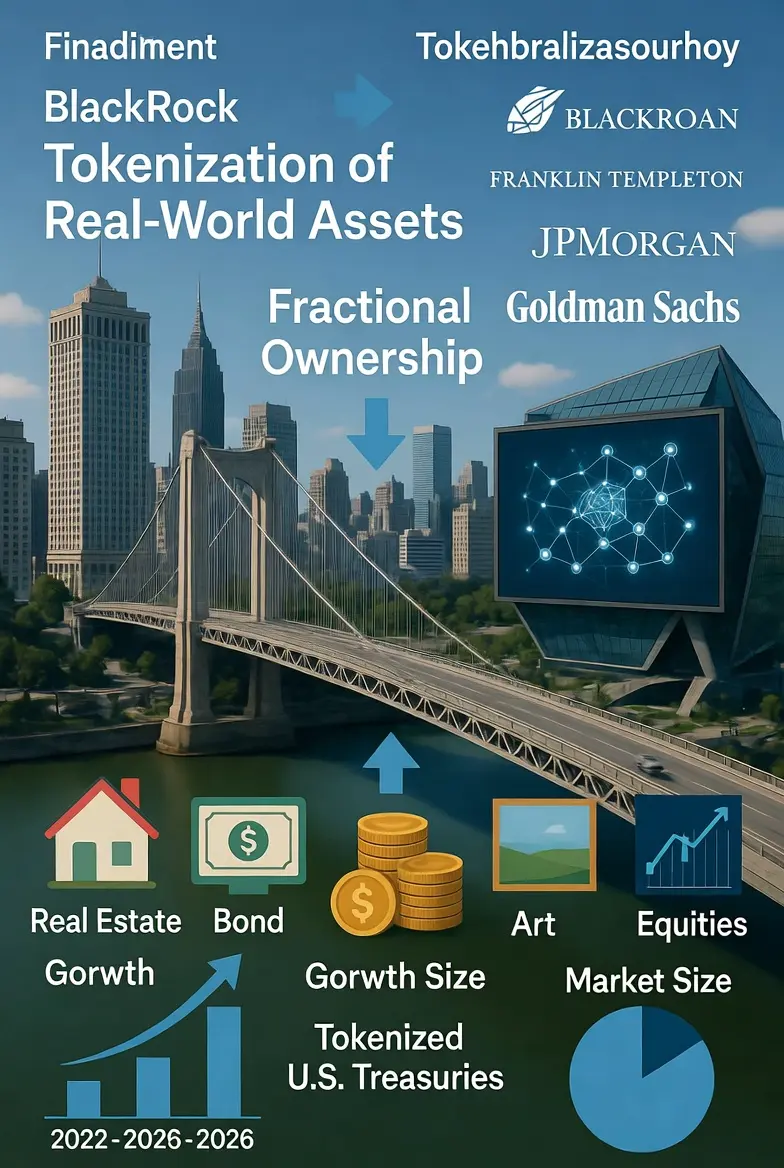
The conversion of real-world assets (RWAs)—from real estate, bonds, and U.S. Treasuries to private credit, commodities, equities, and even art—into blockchain-based tokens is redefining how capital is created, moved, and valued.
And here’s the most critical shift:🚀
This transformation is no longer being driven by crypto-native players, but by the hea
DEFI-0,44%
ETH-0,38%
  • Reward
  • Comment
  • Repost
  • Share
#TraditionalFinanceAcceleratesTokenization
Traditional finance has entered a quiet yet profound revolution.
Tokenization is no longer a “future promise”; as of 2026, it has become a core mechanism reshaping the very infrastructure of TradFi.
The conversion of real-world assets (RWAs)—from real estate, bonds, and U.S. Treasuries to private credit, commodities, equities, and even art—into blockchain-based tokens is redefining how capital is created, moved, and valued.
And here’s the most critical shift:
This transformation is no longer being driven by crypto-native players, but by the heavyweig
ETH-0,38%
DEFI-0,44%
discoveryvip
#TraditionalFinanceAcceleratesTokenization
Traditional finance has entered a quiet yet profound revolution.
Tokenization is no longer a “future promise”; as of 2026, it has become a core mechanism reshaping the very infrastructure of TradFi.
The conversion of real-world assets (RWAs)—from real estate, bonds, and U.S. Treasuries to private credit, commodities, equities, and even art—into blockchain-based tokens is redefining how capital is created, moved, and valued.
And here’s the most critical shift:
This transformation is no longer being driven by crypto-native players, but by the heavyweights of global finance.
BlackRock, Franklin Templeton, JPMorgan, Goldman Sachs, and their peers have moved well beyond pilot programs.
2026 will be remembered as the year tokenization transitioned from proof of concept to production-scale financial infrastructure.
What Tokenization Actually Delivers
By digitizing ownership and moving it onto blockchain rails, tokenization enables:
Fractional ownership
Assets once accessible only to large institutions can now be owned in small fractions
(e.g., holding 0.01% of a commercial property).
Programmable finance
Smart contracts automate compliance, coupon payments, dividends, and distributions.
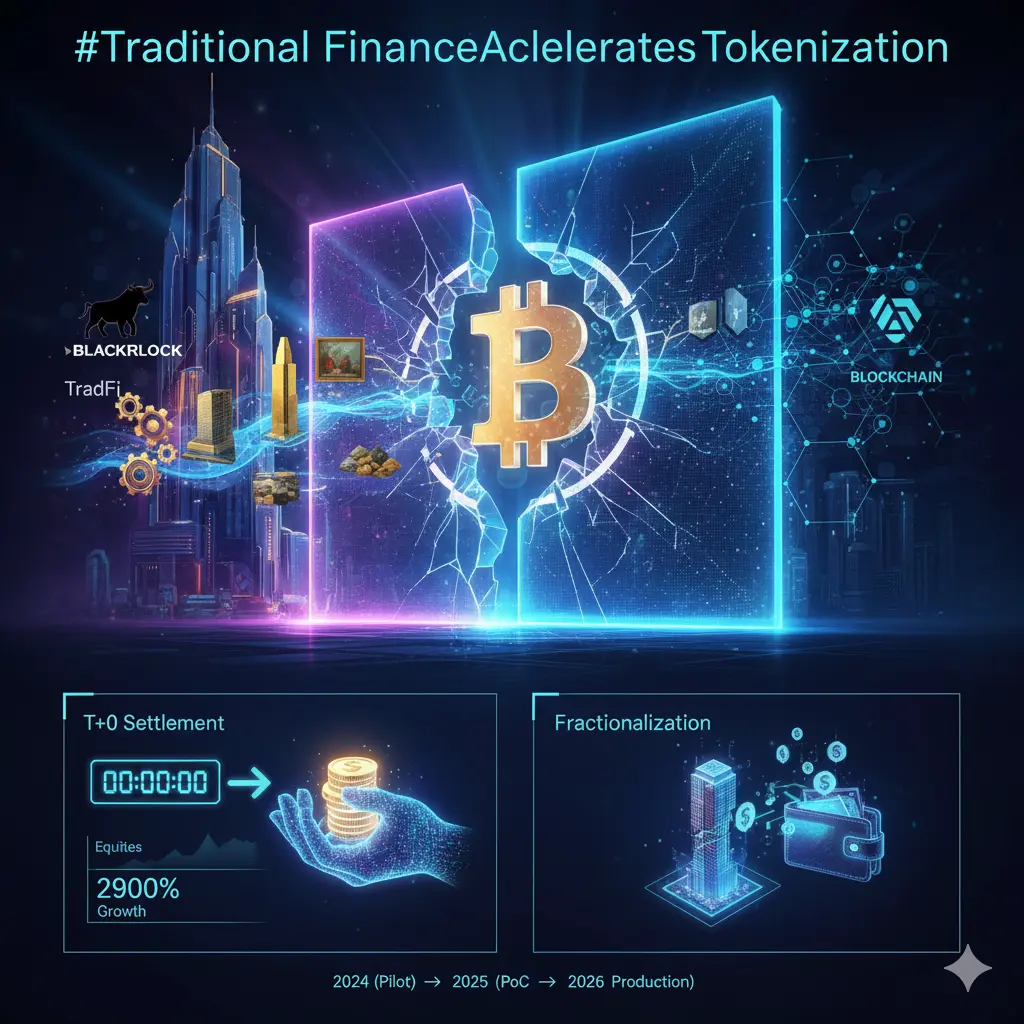
Instant settlement (T+0)
Reconciliation cycles that once took days now complete in seconds.
DeFi integration
Tokenized assets can be used as collateral, plugged into liquidity pools, and deployed for yield.
TradFi’s perspective is clear:
Blockchain is not a speculative tool—it is modern financial plumbing.
The Real Market Size in Early 2026
The numbers are no longer storytelling—they’re evidence:
Excluding stablecoins, on-chain tokenized RWAs total approximately $19–36 billion.
Including stablecoins, the broader tokenized asset market exceeds $300–330 billion.
Tokenized U.S. Treasuries dominate the sector at $8–10B+,
with BlackRock’s BUIDL alone reaching $2–3B at peak levels.
Tokenized equities have exploded:
~$963M as of January 2026, representing 2,900%+ YoY growth.
A market that stood at just $5–6B in 2022 stabilizing above $20B within a few years signals one thing clearly:
this growth is institutional—not speculative.
Liquidity, Volume, and On-Chain Activity
In 2026, the key question is no longer how many products exist, but:
Which ones actually trade?
Monthly on-chain volumes across major networks—led by Ethereum—are now in the double-digit billions.
Deepest liquidity is concentrated in:
Tokenized Treasuries
Cash-equivalent yield products
Institutional participation enables 24/7 trading, collateral mobility, and improved price stability.
Still, challenges remain:
Cross-chain fragmentation
1–3% price discrepancies for identical assets
2–5% friction in cross-chain transfers
Liquidity is maturing—but reaching TradFi scale requires standardization.
How Much of Global Finance Is Tokenized?
Surprisingly little—for now:
Tokenized assets represent roughly 0.01% of global equity and bond markets.
In the $27T U.S. Treasury market, tokenization accounts for only 0.015–0.03%.
Real estate and private credit tokenization remain close to zero.
This isn’t a weakness.
It’s a declaration of multi-trillion-dollar upside.
2030 projections:
5–10% of global assets could be tokenized
Some scenarios point to a $10–30 trillion on-chain asset economy
Pricing and Market Dynamics
Tokenization affects pricing through three primary channels:
Improved liquidity reduces illiquidity premiums
Yield-bearing tokenized products act as safe havens in volatile markets
DeFi composability creates persistent demand for high-quality RWAs
Macro shocks will always matter—but data from 2025–2026 shows RWAs to be far more resilient than purely narrative-driven crypto assets.
repost-content-media
  • Reward
  • 32
  • Repost
  • Share
MuteVersevip:
To The Moon 🌕
View More
#TraditionalFinanceAcceleratesTokenization
Tokenization of real-world assets (RWAs) represents one of the most transformative trends bridging traditional finance (TradFi) and blockchain technology. It involves converting rights to physical or financial assets—such as real estate, bonds, treasuries, private credit, commodities, equities, or even art—into digital tokens on a blockchain. This process enables fractional ownership, faster settlement, enhanced transparency, and global accessibility while maintaining regulatory compliance through legal wrappers and off-chain structures.
As of early
DEFI-0,44%
ETH-0,38%
HighAmbitionvip
#TraditionalFinanceAcceleratesTokenization
Tokenization of real-world assets (RWAs) represents one of the most transformative trends bridging traditional finance (TradFi) and blockchain technology. It involves converting rights to physical or financial assets—such as real estate, bonds, treasuries, private credit, commodities, equities, or even art—into digital tokens on a blockchain. This process enables fractional ownership, faster settlement, enhanced transparency, and global accessibility while maintaining regulatory compliance through legal wrappers and off-chain structures.
As of early 2026, traditional finance institutions are no longer just experimenting; they are actively accelerating adoption, driven by efficiency gains, yield opportunities in a volatile environment, and regulatory progress. Major players like BlackRock, Franklin Templeton, JPMorgan, Goldman Sachs, and others have launched or expanded tokenized products, signaling a shift from pilots to production-scale deployment.
What Tokenization Actually Delivers
Tokenization digitizes ownership and transfers it to blockchain rails, allowing:
Fractionalization: High-value assets become accessible to smaller investors (e.g., owning 0.01% of a commercial building).
Programmability: Smart contracts automate compliance, payments, and distributions.
Interoperability: Assets move across chains or integrate with DeFi protocols for lending, yield farming, or collateral use.
Real-time settlement: T+0 instead of T+2 or longer in traditional markets.
This convergence is accelerating because TradFi sees blockchain as a way to modernize plumbing—reducing costs, improving liquidity, and unlocking new capital flows.
Current Market Size and Growth Statistics (Early 2026)
The tokenized RWA market has shown explosive yet grounded growth:
Excluding stablecoins (which are tokenized fiat but often separated in analysis), on-chain tokenized RWAs stand at approximately $19–36 billion as of early 2026, with some reports citing over $36 billion by late 2025.
Including stablecoins, the broader tokenized asset market exceeds $300–330 billion.
Tokenized U.S. Treasuries dominate, often exceeding $8–10 billion (e.g., BlackRock's BUIDL fund alone surpassing $2–3 billion at peaks).
Tokenized equities have surged dramatically, reaching around $963 million by January 2026—a 2,900% year-over-year increase from just $32 million.
Other categories like tokenized private credit, real estate, and commodities contribute smaller but growing shares, with private credit showing strong origination volume growth.
Growth has been remarkable: From roughly $5–6 billion in 2022 to $15–24 billion by mid-2025 (excluding stablecoins), representing multiples of 300–380% in key periods. Institutional inflows, particularly into tokenized treasuries and money market funds, have driven much of this.
Trading Volume, On-Chain Liquidity, and Activity Metrics
Liquidity remains a key focus and challenge in 2026:
Monthly transaction volumes on networks like Ethereum have climbed into the low double-digit billions (e.g., ~$12 billion over 30-day windows in recent data).
Sustained trading volume is now the primary metric of success, shifting from mere issuance to active secondary markets.
On-chain liquidity is uneven: Tokenized treasuries and cash equivalents offer the deepest pools due to institutional backing and yield appeal, enabling 24/7 trading and collateral mobility.
Fragmentation across chains creates inefficiencies, such as 1–3% pricing gaps for identical assets and 2–5% friction in cross-chain movements.
Overall, liquidity is maturing but still lags traditional markets—secondary trading relies heavily on issuer buybacks or dedicated venues in many cases. However, platforms are pushing for continuous, deep markets to support institutional redeployment.
Percentage of Broader Markets Tokenized
Tokenization remains a tiny fraction of global TradFi:
Tokenized assets represent roughly 0.01% of global equity and bond market capitalization.
For context, the U.S. Treasury market alone is ~$27 trillion; tokenized portions are ~0.015–0.03%.
Real estate and private credit tokenization hover near 0% of their multi-trillion-dollar global totals.
This low penetration highlights massive upside: Projections suggest tokenized assets could reach 10% of global GDP or specific sectors by 2030.
Price Impact and Market Dynamics
Tokenization influences asset pricing in several ways:
Enhanced liquidity reduces illiquidity premiums, potentially lowering borrowing costs for issuers (e.g., tokenized private credit offers better price discovery).
Yield-bearing tokenized products (like treasuries) attract capital seeking stable returns amid crypto volatility, supporting price stability in underlying assets.
In secondary markets, deeper liquidity minimizes slippage and price manipulation risks, though early-stage fragmentation can cause temporary discrepancies.
Broader impact: As more capital flows on-chain, tokenized assets benefit from DeFi composability (e.g., using them as collateral), which can amplify demand and stabilize or elevate prices for high-quality RWAs.
However, macro shocks or regulatory shifts could introduce volatility, though RWAs have shown resilience compared to pure crypto narratives.
Key Drivers of Acceleration in Traditional Finance (2026 Outlook)
Institutions are pouring in due to:
Regulatory clarity in regions like the U.S., EU, and Singapore, enabling compliant issuance.
Proven infrastructure from players like BlackRock (BUIDL), Franklin Templeton (on-chain money markets), and JPMorgan (Onyx/Tokenized Collateral Network).
Yield and efficiency: Tokenized treasuries provide real yields with blockchain benefits.
Broader adoption: From tokenized S&P 500 indexes to private credit and commodities.
Projections for 2026 and beyond:
TVL could exceed $100 billion (some forecasts) or reach $300–500 billion in tokenized cash instruments alone.
Longer-term: $2–4 trillion by 2028–2030, up to $10–30 trillion by 2030–2034 under bullish scenarios (e.g., 10% of global assets).
Challenges and Limitations
Liquidity fragmentation and cross-chain issues persist.
Regulatory hurdles vary by jurisdiction.
Interoperability and standardization are needed for scale.
Security, custody, and oracle dependencies remain critical.
In summary, traditional finance's acceleration of tokenization in 2026 marks a pivotal shift: from experimental to foundational infrastructure. With institutional heavyweights leading, RWAs are unlocking trillions in potential through better liquidity, accessibility, and efficiency—fundamentally reshaping how capital flows in global markets. This isn't hype; it's measurable progress toward a more programmable, inclusive financial system.
repost-content-media
  • Reward
  • Comment
  • Repost
  • Share
#TraditionalFinanceAcceleratesTokenization 1️⃣ Excellent breakdown of how traditional finance is embracing tokenization. Clear, insightful, and perfectly explains why this shift is structural, not just a trend.
2️⃣ This thread explains tokenization in a very mature way. Great clarity on liquidity, settlement efficiency, and why institutions are moving fast.
3️⃣ Well-articulated view on how blockchain is reshaping capital markets. Tokenization truly feels like the bridge between TradFi and DeFi.
4️⃣ Strong analysis. The focus on regulatory compliance + innovation shows why institutions are comf
DEFI-0,44%
  • Reward
  • 1
  • Repost
  • Share
Crypto_Expervip:
follow me brother I will follow back we should support each other 🥰✅
#TraditionalFinanceAcceleratesTokenization
Traditional Finance Meets Blockchain — Tokenization Goes Mainstream
Institutions like JPMorgan, Goldman Sachs, and State Street are no longer testing blockchain—they’re deploying it. Funds, bonds, and treasuries are moving on-chain, unlocking faster settlement, lower costs, and improved transparency.
Tokenization isn’t a trend—it’s a structural upgrade to global financial infrastructure. Fractional ownership boosts liquidity, settlements compress from days to minutes, and compliance becomes more efficient.
Dragon Fly Official Insight:
The next finan
DragonFlyOfficialvip
Traditional Finance Meets Blockchain: Tokenization Is Reshaping Global Markets
Market Context:
Major institutions like State Street, JPMorgan, and Goldman Sachs are no longer experimenting with blockchain—they’re actively launching digital asset platforms for tokenizing traditional financial products. From funds and bonds to treasuries, these assets are moving on-chain, enabling faster, cheaper, and more transparent financial transactions.
Analysis / Signal:
Tokenization is a systemic upgrade, not just a tech experiment. By digitizing assets, liquidity improves through fractional ownership, settlements happen in minutes instead of days, operational costs and reconciliation risks drop, and regulatory transparency is enhanced. For traders and investors, this signals a structural shift in financial infrastructure. Early adoption in tokenized products could create opportunities for efficient exposure to traditional markets with blockchain advantages.
Strategic Insight:
Dragon Fly Official observes that the next wave of financial innovation will come from institutions combining compliance with blockchain efficiency. Platforms like JPMorgan’s Onyx, Goldman Sachs tokenized funds, and State Street digital securities are proof that traditional finance is embracing Web3 capabilities. Positioning in tokenized ETFs, funds, or regulated digital bonds may be the first step in accessing this evolving ecosystem.
Actionable Takeaway:
Monitor institutional blockchain adoption closely. Consider allocating selectively into regulated tokenized products or infrastructure projects supporting asset digitization. This is where traditional market reliability meets blockchain efficiency, creating a new financial frontier.
#TraditionalFinanceAcceleratesTokenization
repost-content-media
  • Reward
  • Comment
  • Repost
  • Share
#TraditionalFinanceAcceleratesTokenization 1️⃣ Excellent breakdown of how traditional finance is embracing tokenization. Clear, insightful, and perfectly explains why this shift is structural, not just a trend.
2️⃣ This thread explains tokenization in a very mature way. Great clarity on liquidity, settlement efficiency, and why institutions are moving fast.
3️⃣ Well-articulated view on how blockchain is reshaping capital markets. Tokenization truly feels like the bridge between TradFi and DeFi.
4️⃣ Strong analysis. The focus on regulatory compliance + innovation shows why institutions are comf
DEFI-0,44%
  • Reward
  • 15
  • Repost
  • Share
Crypto_Buzz_with_Alexvip:
Buy To Earn 💎
View More
Load More